
Asian Hornet Facts for Kids
The Asian Hornet, Vespa velutina, is also widely called the Yellow-Legged Hornet. It is native to parts of Asia but has become an invasive species in much of western Europe after being detected in France in 2004. It should not be confused with the much larger Northern Giant Hornet, Vespa mandarinia. Asian Hornets are mostly dark brown to black, with an orange face, yellow tips to the legs, and a broad orange-yellow band near the rear of the abdomen. A colony begins when one overwintered queen builds a small paper nest in spring. Later, workers take over nest building and hunting while the queen concentrates on laying eggs. Adults feed mainly on sugary liquids, while workers capture insects, including honey bees, to feed the larvae.
Quick Asian Hornet Facts
- Animal Type: Insect and social hornet
- Scientific Name: Vespa velutina
- Also Called: Yellow-Legged Hornet
- Known For: Dark body, orange face, yellow leg tips, paper nests, insect hunting, honey bee predation, and invasive spread in Europe
- Diet: Adults mainly take sugary liquids; larvae receive chewed insect prey brought by workers
What You’ll Learn
Discover 10 Asian Hornet facts for kids with accurate Vespa velutina science, quick facts, a quiz, glossary, drawing activity, and insect links.
Clear explanations make them useful for children, families, teachers, and curious young insect learners.
10 Fun Asian Hornet Facts for Kids
1. It Is Not the Northern Giant Hornet
The name Asian Hornet usually refers to Vespa velutina, also called the Yellow-Legged Hornet. It is a different species from the Northern Giant Hornet, Vespa mandarinia, which is much larger and has a very different orange-and-black appearance.
Kid Decode: Two hornets can share the word Asian in their names without being the same insect.
2. Yellow Socks Are a Key Identification Clue
Workers are generally dark brown or black, with an orange face, a broad orange-yellow band on the fourth abdominal segment, and bright yellow lower legs. Workers reach roughly 25 millimetres, while queens can reach about 30 millimetres.
Kid Decode: The easiest field clue may be four tiny pairs of bright yellow socks.
3. One Queen Starts the Whole Colony
A mated queen survives winter in a sheltered hiding place and emerges in spring. She begins a small primary nest alone, lays the first eggs, gathers food, and cares for the first larvae until workers emerge.
Kid Decode: A colony of thousands can begin with one queen doing every job herself.
4. The Nest Is Made From Paper
Asian Hornets scrape plant fibres and wood, chew the material with saliva, and shape it into a paper-like nest. Early nests are small, but mature secondary nests can become large and are often built high in trees or other sheltered sites.
Kid Decode: The hornets manufacture their own building paper before humans ever enter the story.
5. Workers Take Over Most Colony Jobs
After the first workers emerge, they forage, hunt, enlarge the nest, cool and defend it, and feed the brood. The queen increasingly specializes in egg laying as the colony expands through summer.
Kid Decode: The queen starts the company, then the worker team takes over almost every department.
6. Adults and Larvae Eat Different Foods
Adult hornets need sugar-rich foods such as nectar, tree sap, ripe fruit, and honeydew. The growing larvae need protein, so workers hunt insects and chew the prey before bringing it back to the nest.
Kid Decode: Adults run on sugar while the nursery orders a high-protein insect menu.
7. Honey Bees Can Become Major Prey
Workers often hover near honey bee colonies and catch returning bees, especially when a hornet colony is large in late summer and autumn. They also prey on many other insects, so their ecological effect is broader than honey bees alone.
Kid Decode: A busy beehive can become a predictable hunting station for an experienced hornet.
8. A Colony Lasts Only One Season
The annual colony grows through spring, summer, and autumn. Males and new queens are produced late in the season, and after mating the workers, males, and old queen die as cold weather arrives.
Kid Decode: The giant nest is a one-year city rather than a permanent hornet castle.
9. Only New Queens Carry the Colony Into Winter
Mated young queens leave the old nest and hide individually in protected places such as bark, leaf litter, buildings, or other crevices. The following spring, surviving queens can each attempt to found a completely new colony.
Kid Decode: Winter shrinks an entire hornet society down to scattered sleeping queens.
10. It Has Become an Invasive Species in Europe
Vespa velutina was detected in southwestern France in 2004 and has since spread through several European countries. Authorities monitor and remove nests because the hornet can put pressure on honey bees and other pollinating insects. It is not considered more inherently dangerous to people than native social wasps and hornets, but active nests should never be disturbed.
Kid Decode: A hornet native to Asia became a major wildlife-management problem after crossing into Europe.
The Weirdest Asian Hornet Fact
A nest that begins as a queen’s tiny spring paper shell can later produce thousands of hornets during one season, yet the entire colony disappears in winter except for newly mated queens hiding elsewhere.
Try This Asian Hornet Activity
Asian Hornet Colony Activity
Draw a life-cycle wheel for Vespa velutina. Start with one overwintered queen, then a small spring paper nest, workers emerging, a large summer colony, insect hunting, honey bee predation, males and new queens in autumn, and newly mated queens hiding for winter. Make the hornets mostly black with an orange face, one broad orange-yellow abdominal band, and yellow leg tips. Add a comparison bubble showing that the Northern Giant Hornet is a different and larger species.
Quick Asian Hornet Quiz
- What is the Asian Hornet’s scientific name? Answer: Vespa velutina.
- What color are the ends of its legs? Answer: Yellow.
- Who starts a new colony in spring? Answer: A single overwintered queen.
- What do workers bring the larvae? Answer: Chewed insect prey.
- Is the Asian Hornet the same species as the Northern Giant Hornet? Answer: No.
Mini Glossary
- Hornet: A large social wasp belonging to the genus Vespa.
- Queen: A reproductive female that starts and lays eggs for a colony.
- Worker: A non-reproductive female that performs most nest and foraging jobs.
- Primary Nest: The small first nest founded by a queen in spring.
- Invasive Species: A non-native species that spreads and causes ecological, economic, or other harm.
 Elephant Facts for Kids
 Goral Facts for Kids
 Guppy Facts for Kids
 Cave Lion Facts for Kids
More Animal Facts for Kids
Visit the full animal facts library or explore a focused animal group.
More Extinct Animal Facts for Kids
Discover dinosaurs, Ice Age giants, prehistoric sea creatures, recently extinct species, and other animals from the past.
Fact check note: Fact checked with UK Animal and Plant Health Agency and DEFRA identification guidance for Vespa velutina, including the orange face, dark body, yellow leg tips, single broad orange-yellow abdominal band, worker and queen size, and risks to honey bees and pollinators; Agri-Food and Biosciences Institute for native Asian origin and European spread; and peer-reviewed Vespa velutina life-cycle research describing spring nest founding by one queen, worker takeover, secondary nests, insect prey for larvae, sugar feeding by adults, autumn reproductives, and overwintering mated queens.

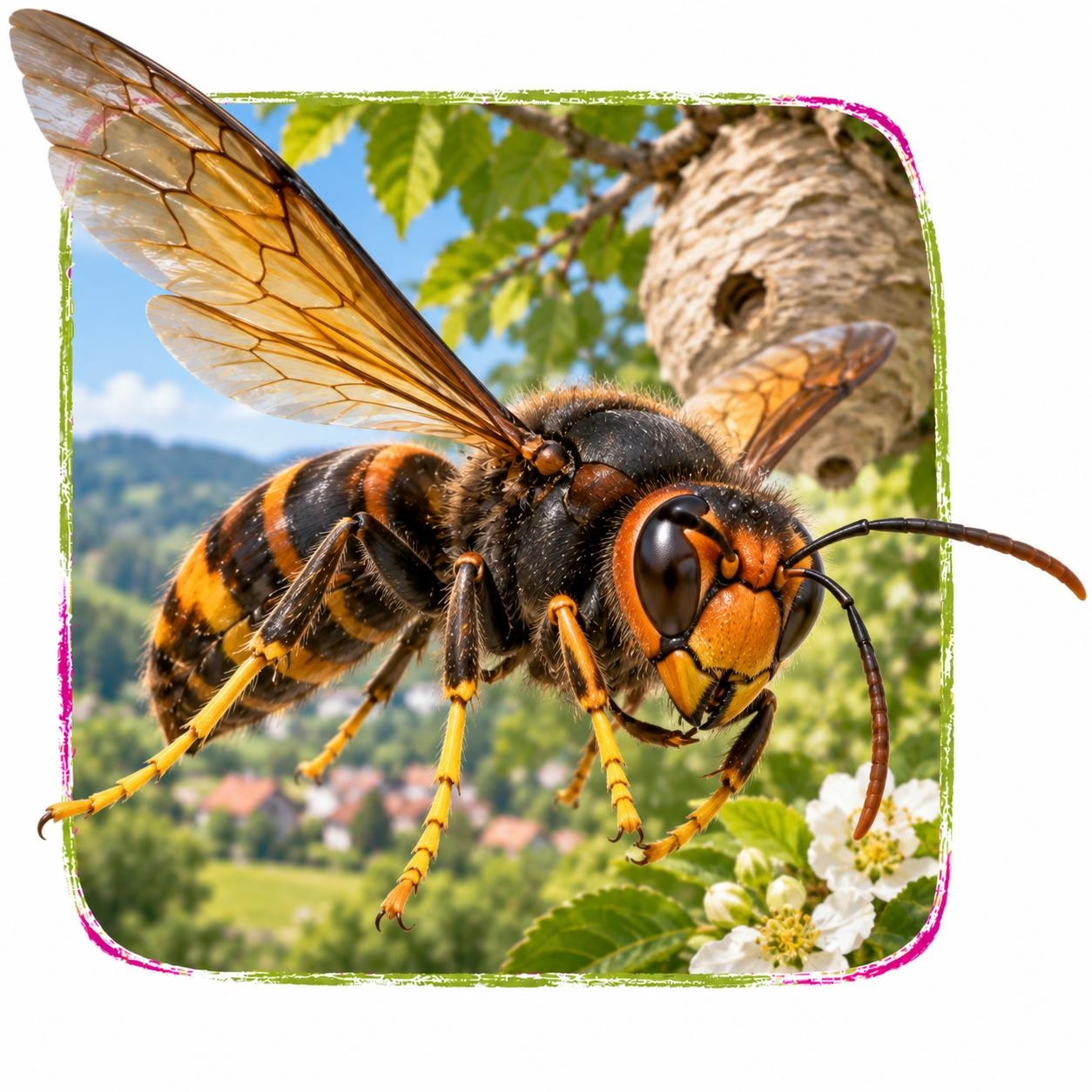
Asian Hornet in its natural Native Asian forests, woodland edges, farmland, orchards, towns, gardens, and other habitats; introduced populations also occupy urban and rural landscapes in Europe habitat