
Black-Backed Jackal Facts for Kids
The Black-Backed Jackal, Lupulella mesomelas, is a slender African canid with rusty-red flanks, long pointed ears, a bushy black-tipped tail, and a distinctive silver-and-black saddle stretching across its back. Older books often call it Canis mesomelas, but the current Mammal Diversity Database places it in the genus Lupulella with the Side-Striped Jackal. Black-Backed Jackals occur in two widely separated regions: eastern Africa and southern Africa. They are adaptable opportunistic omnivores that hunt rodents, birds, reptiles, insects, and small antelopes, eat fruit, and scavenge carcasses left by larger predators. Adults commonly form long-term pairs that defend territories, and older offspring may stay to help raise later litters. The species is currently listed as Least Concern.
Quick Black-Backed Jackal Facts
- Animal Type: Mammal and canid
- Scientific Name: Lupulella mesomelas; formerly widely called Canis mesomelas
- Known For: Silver-black back saddle, rusty flanks, black-tipped tail, long-term pair bonds, scent marking, yipping calls, scavenging, cooperative hunting, and helper offspring
- Habitat: Savanna, grassland, scrub, dry woodland, semi-desert, farmland, coastal areas, and other open African habitats
- Diet: Rodents, hares, small antelopes, birds, reptiles, insects, carrion, fruit, berries, and other available foods
What You’ll Learn
Discover 10 fun Black-Backed Jackal facts for kids with current canid taxonomy, quick facts, a quiz, glossary, drawing activity, and African wildlife links.
Clear explanations make them fun for children, families, teachers, and curious young predator fans.
10 Fun Black-Backed Jackal Facts for Kids
1. The Black Back Is Really a Dark Saddle
A broad mantle of black and silvery hair stretches from the shoulders toward the base of the tail, contrasting strongly with the rusty-red flanks and legs. The tail itself ends in a dark tip.
Kid Decode: It looks as if someone laid a charcoal-and-silver blanket across the jackal’s back.
2. Its Scientific Name Recently Moved to Lupulella
For many years the species was called Canis mesomelas. Modern mammal taxonomy places the Black-Backed Jackal in Lupulella, together with the Side-Striped Jackal, reflecting their deep evolutionary separation from wolves and the golden jackal.
Kid Decode: The animal stayed the same while its scientific address moved to a different genus.
3. Its Range Is Split Into Two Big Pieces
Black-Backed Jackals occur in eastern Africa and again across much of southern Africa, with a large gap between these population regions. They use open habitats ranging from dry scrub and semi-desert to grassland, savanna, farms, and coastal landscapes.
Kid Decode: The range map looks like two African neighborhoods with a huge gap between them.
4. Pairs Often Stay Together for Years
Adult Black-Backed Jackals commonly form long-term pair bonds. A pair scent-marks and patrols a territory together, hunts cooperatively at times, and raises pups as a team.
Kid Decode: Two jackals can become hunting partners, neighbors, and parents all at once.
5. Scent Marks Draw Invisible Borders
Jackals leave urine, feces, and gland scents at conspicuous points around a territory. Vocalizations such as yelps and howls also advertise presence and help pairs or family members locate one another.
Kid Decode: A territory can have no fence at all and still be covered in chemical signposts.
6. They Are Hunters and Scavengers
Black-Backed Jackals hunt insects, rodents, hares, birds, reptiles, and young antelopes, but they also take carrion from kills made by lions, leopards, cheetahs, and other predators. Fruit and other plant foods can also be eaten.
Kid Decode: Dinner may be freshly caught, found under a bush, or borrowed from a lion’s leftovers.
7. Cooperation Can Tackle Bigger Prey
A jackal hunting alone usually focuses on small prey, but pairs or family members can cooperate to chase or overpower larger animals. Group hunting is only one part of a flexible feeding strategy rather than the rule for every meal.
Kid Decode: One jackal catches mice; teamwork can unlock a much larger menu.
8. Older Pups May Become Helpers
Young jackals from an earlier litter sometimes remain with their parents instead of dispersing immediately. These helpers can guard, play with, or bring food to younger siblings, improving the survival chances of the new litter.
Kid Decode: A teenage jackal may stay home and become the next litter’s babysitter.
9. Pups Grow Up in Dens
After a pregnancy of about two months, the female gives birth in a den, often a burrow or sheltered cavity. Several pups may be born, and the parents can move them between den sites while feeding them milk and later regurgitated food.
Kid Decode: The nursery may move house before the pups are old enough to hunt.
10. Adaptability Keeps the Species Widespread
The Black-Backed Jackal is globally listed as Least Concern and survives in protected areas, rangelands, farms, and other human-modified habitats. It is sometimes persecuted because it can kill poultry or young livestock, but populations remain broadly secure.
Kid Decode: Living beside people can create conflict, yet this adaptable canid continues to thrive across much of its range.
The Weirdest Black-Backed Jackal Fact
A pup from last year’s litter may postpone leaving home and help its parents feed and defend the next generation, turning one jackal family into a cooperative childcare team.
Try This Black-Backed Jackal Activity
Black-Backed Jackal Family Activity
Draw an African savanna scene with a Black-Backed Jackal pair and pups. Add rusty-red flanks, long pointed ears, narrow muzzle, bushy black-tipped tail, and a silver-black saddle across the back. Show scent marking at a territory boundary, a calling pair, one jackal hunting a rodent, another scavenging safely after a large predator has left, older offspring bringing food to younger pups, and a burrow den with several pups.
Quick Black-Backed Jackal Quiz
- What is the Black-Backed Jackal’s current scientific name? Answer: Lupulella mesomelas.
- What marking gives it its common name? Answer: A black-and-silver saddle across the back.
- Are Black-Backed Jackals only scavengers? Answer: No, they hunt as well as scavenge.
- What can older offspring sometimes do? Answer: Stay and help raise younger pups.
- What is the species’ current IUCN category? Answer: Least Concern.
Mini Glossary
- Canid: A member of the dog family Canidae.
- Territory: An area defended against rivals.
- Scent Mark: A chemical signal left to communicate with other animals.
- Scavenger: An animal that eats dead animals it did not kill itself.
- Helper: An older offspring or other group member that assists parents in raising young.
 Jaguar Facts for Kids
 Blue Tang Facts for Kids
 Rabbit Facts for Kids
 Giganotosaurus Facts for Kids
More Animal Facts for Kids
Visit the full animal facts library or explore a focused animal group.
More Extinct Animal Facts for Kids
Discover dinosaurs, Ice Age giants, prehistoric sea creatures, recently extinct species, and other animals from the past.
Fact check note: Fact checked with the American Society of Mammalogists Mammal Diversity Database version 2.5 account for Lupulella mesomelas, which records the move from Canis to Lupulella, separated eastern and southern African distributions, and current Least Concern status; Animal Diversity Web for territorial and social behavior, hunting and scavenging, omnivorous diet, reproduction and denning; and African Wildlife Foundation for the distinctive black-backed mantle, savanna and woodland habitat, pair and cooperative hunting, regurgitated feeding of pups, den changes, and older offspring helping raise younger siblings.

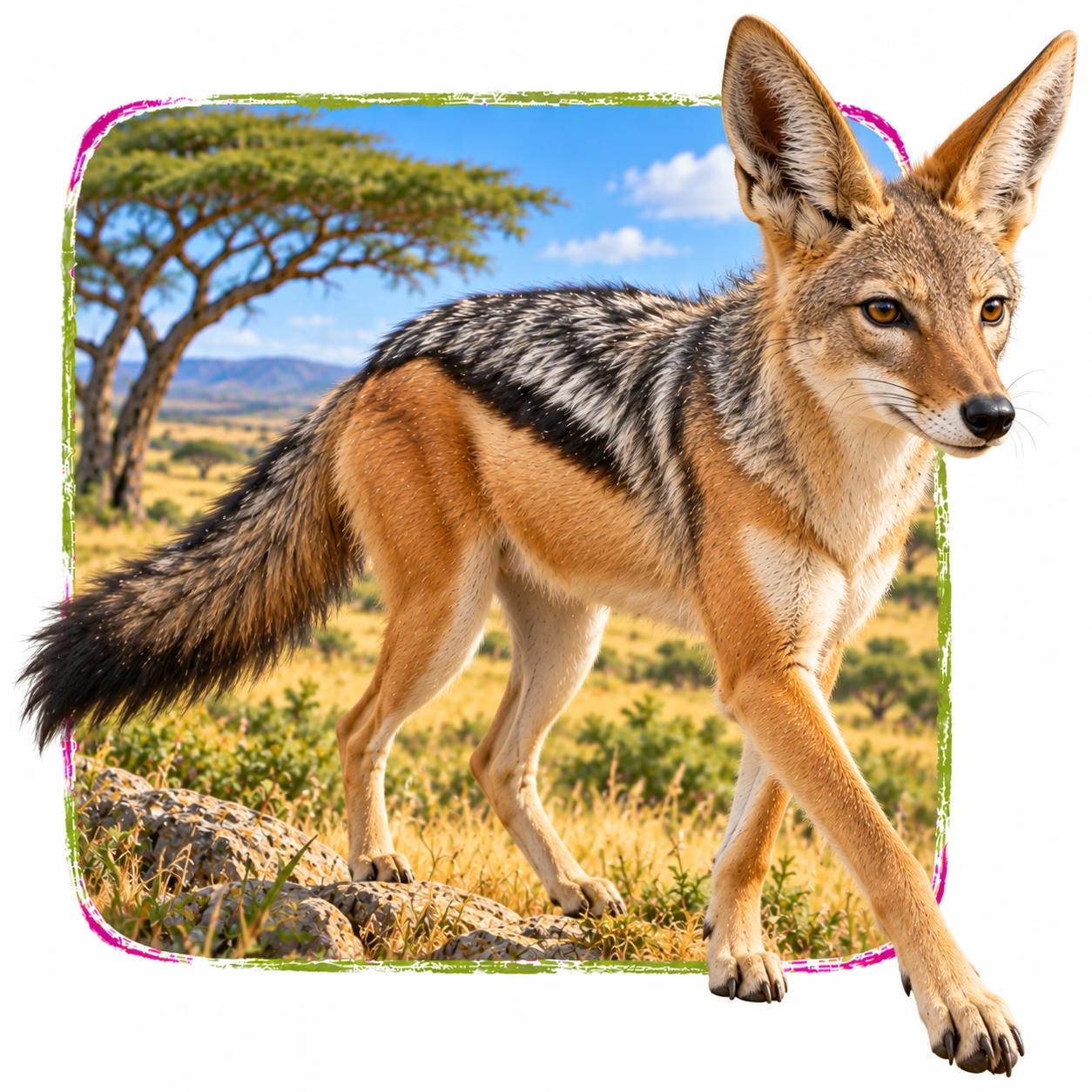
Black-Backed Jackal in its natural Savanna, grassland, dry scrub, open woodland, semi-desert, farmland, rangeland, coastal habitats, and other open landscapes in eastern and southern Africa habitat