
Common Eland Facts for Kids
The Common Eland, currently treated by the Mammal Diversity Database as Tragelaphus oryx, is one of Africa’s largest antelopes. Older books often use the scientific name Taurotragus oryx, and that name is still common in zoo literature. Common Elands range across eastern, central, and southern Africa in savannas, grasslands, open woodland, scrub, and semi-arid country. Both males and females grow gently spiraled horns, but males are much larger and develop thicker horns, a heavier dewlap, darker coats, and dense forehead hair as they age. Elands are adaptable herbivores that both graze and browse, travel in flexible herds, cope well with dry conditions, and can jump astonishingly high despite their huge bodies. The species is currently listed as Least Concern.
Quick Common Eland Facts
- Animal Type: Mammal and spiral-horned antelope
- Scientific Name: Tragelaphus oryx under current Mammal Diversity Database treatment; formerly widely called Taurotragus oryx
- Known For: Huge size, spiral horns in both sexes, large dewlap, knee-clicking males, powerful jumping, flexible herds, and mixed grazing-and-browsing diet
- Habitat: Savanna, grassland, open woodland, scrub, semi-desert, and mountain grassland
- Diet: Grasses, herbs, leaves, shoots, shrubs, fruits, seeds, roots, bulbs, and other plant foods
What You’ll Learn
Discover 10 fun Common Eland facts for kids with current antelope taxonomy, quick facts, a quiz, glossary, drawing activity, and African wildlife links.
Easy-to-understand facts make them great for kids, parents, teachers, and young African wildlife explorers.
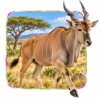
10 Fun Common Eland Facts for Kids
1. It Is One of the Largest Antelopes
Adult male Common Elands can weigh several hundred kilograms and exceptionally approach a tonne. Females are smaller, but both sexes are still enormous compared with most antelopes.
Kid Decode: An animal built like a giant cow can still move with the springiness of an antelope.
2. Both Males and Females Grow Spiral Horns
Common Elands of both sexes have permanent horns with a strong spiral ridge. Male horns are usually thicker and often shorter, while female horns are generally more slender and can appear longer.
Kid Decode: In this antelope family, both the bulls and the cows arrive wearing corkscrew headgear.
3. Big Males Develop a Huge Dewlap
A flap of skin called a dewlap hangs from the throat and chest, especially in adult males. Older males may also become bluish-gray, grow dense forehead hair, and develop a much heavier neck and shoulders.
Kid Decode: An old bull can look dramatically different from the tan, slimmer animal he was when young.
4. Walking Bulls Can Make Loud Clicks
Adult males can produce distinctive clicking sounds from the forelimb region as they walk. Scientists have studied the clicks as possible signals of body size or quality, but the exact anatomical mechanism creating the sound is still not fully resolved.
Kid Decode: A giant antelope can announce each step with its own mysterious built-in clicker.
5. Huge Bodies Can Still Jump High
Elands are powerful jumpers despite their mass. Young animals have been reported clearing obstacles around 3 metres high from a standing start, while adults can also cross substantial fences.
Kid Decode: A nearly cattle-sized antelope can suddenly behave like a loaded spring.
6. They Switch Between Grazing and Browsing
Common Elands eat grasses when fresh grazing is abundant and turn more heavily to leaves, shrubs, herbs, fruit, roots, bulbs, and other browse as conditions change. This flexible diet helps them survive across many African habitats.
Kid Decode: The menu can move from lawn to shrub shelf as the seasons change.
7. They Can Cope With Long Dry Periods
Elands obtain substantial water from succulent vegetation and can go long periods without drinking free water. They also reduce activity during intense heat and may feed more at cooler times.
Kid Decode: Moist leaves can become an invisible water bottle in dry country.
8. Herds Constantly Change Shape
Common Elands are social but do not stay in one fixed herd. Female-and-young groups can become large, males may form smaller groups or travel alone, and temporary aggregations can contain hundreds of animals when food is abundant.
Kid Decode: An eland herd is less like a permanent club and more like a giant moving meetup.
9. Calves Hide Before Joining Nursery Groups
After a pregnancy of about nine months, a female usually gives birth to one calf. Newborns may remain concealed at first, then young calves gather with other youngsters in nursery groups while mothers return to nurse them.
Kid Decode: The first days are spent hidden, but soon the calf joins an antelope preschool.
10. The Species Is Still Widespread but Faces Local Pressure
The Common Eland is globally listed as Least Concern and remains widespread in many protected areas and rangelands. Hunting, habitat conversion, livestock expansion, fencing, and local population loss can still cause regional declines.
Kid Decode: A common global label can still hide empty spaces where elands once roamed.
The Weirdest Common Eland Fact
Large male elands can make repeated clicking sounds as they walk, and researchers have tested whether those clicks advertise male size, yet scientists still do not fully agree on the exact anatomical mechanism producing them.
Try This Common Eland Activity
Common Eland Giant-Antelope Activity
Draw an African savanna with a huge adult male Common Eland, a female, and calves. Add gently twisted horns on both sexes, the male’s thick neck and dewlap, tan or gray-brown coats, faint body stripes where appropriate, cloven hooves, a walking bull with click symbols near the front legs, a jumping silhouette, grasses and leafy browse, a large temporary herd, and a nursery group of calves.
Quick Common Eland Quiz
- What is the Common Eland’s current scientific name in the Mammal Diversity Database? Answer: Tragelaphus oryx.
- Do females grow horns? Answer: Yes.
- What is the loose skin hanging from the throat called? Answer: A dewlap.
- What does an eland eat? Answer: Both grasses and browse such as leaves and shrubs.
- What is its current IUCN category? Answer: Least Concern.
Mini Glossary
- Antelope: A hoofed bovid mammal found mainly in Africa and Asia.
- Dewlap: A loose fold of skin hanging from the throat or chest.
- Browser: An animal that feeds on leaves, shoots, shrubs, and other woody plants.
- Ruminant: A hoofed herbivore that ferments plant food and rechews cud.
- Nursery Group: A temporary group in which young animals gather together.
 European Hornet Facts for Kids
 Slow Loris Facts for Kids
 Meadow Vole Facts for Kids
 Irish Elk Facts for Kids
More Animal Facts for Kids
Visit the full animal facts library or explore a focused animal group.
More Extinct Animal Facts for Kids
Discover dinosaurs, Ice Age giants, prehistoric sea creatures, recently extinct species, and other animals from the past.
Fact check note: Fact checked with the American Society of Mammalogists Mammal Diversity Database current account for Tragelaphus oryx, which moves Common Eland from Taurotragus into Tragelaphus and lists it as Least Concern; Animal Diversity Web and Mammalian Species for size, horns in both sexes, dewlap, mixed grazing-and-browsing diet, social grouping, roughly nine-month gestation and single calves; Toronto Zoo and San Diego Zoo resources for habitat flexibility, calf nurseries and jumping ability; and recent Scientific Reports research showing that male Common Elands produce forelimb clicking sounds while the exact mechanical source remains unresolved.

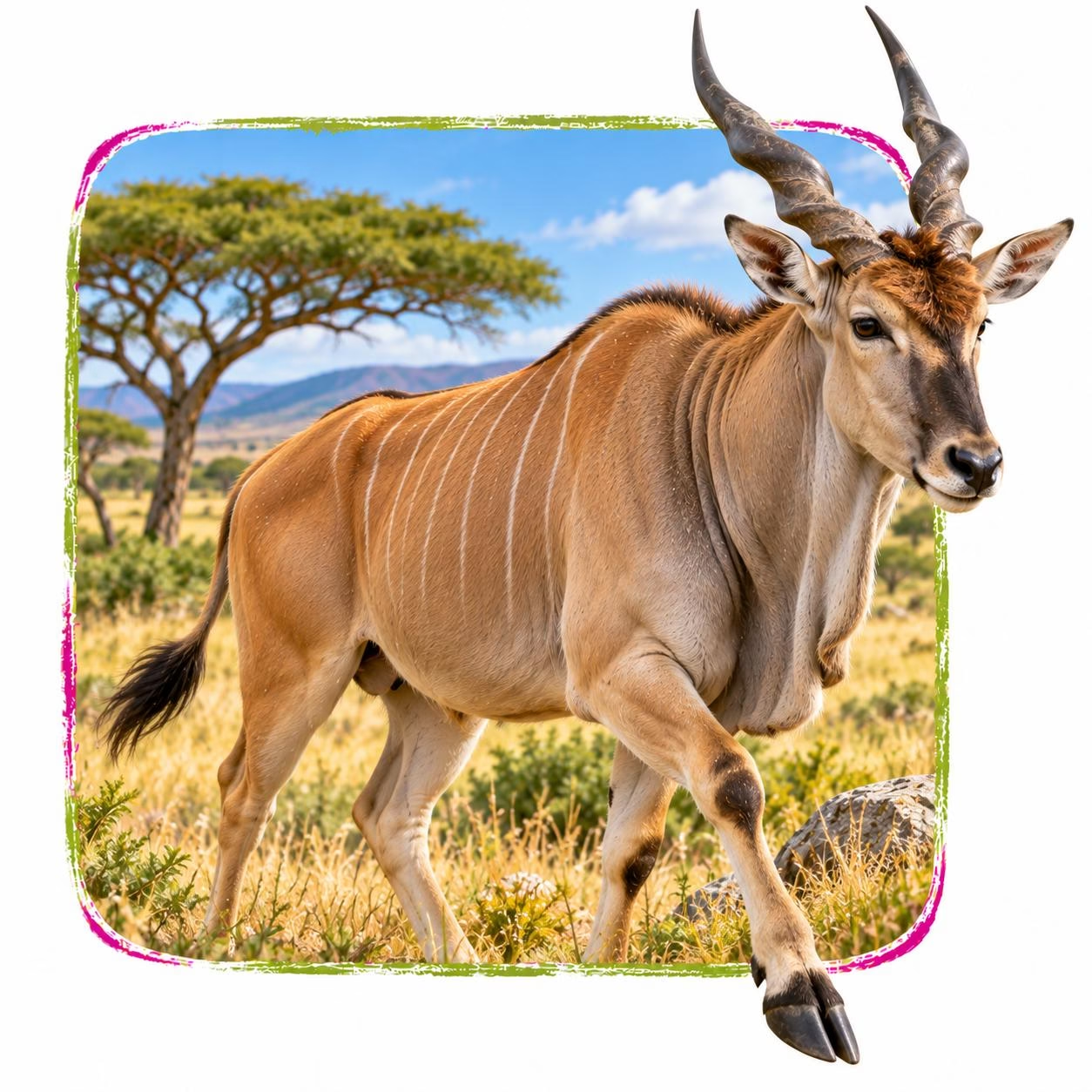
Common Eland in its natural Savanna, grassland, open woodland, scrub, semi-desert, mountain grassland, and other African habitats with seasonal grazing and browse habitat