
Common Pheasant Facts for Kids
The Common Pheasant, Phasianus colchicus, is a large long-tailed game bird native across parts of southeastern Europe, the Caucasus, and temperate Asia. People have introduced it widely to Europe, North America, New Zealand, Australia, and other regions. The species contains many geographic forms, so males do not all look identical. Introduced populations often include mixtures of several subspecies. Many familiar males have an iridescent green or blue-green head, red facial wattles, coppery patterned body, long barred tail, and a white neck ring, but that white ring is not a universal species feature. Females are much more cryptically patterned in brown and buff. Common Pheasants spend most of their time on the ground, eat a broad omnivorous diet, nest on the ground, and produce chicks that can walk and feed soon after hatching. The species is globally listed as Least Concern.
Quick Common Pheasant Facts
- Animal Type: Bird and game bird
- Scientific Name: Phasianus colchicus
- Known For: Long pointed tail, colorful males, camouflaged females, red facial wattles, loud crowing, ground nests, precocial chicks, dust bathing, and rapid burst flight
- Habitat: Grassland, farmland, field edges, scrub, reedbeds, wetlands, woodland margins, hedgerows, and other areas combining feeding ground with dense cover
- Diet: Seeds, grain, grasses, leaves, roots, fruit, nuts, insects, snails, earthworms, and other small foods
What You’ll Learn
Discover 10 fun Common Pheasant facts for kids with species-wide bird science, quick facts, a quiz, glossary, drawing activity, and grassland wildlife links for curious young nature explorers.
These easy explanations are written for children, families, teachers, and curious young bird watchers.
10 Fun Common Pheasant Facts for Kids
1. Common Pheasants Come in Many Regional Forms
Phasianus colchicus includes many named geographic forms, and researchers have described around 30 subspecies or traditional subspecies groups. Plumage varies widely, especially in males, and introduced populations may contain mixed ancestry from several forms.
Kid Decode: There is no single pheasant uniform that every wild male must wear.
2. The White Neck Ring Is Not Universal
The familiar Ring-Necked Pheasant look comes especially from eastern Asian forms and their descendants. Some native western forms naturally lack the crisp white collar, so the presence or absence of a neck ring cannot define the entire species.
Kid Decode: One of the bird’s most famous markings is optional across the species.
3. Males and Females Look Dramatically Different
Males are larger and often brightly patterned with iridescent head feathers, red facial skin, metallic copper, gold, green, and black body colors, and a very long pointed tail. Females are mottled brown and buff, which helps conceal them on the ground while nesting.
Kid Decode: The flashy male advertises himself while the female wears leaf-litter camouflage.
4. A Crow Is Followed by a Wing-Flapping Burst
During the breeding season, males defend territories with a loud two-part crow that is often followed by a rapid burst of wing beating. The sound and display advertise the male to females and warn rival males.
Kid Decode: The pheasant’s announcement comes with its own built-in drumroll.
5. They Usually Run Before They Fly
Common Pheasants spend most of their time walking and running on the ground. When startled at close range, their powerful breast muscles can launch them almost vertically into fast explosive flight, often followed by a glide back toward cover.
Kid Decode: The bird prefers its feet until danger presses the emergency launch button.
6. The Menu Changes With the Seasons
Seeds, grain, roots, shoots, berries, fruits, and other plant foods are important through much of the year. In spring and summer, insects, snails, worms, and other invertebrates become especially useful, particularly for growing chicks.
Kid Decode: Winter leans toward seeds while summer brings more tiny crawling snacks.
7. Females Build Hidden Ground Nests
A hen chooses a sheltered patch of tall grass or other vegetation and scrapes a shallow nest on the ground. She lines it lightly with nearby grasses, leaves, plant stems, and sometimes feathers.
Kid Decode: The nursery is less a built house than a carefully hidden bowl in the grass.
8. A Clutch Can Contain Many Eggs
Clutch size varies, but females often lay around seven to fifteen eggs. The hen incubates them for roughly three and a half weeks while relying heavily on her brown camouflage.
Kid Decode: One hidden grass nest can hold a surprisingly crowded carton of eggs.
9. Chicks Are Ready to Follow Mom
Pheasant chicks are precocial. They hatch covered in down with open eyes, leave the nest quickly, follow the female, and begin picking up food for themselves while she guards and guides them.
Kid Decode: The chick skips the helpless nest stage and starts walking almost immediately.
10. Humans Carried Pheasants Far Beyond Their Native Range
Common Pheasants were moved around for food and hunting over many centuries and now live far beyond their original Eurasian range. The species is globally Least Concern, but some native regional forms have declined through habitat loss, hunting, and genetic mixing with released birds.
Kid Decode: A globally common bird can still have rare local family lines worth protecting.
The Weirdest Common Pheasant Fact
Millions of people recognize the white-ringed male pheasant, yet the white neck ring is not a defining trait of the whole species because many native Common Pheasant forms naturally do not have one.
Try This Common Pheasant Activity
Common Pheasant Plumage-and-Nest Activity
Draw a Common Pheasant scene at a grassy farmland edge. Add one colorful male with long barred tail, red facial wattles, iridescent head, and a white neck ring, then add a small comparison silhouette of a naturally ringless male form to show species variation. Include a camouflaged brown female, a shallow ground nest with eggs, downy precocial chicks following the hen, seed and insect foods, dust bathing, running, and one fast burst of flight from dense cover.
Quick Common Pheasant Quiz
- What is the Common Pheasant’s scientific name? Answer: Phasianus colchicus.
- Do all male Common Pheasants have a white neck ring? Answer: No.
- Where does the female usually build her nest? Answer: On the ground in protective vegetation.
- What does precocial mean for a pheasant chick? Answer: It hatches relatively developed and can move and feed soon afterward.
- What is the species’ current global IUCN category? Answer: Least Concern.
Mini Glossary
- Game Bird: A bird traditionally hunted for food or sport.
- Wattle: A patch or fold of bare fleshy skin on a bird’s head or neck.
- Subspecies: A named geographic form within a species, although boundaries can sometimes be debated.
- Precocial: Hatching relatively developed and able to move soon after birth.
- Dust Bath: Rolling or flicking dry soil through feathers as part of feather care.
 Saola Facts for Kids
 Sunbird Facts for Kids
 Vole Facts for Kids
 Columbian Mammoth Facts for Kids
More Animal Facts for Kids
Visit the full animal facts library or explore a focused animal group.
More Extinct Animal Facts for Kids
Discover dinosaurs, Ice Age giants, prehistoric sea creatures, recently extinct species, and other animals from the past.
Fact check note: Fact checked with Cornell Lab of Ornithology’s Ring-necked Pheasant identification and life-history accounts for Phasianus colchicus body form, male and female plumage, ground feeding, dust bathing, territorial displays, shallow ground nests, clutch size, incubation and precocial chicks; the British Trust for Ornithology for current global Least Concern status; and a 2021 Scientific Reports phylogeographic study documenting roughly 31 traditionally described subspecies, the broad native Eurasian range, repeated introductions, hybridization and mixed ancestry across introduced European populations.

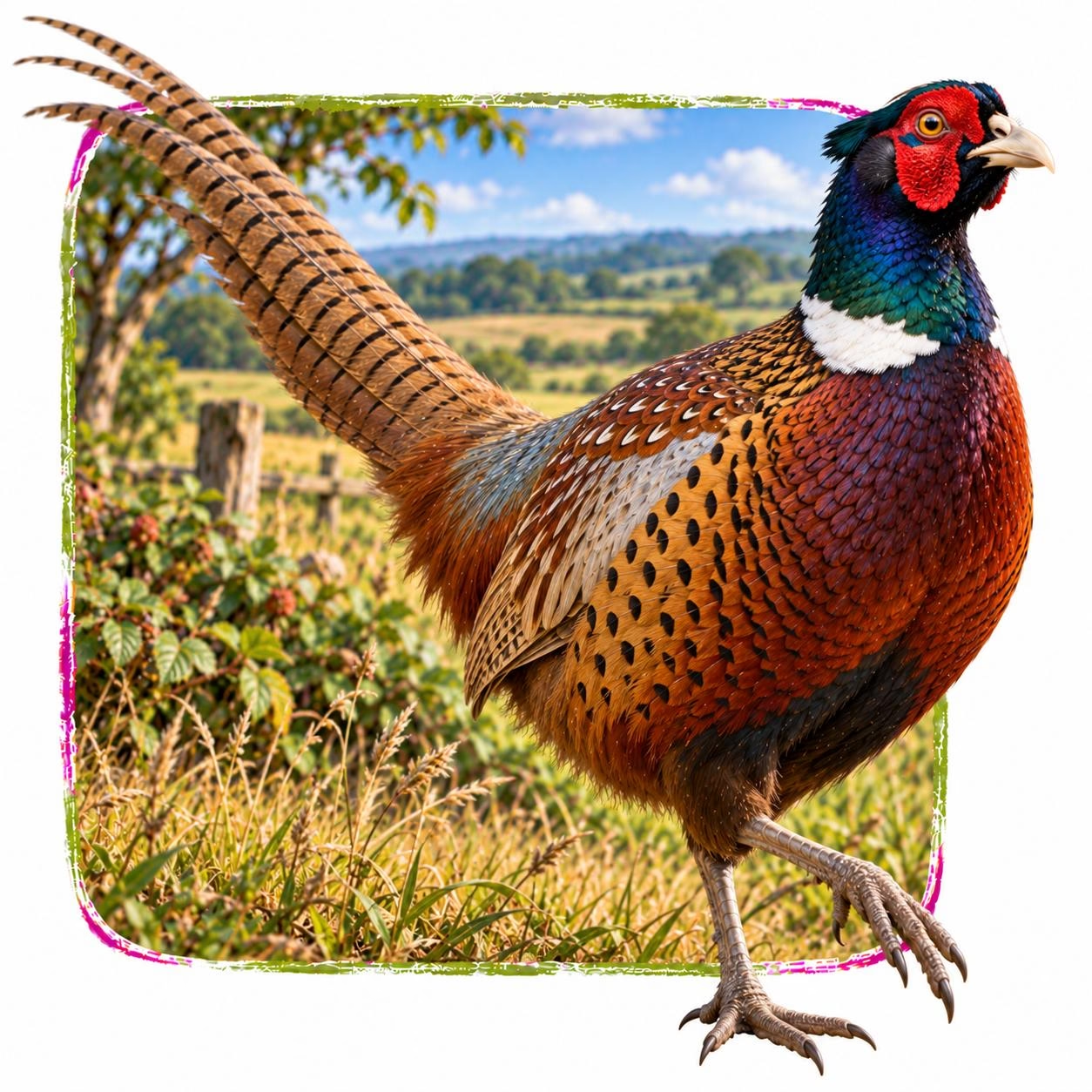
Common Pheasant in its natural Grassland, farmland, field edges, scrub, reedbeds, wetlands, woodland margins, hedgerows, and other open landscapes with dense escape and nesting cover habitat