
Adder vs Grass Snake: British Snake Species Comparison
Britain’s Adder, Vipera berus, and Grass Snake, Natrix helvetica, are easy to mix up from far away. Look closer and their clues are very different. The Adder is shorter and stockier, with a dark zigzag and slit-like pupil. The Grass Snake is much longer, has a pale collar and round pupil, and often hunts around fresh water. Here, Grass Snake means Britain’s barred grass snake, which scientists now treat as Natrix helvetica.
About Adder
- Type Living
- Diet Carnivore; small mammals, lizards, amphibians and young birds
- Group Viper family species (Vipera berus)
- Known for A dark zigzag, red eye with a vertical pupil, stocky body and the only venomous bite among native British snakes
- Special skill Uses hollow hinged fangs to deliver venom to small prey, while relying on camouflage to avoid danger
About Grass Snake
- Type Living
- Diet Carnivore; mainly frogs and other amphibians, plus fish and occasional small prey
- Group Colubrid snake species; Britain’s barred grass snake (Natrix helvetica)
- Known for Long slender body, pale yellow or cream neck collar, round pupil, strong swimming and dramatic play-dead defense
- Special skill Swims strongly and can escape danger by playing dead or releasing a foul-smelling musk
Adder vs Grass Snake: Quick Answer
An Adder is usually a short, sturdy snake with a dark zigzag down its back. It is Britain’s only native venomous snake, but it is shy and usually slips away. A Grass Snake is longer and slimmer, with a yellowish or cream collar behind the head. It is non-venomous, swims well, lays eggs and may play dead when frightened.
Where Do They Fit?
Follow the branches to see how Adder and Grass Snake are classified and related.
Adder vs Grass Snake: Quick Comparison
| Feature | Adder | Grass Snake |
|---|---|---|
| Scientific name | Vipera berus | Natrix helvetica in Britain |
| Typical adult length | About 60-80 cm in Britain | Often about 90-150 cm |
| Body shape | Shorter and stockier | Longer and more slender |
| Best marking | Dark zigzag along the back | Pale yellow, cream or whitish neck collar and dark side bars |
| Eye clue | Reddish iris with a vertical pupil | Round pupil |
| Venom | Venomous; bites are uncommon but need medical help | Non-venomous |
| Favorite habitat | Heaths, moors, dunes and sunny woodland edges | Wetlands, ponds, canals, meadows and gardens |
| Main food | Small mammals, lizards, amphibians and young birds | Mainly amphibians, plus fish and occasional small prey |
| Young | Gives birth to live young | Lays 10-40 eggs in warm rotting vegetation |
| Defense | Camouflage, warning display and a bite if badly threatened | Hissing, foul musk, fleeing or playing dead |
How Are Adders and Grass Snakes Alike?
- Both are native British snakes with scales, forked tongues and no legs.
- Both are ectotherms that bask in sunshine to warm their bodies.
- Both are carnivores that swallow animal prey whole.
- Both are shy around people and usually try to escape rather than confront them.
- Both shelter through the coldest months and emerge again in spring.
How Are Adders and Grass Snakes Different?
- An Adder is stocky with a back zigzag; a Grass Snake is slender with a pale neck collar.
- Adders have vertical pupils, while Grass Snakes have round pupils.
- The Adder is venomous, but the Grass Snake is non-venomous.
- Grass Snakes are longer and much more closely linked with ponds and wetlands.
- Adders give birth to live young, while Grass Snakes lay eggs in warm rotting plants.
Adder vs Grass Snake Adaptation Showdown
- Size – Grass Snake: It is Britain’s longest native snake and can reach around 150 cm, far longer than most adders.
- Speed – Tie: Both can move quickly when alarmed, but no fair shared-course measurement gives either species the title.
- Strength – Tie: Each handles the small prey suited to its own body; venom and body length are different tools, not a simple strength test.
- Stealth – Adder: Its brown or gray body and dark zigzag can vanish among heather, bracken and leaf litter.
- Social – Tie: Both are mainly solitary and gather only around especially useful basking, breeding or shelter places.
- Swimming – Grass Snake: It is a confident swimmer that often searches ponds and waterways for frogs and fish.
- Weirdest – Grass Snake: When escape fails, it may roll over, open its mouth and pretend to be dead while releasing a terrible smell.
Fun Adder vs Grass Snake Facts
A Newer British Name
A 2017 study separated western grass snakes from Natrix natrix. Britain’s snake is now generally called Natrix helvetica, the barred grass snake.
Live Young or Warm Eggs
Adder eggs develop inside the mother, so she gives birth to live young. Grass Snake eggs hatch in warm compost or other rotting plants.
Eyes Give a Clue
An Adder has a reddish eye with a narrow vertical pupil. A Grass Snake has a round pupil, although nobody should move close enough to test this clue.
A Pretend-Dead Performance
A frightened Grass Snake can turn limp, roll partly onto its back and leave its mouth open. The trick may persuade a predator to lose interest.
Venom With Perspective
Adder venom helps subdue prey. Bites to people are uncommon and very rarely fatal, but any suspected bite needs urgent medical advice.
Adder vs Grass Snake Quiz
Which snake usually has a dark back zigzag? A) Adder B) Grass Snake C) Both always do Answer: A) Adder
Which snake has a pale neck collar? A) Adder B) Grass Snake C) Neither Answer: B) Grass Snake
Which is Britain’s only native venomous snake? A) Adder B) Grass Snake C) Both Answer: A) Adder
Which snake lays eggs in warm rotting plants? A) Adder B) Grass Snake C) Neither Answer: B) Grass Snake
Which is the stronger swimmer? A) Adder B) Grass Snake C) Neither can swim Answer: B) Grass Snake
Adder vs Grass Snake FAQ
Are adders aggressive?
No. Adders are shy and usually flee or stay hidden. A bite is most likely when one is stepped on, handled or trapped.
Is a Grass Snake venomous?
No. Britain’s Grass Snake is non-venomous and is harmless when left undisturbed.
What should I do after a suspected Adder bite?
Move away calmly, keep the bitten limb still, remove rings or tight items and get urgent medical help. Do not cut or suck the wound.
Can both snakes swim?
Yes, but the Grass Snake is the stronger water specialist and often hunts around ponds.
Should I pick up a British snake?
No. Observe from a safe distance, keep pets away and let the snake choose its own escape route.
Animal Words to Know
- Ectotherm: An animal that depends mostly on outside heat to control body temperature.
- Helvetic: A word connected with Switzerland; helvetica is part of the barred grass snake’s scientific name.
- Melanistic: Unusually dark or black because the body makes lots of dark pigment.
- Musk: A strong-smelling substance some animals release in defense.
- Venom: A harmful substance delivered by a bite or sting.
Make a Safe Snake Clue Wheel
Make a Safe Snake Clue Wheel
Cut two paper circles with adult help and join them using a paper fastener. Add windows for body shape, back marking, pupil, habitat and birth. Turn the wheel to reveal Adder clues or Grass Snake clues. Use drawings or photographs only—never approach or handle a wild snake.
Meet Each Animal
Want the full fact file? Here are quick highlights from each animal’s own facts page.
Adder Fact Highlight
From the full animal facts page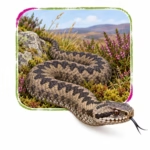
Grass Snake Fact Highlight
From the full animal facts page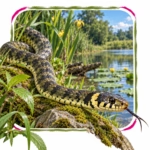
More Animal Comparisons
Pick another animal matchup and keep exploring. Compare appearances, habitats, diets, abilities, and surprising differences.






Make an Animal Story
Create a snake story about a zigzag heathland neighbor meeting a collar-wearing pond swimmer!
Source notes: References used for this comparison. See more See less
Try Another Matchup
Explore this comparison →