
African Elephant vs Asian Elephant: Living Elephant Species Comparison
African and Asian elephants share the same extraordinary elephant toolkit—trunk, tusks, padded feet, giant ears, strong family bonds, and long childhood—but they are not one animal living on two continents. This page uses the African savanna elephant for the measurable African side because Africa has two living elephant species. The savanna elephant is generally larger, with enormous ears, two trunk-tip fingers, a more dipped back, and tusks commonly visible in females and males. The Asian elephant is usually smaller-eared, has one trunk-tip finger, a twin-domed forehead, a rounder back, and large tusks mainly in some males. Individuals vary, so identification should combine several clues rather than one feature.
About African Elephant
- Type Mammal
- Diet Herbivore and flexible grazer-browser eating grasses, leaves, shoots, roots, bark, twigs, herbs, and fruit; the mix changes with habitat, rainfall, season, and local plant availability
- Group African elephant, represented here by the African savanna elephant (Loxodonta africana); Africa also has the smaller, genetically distinct African forest elephant (Loxodonta cyclotis)
- Known for The African savanna elephant is the largest living land animal; adult females are commonly about 2.2–2.6 meters at the shoulder and 2,000–3,500 kilograms, while adult males may reach about 3.2–4 meters and 4,500–6,100 kilograms, with great regional and individual variation
- Special skill Huge fan-shaped ears rich in blood vessels, two opposing finger-like projections at the trunk tip, wrinkled moisture-holding skin, shock-absorbing foot pads, continuously replaced grinding molars, long-distance low-frequency communication, and usually visible tusks in both sexes
About Asian Elephant
- Type Mammal
- Diet Herbivore eating grasses plus leaves, roots, vines, twigs, shoots, bark, and fruit; elephants may also raid bananas, rice, sugar cane, and other crops where farms overlap movement routes
- Group Asian elephant (Elephas maximus), a distinct species with several regional populations and commonly recognized subspecies, including Indian, Sri Lankan, Sumatran, and Bornean elephants
- Known for Slightly smaller on average than the African savanna elephant; adults are commonly about 1.8–3.8 meters at the shoulder and 2,750–5,420 kilograms, with males normally much larger than females and island populations often smaller
- Special skill Smaller rounded ears, one finger-like projection at the trunk tip, twin-domed forehead, often rounded or level back, depigmented pink-speckled areas on some adults, cushioned feet, conveyor-belt molars, and prominent tusks mainly in some males
African Elephant vs Asian Elephant: Quick Answer
An African savanna elephant is usually larger, with enormous fan-shaped ears, two finger-like trunk tips, a more dipped back, and visible tusks in most adults of both sexes. An Asian elephant usually has smaller rounded ears, one trunk-tip finger, a twin-domed forehead, a rounder or level back, and large tusks mainly in some males. Both are intelligent, social herbivores, and both need connected habitat, water, and protection.
Where Do They Fit?
Follow the branches to see how African Elephant and Asian Elephant are classified and related.
African Elephant vs Asian Elephant: Quick Comparison
| Feature | African Elephant | Asian Elephant |
|---|---|---|
| Representative | African savanna elephant, Loxodonta africana | Asian elephant, Elephas maximus |
| Living species context | Africa has savanna and forest elephant species | Asia has one living elephant species with regional populations |
| Typical size | Savanna adults about 2,000–6,100 kg; males may reach about 4 m at shoulder | Adults commonly about 2,750–5,420 kg and 1.8–3.8 m at shoulder |
| Ears | Very large and broadly fan-shaped | Smaller and more rounded |
| Trunk tip | Two opposing finger-like projections | One finger-like projection above the nostrils |
| Head and back | Single-domed head and often a dipped or saddle-shaped back | Twin-domed forehead and often a rounded or level back |
| Tusks | Usually visible in both females and males, with natural exceptions | Large tusks mainly in some males; females usually have tiny tushes or none visible |
| Wild range | Sub-Saharan Africa; savanna representative mainly east and south | Fragmented South and Southeast Asian range across 13 countries |
| Family life | Matriarch-led female-and-calf families, often joining larger gatherings | Matriarch-led female-and-calf families, usually smaller and highly fluid |
| IUCN status | African savanna elephant: Endangered; forest elephant: Critically Endangered | Asian elephant: Endangered |
How Are African and Asian Elephants Alike?
- Both are proboscidean mammals and the largest living land animals in their regions, with trunks formed from the nose and upper lip.
- Both use the trunk to smell, breathe, touch, drink, bathe, feed, trumpet, explore, reassure companions, and manipulate objects with remarkable precision.
- Both are herbivores that eat grasses and browse, need dependable fresh water, travel across large home ranges, and reshape vegetation and pathways as ecosystem engineers.
- Both form matriarch-led female-and-calf families, have a pregnancy lasting about 22 months, normally produce one calf, and depend on years of social learning.
- Both communicate through touch, scent, posture, audible calls, low-frequency rumbles, and vibrations that can travel through air and ground.
How Are African and Asian Elephants Different?
- African savanna elephants are generally the larger species; Asian elephants overlap in size but are smaller on average, and sex creates major variation in both.
- African elephants have much larger fan-shaped ears, while Asian elephants have smaller rounded ears suited to a more forest-associated body plan.
- The African trunk tip has two opposing finger-like projections; the Asian trunk tip has one upper projection and often curls material against the underside.
- An African savanna elephant usually shows a single-domed head and dipped back; an Asian elephant commonly shows two forehead domes and a rounder or level back.
- Most African savanna females and males develop visible tusks, while large Asian tusks occur mainly in some males; many Asian males and nearly all females lack prominent tusks.
- African savanna families may form very large temporary gatherings, while Asian family groups tend to be smaller, though group size changes with habitat and resources.
African Elephant vs Asian Elephant Adaptation Showdown
Giant-herbivore adaptation showdown: African elephant wins size and absolute strength because the selected savanna species is the largest living land animal, but this is not a fight claim. Speed is a tie because trustworthy like-for-like maxima are poor and both can move surprisingly quickly. Asian elephant wins stealth for a smaller forest-adapted outline, compact ears, and quieter movement through dense vegetation. Social life is a tie because both build complex matriarch-led networks with different normal group sizes. Swimming is a tie because both are strong swimmers that can use the trunk as a snorkel. African elephant wins weirdest adaptation for two opposing trunk-tip fingers that can pinch small objects like living tongs. Every category varies with species, sex, age, habitat, and individual.
Fun African Elephant vs Asian Elephant Facts
Africa Has Two Living Elephant Species
African savanna elephants and African forest elephants were once commonly treated together, but genetic, anatomical, ecological, and behavioral evidence supports them as distinct species. Savanna elephants are generally larger with outward-curving tusks; forest elephants are smaller, rounder-eared, and usually have straighter downward-pointing tusks. This comparison therefore uses the savanna species rather than pretending every African elephant has one body plan.
Their Trunk Tips Use Different Finger Counts
An African elephant has one finger-like projection above and one below the nostrils at the trunk tip. It can bring the two together to pinch food. An Asian elephant has one upper finger and often picks up an object by curling it against the lower surface of the trunk. Both systems can pluck vegetation, investigate textures, and handle surprisingly small objects.
The Giant Ears Work Like Living Radiators
Elephant ears contain a dense network of blood vessels. Moving the ears increases air flow across the thin skin, helping release heat from the blood. African savanna elephants generally carry much larger ears because they often live in hotter, more open landscapes, but both species also cool themselves with shade, water, mud, and changes in activity.
The Tusk Rule Has Important Exceptions
Tusks are enlarged upper incisor teeth. Most African savanna females and males grow visible tusks, but inherited tusklessness occurs naturally and has become more common in some heavily poached populations. Among Asian elephants, large tusks occur mainly in some males; the proportion varies greatly by region, and many males are tuskless while females usually have tiny tushes or no visible tusks.
Elephant Footprints Can Become Tiny Ponds
An elephant is an ecosystem engineer. Its trails open routes through vegetation, dung spreads seeds and nutrients, feeding changes plant growth, and a deep footprint may fill with rainwater. That temporary puddle can hold insects, tadpoles, or other miniature life. African and Asian elephants perform these jobs in different ecosystems, so protecting them also protects many smaller neighbors.
African Elephant vs Asian Elephant Quiz
- Which representative is the largest living land animal? Answer: The African savanna elephant.
- How many finger-like projections are at an African elephant’s trunk tip? Answer: Two.
- Which elephant usually has smaller rounded ears and a twin-domed forehead? Answer: The Asian elephant.
- Do all adult Asian males have large tusks? Answer: No. Many males are tuskless, and the proportion varies by region.
- What leads a female-and-calf elephant family? Answer: An experienced adult female called the matriarch.
African Elephant vs Asian Elephant FAQ
What is the easiest way to tell an African elephant from an Asian elephant?
Use several clues together. An African savanna elephant is usually larger with enormous ears, two trunk-tip fingers, a single-domed head, and a dipped back. An Asian elephant usually has smaller ears, one trunk-tip finger, a twin-domed forehead, and a rounder or level back.
Are African elephants always bigger?
African savanna elephants are larger on average, especially adult males, but age, sex, health, subspecies, and individual variation create overlap. African forest elephants are much smaller than savanna elephants and can overlap Asian elephants in size.
Do female elephants have tusks?
Most African savanna females grow visible tusks, although tusklessness occurs. Asian females normally have no prominent tusks; some have small tushes that barely extend beyond the lip.
Can both kinds of elephant swim?
Yes. Elephants are buoyant, powerful swimmers and can hold the trunk above the surface like a snorkel. Swimming ability does not mean every water crossing is safe, especially for calves or in strong currents.
Which elephant is more endangered?
The IUCN lists the African forest elephant as Critically Endangered and both the African savanna elephant and Asian elephant as Endangered. Threats differ by region but include habitat loss and fragmentation, conflict with people, poaching, and blocked movement routes.
Animal Words to Know
- Proboscidean: A member of the mammal order containing living elephants and extinct relatives such as mammoths.
- Matriarch: An experienced adult female who helps guide an elephant family.
- Infrasound: Very low-frequency sound, including rumbles that may travel farther than ordinary calls.
- Tusk: An enlarged incisor tooth that grows outward and contains living tissue at its base.
- Ecosystem engineer: An animal that changes habitat in ways that affect many other species.
African and Asian Elephant Detective Activity
African and Asian Elephant Detective Activity
Draw an African savanna elephant and an Asian elephant on the same ground line. Make the African elephant slightly taller, with enormous fan-shaped ears, a gently dipped back, one rounded forehead, and two trunk-tip fingers. Give the Asian elephant smaller rounded ears, a twin-domed forehead, a rounder back, and one trunk-tip finger. Add a tusked male of each and label ears, forehead, back, trunk tip, tusks, and habitat.
Meet Each Animal
Want the full fact file? Here are quick highlights from each animal’s own facts page.
African Elephant Fact Highlight
From the full animal facts page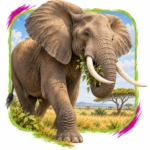
Asian Elephant Fact Highlight
From the full animal facts page
More Animal Comparisons
Pick another animal matchup and keep exploring. Compare appearances, habitats, diets, abilities, and surprising differences.






Make an Animal Story
Turn this African vs Asian elephant comparison into a giant-ear and forest-trunk adventure with our free Animal Story Generator.
Source notes: References used for this comparison. See more See less
Try Another Matchup
Explore this comparison →