
Albatross vs Seagull: Dynamic-Soaring-Albatross-to-Adaptable-Coastal-Gull Seabird Comparison
Albatrosses and gulls are both web-footed ocean-going birds, but an albatross is not an extra-large seagull. Albatrosses belong to the tube-nosed family Diomedeidae and are shaped for weeks of efficient travel over windy open oceans. Gulls belong to Laridae and are flexible coast, lake, river, field, and city foragers. For a clear visual, this page pairs the record-winged wandering albatross with an American herring gull, while reminding readers that both names cover broader groups. The albatross has far longer narrower wings and tubular nostrils; the gull is smaller, quicker on land, and more comfortable switching among many habitats and foods.
About Albatross
- Type Bird
- Diet Marine carnivore and scavenger eating squid, fish, krill, other crustaceans, fish eggs, and carrion, caught at the surface, during shallow dives, or behind natural predators and vessels. Diet and diving ability differ among species; plastic and baited fishing hooks can be mistaken for food with deadly results
- Group Albatrosses are 22 living species covered by the Agreement on the Conservation of Albatrosses and Petrels, in family Diomedeidae and the tube-nosed seabird order Procellariiformes. The wandering albatross Diomedea exulans is used as the giant visual and wingspan example, not as an average for every albatross
- Known for A large oceanic bird with extremely long narrow wings, heavy hooked bill built from horny plates, tubular nostrils, webbed feet, and usually white, brown, gray, or black plumage. Wandering albatrosses reach about 110–135 centimeters long, roughly 6–12 kilograms, and about 3.5 meters across the wings—the widest verified wingspan among living birds
- Special skill Dynamic soaring harvests energy from wind-speed differences above waves, allowing long flights with little flapping. Tubular nostrils and a strong sense of smell help locate food, salt glands remove excess sea salt, and long wings trade rapid takeoff and tight turning for extraordinary efficient travel over windy oceans.
About Seagull
- Type Bird
- Diet Flexible omnivore and predator eating fish, crabs, mussels, worms, insects, eggs, carrion, rodents, fruit, grain, and discarded human food according to species and place. American herring gulls often specialize individually, forage on foot or while paddling, follow fishing activity, and may drop hard-shelled prey on rocks
- Group “Seagull” is an everyday name for gulls, the broad-winged members of family Laridae commonly grouped in Larinae; there is no single species scientifically named “the seagull.” The American herring gull Larus smithsonianus is used for exact measurements and artwork, while other gull species can be far smaller, larger, darker, paler, inland, coastal, Arctic, or tropical
- Known for A sturdy, broad-winged waterbird with a fairly heavy bill, webbed feet, long wings, and usually white, gray, black, or brown plumage that changes with age and season. The American herring gull example measures about 56–66 centimeters and 800–1,250 grams, has a barrel-shaped body, pink legs, pale-gray back, black-and-white wingtips, and a yellow adult bill with a red spot
- Special skill Broad wings support flapping, gliding, hovering into wind, and thermal soaring; webbed feet paddle and help launch from water; waterproof plumage and salt-handling glands support marine life. Flexible bills, feet, memory, and learning let gulls open shellfish, follow tides, exploit new foods, and live from remote islands to busy cities.
Albatross vs Seagull: Quick Answer
A wandering albatross can stretch about 3.5 meters from wingtip to wingtip and uses ocean winds to glide vast distances with little flapping. An American herring gull is much smaller—about 56–66 centimeters long and 800–1,250 grams—with broader wings, longer-looking legs, and a flexible shoreline-and-inland lifestyle. Albatrosses have tubular nostrils and usually lay one egg on remote islands; gulls lack the albatross-style bill tubes, commonly lay one to three eggs, and can thrive near lakes, fields, rooftops, and harbors.
Where Do They Fit?
Follow the branches to see how Albatross and Seagull are classified and related.
Albatross vs Seagull: Quick Comparison
| Feature | Albatross | Seagull or Gull |
|---|---|---|
| Scientific family | Diomedeidae in order Procellariiformes, the tube-nosed seabirds | Laridae in order Charadriiformes, alongside terns and skimmers |
| Visual example | Wandering albatross, a giant Southern Ocean species | American herring gull, a large North American gull |
| Example scale | About 110–135 cm long, 6–12 kg, and roughly 3.5 m wingspan | About 56–66 cm long and 800–1,250 g with much shorter wings |
| Wing design | Extremely long, narrow, stiff-looking wings for dynamic soaring | Broad, tapered wings for flapping, gliding, hovering, and thermal soaring |
| Bill and nose | Large hooked plated bill with obvious tubular nostrils and strong smell | Sturdy one-piece-looking bill with ordinary external nostril openings |
| Home ground | Windy open ocean and remote breeding islands | Coasts, lakes, rivers, fields, towns, rooftops, and islands |
| Food | Squid, fish, krill, crustaceans, fish eggs, and carrion | Fish, shellfish, worms, insects, eggs, carrion, grain, fruit, and scraps |
| Breeding pace | Usually one egg, long chick growth, late maturity, and skipped years in many species | Often one to three eggs, faster chick cycle, and usually annual breeding attempts |
| Land movement | Walks and courts on islands but needs room or wind for easy takeoff | Walks, runs, perches, launches, and turns comfortably in varied places |
| Memory clue | Long-winged ocean wind traveler | Broad-winged adaptable shoreline neighbor |
How Are Albatrosses and Seagulls Alike?
- Both are warm-blooded feathered seabirds with long wings, waterproof plumage, webbed front toes, salt-handling glands, excellent vision, and bills capable of seizing slippery animal food.
- Both eat fish, marine invertebrates, carrion, or food exposed by other predators and vessels, rest on the sea surface, bathe and preen, and can travel far beyond sight of land.
- Both commonly form breeding colonies, create long pair relationships in many species, lay eggs on land, share incubation and chick feeding, and recognize mates or young through calls and behavior.
- Both use soaring to reduce flight cost, follow winds and productive water, and face danger from fishing gear, plastic, oil, disturbed nest sites, invasive predators, and changing ocean food webs.
- Both are wild birds that should be watched from a distance; people should never feed, chase, handle, approach nests, throw objects, or leave hooks, bait, line, and plastic where birds can swallow or become tangled in them.
How Are Albatrosses and Seagulls Different?
- Albatrosses are procellariiform tube-nosed seabirds in Diomedeidae; gulls are charadriiform birds in Laridae. Similar white-gray plumage and webbed feet do not make them one family.
- Great albatrosses dwarf most gulls in wingspan and mass. A wandering albatross can span about 3.5 meters, while even a large gull looks compact beside its extremely long wings.
- An albatross has separated tubular nostrils on a large plated hooked bill and an especially developed sense of smell. A gull has visible nostril openings but not the albatross’s tube-nose construction.
- Albatross wings extract energy from changing wind above waves and are awkward in calm, tight spaces. Gull wings are broader and better suited to frequent flapping, hovering into wind, urban turns, inland thermals, and varied takeoff sites.
- Albatrosses live overwhelmingly at sea and visit remote islands to breed slowly. Gulls often feed, rest, and breed around shores, inland waters, farms, rooftops, landfills, and other landscapes close to people.
- Most albatrosses lay one egg and invest many months in one chick, with late maturity and skipped breeding years common. American herring gulls usually lay one to three eggs and can attempt breeding annually.
Albatross vs Seagull Adaptation Showdown
Ocean wind-glider versus adaptable coast-and-inland forager showdown: Albatross wins size because the wandering albatross example reaches roughly 6–12 kilograms and a 3.5-meter wingspan, far beyond the 800–1,250-gram American herring gull. Speed is a tie because dynamic-soaring ground speed changes with wind and cannot be fairly compared with a gull’s flapping or local maneuvering by one internet maximum. Albatross wins absolute whole-body strength from greater mass and a larger bill, without implying combat. Stealth is a tie because both use countershading but usually forage openly. Social behavior is a tie: albatrosses have long courtship traditions and pair coordination, while gulls have complex colonies, calls, territories, and shared care. Swimming is a tie because both paddle and rest afloat but neither example is a specialized underwater pursuit swimmer. Albatross wins strangest adaptation for combining tube nostrils, salt removal, smell-guided feeding, and dynamic soaring across wave-layer winds. These fields compare survival tools, not a fight.
Fun Albatross vs Seagull Facts
The Wandering Albatross Holds the Wingspan Record
A wandering albatross can spread wings about 3.5 meters wide, the largest verified wingspan among living birds. Not every albatross is that large: Laysan and black-footed albatrosses span roughly two meters. The record belongs to a species and exceptional body plan, not to a mythical average bird called simply “the albatross.”
An Albatross Borrows Energy From the Wind
During dynamic soaring, an albatross glides low in slower air behind waves, turns upward into faster wind, gains energy, then sweeps down again. Repeating the cycle can carry it enormous distances with little flapping. The bird is not flying for free—muscles still steer and stabilize it—but wind supplies much of the forward energy.
Tube Nostrils Help an Albatross Smell the Ocean
Albatrosses belong to the tube-nosed order Procellariiformes. Their external nostrils sit in tubes along the bill, and a well-developed sense of smell helps locate food odors over open water. Nearby salt glands remove excess salt from seawater and salty prey, sending concentrated fluid toward the nostrils and bill grooves for excretion.
One Albatross Chick Can Be a Year-Long Project
Wandering albatrosses lay one egg, incubate it for roughly eleven weeks, and feed the chick across a breeding season that lasts just over a year. Successful parents usually do not breed the next year. Other albatross species have different schedules, but the family is generally slow to mature and slow to replace lost adults.
A Herring Gull Changes Clothes for Four Years
An American herring gull does not hatch looking white and gray. Its first plumage is mottled brown, later years mix brown with increasing gray and white, and the clean adult pattern usually appears around the fourth year. Plumage stages make young gulls easy to mistake for different species and show why color alone is a risky identifier.
Albatross vs Seagull Quiz
- Which bird family has tubular nostrils? Answer: The albatross family, Diomedeidae.
- Which example has the larger wingspan? Answer: The wandering albatross, at about 3.5 meters.
- What is dynamic soaring? Answer: Repeatedly using wind-speed differences above waves to gain flight energy.
- Which bird uses a wider variety of inland and urban habitats? Answer: The gull.
- How many eggs does an albatross usually lay in one attempt? Answer: One.
Albatross vs Seagull FAQ
Is an albatross a giant seagull?
No. Albatrosses are tube-nosed seabirds in family Diomedeidae, while gulls are in family Laridae with terns and skimmers. They independently share useful seabird traits such as webbed feet, pale plumage, salt handling, and soaring, but their skeletons, bills, nostrils, wings, breeding, and evolutionary history differ.
Which is bigger, an albatross or seagull?
The albatross example is far bigger. A wandering albatross can weigh roughly 6–12 kilograms and span about 3.5 meters, while an American herring gull weighs about 800–1,250 grams and is 56–66 centimeters long. Smaller albatrosses and larger gulls narrow the gap but do not erase the group-level contrast.
Can an albatross take off from flat ground?
Yes, but its extremely long wings and high wing loading make calm, confined ground difficult. Albatrosses prefer wind, slopes, open water, or a running start. They are not helpless on land, and images should not show broken or dragging wings as normal.
Do albatrosses and gulls drink seawater?
Both have salt glands that help remove excess salt, allowing marine feeding and some seawater intake. Albatrosses are especially oceanic and route concentrated salt solution toward their tubular nostrils. Salt glands reduce the salt burden; they do not make pollution, oil, or contaminated water safe.
Why are albatrosses threatened by fishing?
Birds can seize baited longline hooks, collide with cables, become tangled, or follow vessels into danger. Because albatrosses mature late, lay one egg, and breed slowly, losing adult birds has a large population effect. Bird-scaring lines, weighted hooks, safer setting times, and careful waste control can reduce bycatch.
Animal Words to Know
- Dynamic soaring: A flight pattern that gains energy by crossing layers of air moving at different speeds above waves.
- Procellariiformes: The tube-nosed seabird order containing albatrosses, petrels, shearwaters, and storm-petrels.
- Salt gland: A gland above the eyes that removes extra salt from the bloodstream and sends concentrated fluid toward the nasal area.
- Wing loading: Body mass supported by a given wing area, influencing takeoff, turning, gliding, and minimum flight speed.
- Bycatch: An animal unintentionally caught or killed by fishing gear aimed at another species.
Albatross and Gull Wingspan Activity
Albatross and Gull Wingspan Activity
Draw the outstretched wings of a wandering albatross and herring gull on the same scale. Give the albatross enormously long narrow wings, a large hooked bill with tube-like nostrils, and open Southern Ocean waves. Make the gull much smaller, with broader wings, a sturdier bill, and a coast, lake, or city background. Label wingspan, wing shape, bill, nostrils, ocean gliding, and shoreline flight.
Meet Each Animal
Want the full fact file? Here are quick highlights from each animal’s own facts page.
Albatross Fact Highlight
From the full animal facts page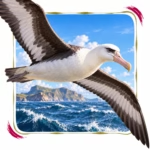
Seagull Fact Highlight
From the full animal facts page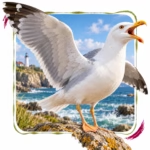
More Animal Comparisons
Pick another animal matchup and keep exploring. Compare appearances, habitats, diets, abilities, and surprising differences.

Make an Animal Story
Turn this albatross vs seagull comparison into a wind-riding open-ocean journey with our free Animal Story Generator.
Source notes: References used for this comparison. See more See less
Try Another Matchup
Explore this comparison →