
American Badger vs Honey Badger
American Badgers and Honey Badgers are both mustelids, relatives of weasels and otters, but they live on different continents. The American species is flatter, with a white head stripe and side-to-side facial marks. The Honey Badger has a dark underside and broad pale mantle across its back. Both use wide feet and long claws to dig for food and shelter.
About American Badger
- Type Mammal
- Diet Carnivore; mostly burrowing rodents plus other small animals
- Group Mustelid; family Mustelidae
- Known for A flat body, bold face markings, and extremely fast digging
- Special skill Powerful forelimbs can rapidly tunnel after prey and build deep burrows
About Honey Badger
- Type Mammal
- Diet Mostly carnivore; small animals, insects, eggs, bee larvae, fruit, roots, and bulbs
- Group Mustelid; family Mustelidae
- Known for A pale back mantle, long front claws, and thick loose skin
- Special skill Thick loose skin lets the body twist, while scent glands add a strong defense
Quick Answer
Quick answer: The American Badger lives in North America and specializes in tunneling after rodents across open ground. The Honey Badger ranges across much of sub-Saharan Africa and parts of Asia, where its menu includes small animals, reptiles, insects, roots, fruit, and bee brood. Their published mass ranges overlap closely, but their coats, ranges, defenses, and daily travels are easy to compare.
American Badger vs Honey Badger: Quick Comparison
| Feature | American Badger | Honey Badger |
|---|---|---|
| Scientific identity | Taxidea taxus | Mellivora capensis |
| Family | Mustelidae | Mustelidae |
| Published adult size | About 4-12 kg and 52-87.5 cm total length | About 8-12 kg and 60-70 cm body length |
| Native range | North America | Sub-Saharan Africa, Arabia, and parts of western and southern Asia |
| Coat clue | Gray to reddish body, dark face patches, and a white stripe over the head | Dark lower body with a broad gray or pale mantle over the back |
| Favorite habitat | Dry open grasslands, fields, pastures, and scrub | Grasslands, forests, thorn scrub, rocky hills, steppes, and deserts |
| Food | Mostly burrowing rodents, plus other small prey and some insects | Small mammals, reptiles, birds, eggs, insects, bee larvae, and some plant foods |
| Digging gear | Flat body, stocky legs, and powerfully built forelimbs | Strong wide front feet with long claws and muscular shoulders |
| Social pattern | Usually solitary; may tolerate a coyote hunting nearby | Usually solitary and nomadic; mothers raise cubs alone |
| Special defense | Rapid digging and a low sturdy body | Thick loose skin, bold warning colors, and strong-smelling anal-gland fluid |
How Are American Badgers and Honey Badgers Alike?
- Both are mammals in the mustelid family, along with weasels and otters.
- Both have stocky bodies, strong forefeet, and long claws for digging.
- Both shelter in burrows and often search for food at night.
- Both are usually solitary as adults outside breeding or parent-young time.
- Both are flexible carnivores that eat many kinds of small animal prey.
How Are American Badgers and Honey Badgers Different?
- The American Badger is native to North America, while the Honey Badger lives across parts of Africa and Asia.
- The American species has striped facial markings; the Honey Badger has a broad pale mantle over a dark body.
- The American Badger is especially tied to open country with burrowing rodents; the Honey Badger uses a much wider range of warm habitats.
- American Badgers may hunt near coyotes, while Honey Badgers are nomadic foragers that can travel many kilometers in a day.
- Honey Badgers have unusually thick loose skin and powerful scent glands; American Badgers rely heavily on rapid digging and a low, sturdy build.
American Badger vs Honey Badger Showdown
Adaptation showdown: Size is a Tie because both published mass ranges reach about 12 kilograms and their length measures overlap. Speed is a Tie because the sources provide no fair matched running test. Strength is a Tie because both are powerful diggers built for different soils and prey. American Badger wins stealth because it can pursue prey underground and may dig a fresh shelter in a single day. Social behavior is a Tie because adults of both species are usually solitary. Swimming is a Tie because neither is documented here as a water specialist. Honey Badger wins weirdest for thick loose skin that allows twisting inside a predator’s grasp and for a strong-smelling gland defense.
Fun American Badger vs Honey Badger Facts
A Coyote Can Become a Hunting Neighbor
American Badgers sometimes forage near coyotes. A coyote can chase a rodent above ground while a badger can follow it underground, and the two species may tolerate each other or even play.
A New Summer Burrow
An American Badger may dig a new burrow each day during summer. A typical den can reach about 3 meters below the surface and contain roughly 10 meters of tunnels.
A Pause Before Pregnancy Continues
American Badgers mate in late summer or early fall, but the embryo delays attaching to the uterus until winter. This delayed implantation helps time births for early spring.
Loose Skin, Tight Escape
A Honey Badger’s skin is thick and loose. That makes it difficult for a predator to grip firmly and gives the badger room to twist its body.
The Hive Prize Is Brood
Honey Badgers may open beehives, but they eat bee larvae as well as honey. Their diet is much broader and also includes rodents, reptiles, birds, eggs, insects, roots, bulbs, and fruit.
American Badger vs Honey Badger Quiz
- Which badger is native to North America? Answer: The American Badger.
- Which badger has a broad pale mantle across its back? Answer: The Honey Badger.
- What family includes both animals? Answer: The mustelid family, Mustelidae.
- Why are their long front claws useful? Answer: They help the badgers dig for prey and shelter.
- What unusual reproductive timing occurs in American Badgers? Answer: Delayed implantation pauses early development until winter.
American Badger vs Honey Badger FAQ
Are American Badgers and Honey Badgers the same species?
No. They are different species in the same mustelid family.
Which badger is bigger?
Their published adult mass ranges overlap, and both can reach about 12 kilograms in the sources used here.
Do Honey Badgers eat only honey?
No. They mostly eat animal prey and insects, including bee larvae, and they also take some fruit, roots, and bulbs.
Do American Badgers really hunt with coyotes?
They are sometimes seen foraging at the same time. Coyotes can chase prey above ground while badgers can dig after prey below it.
Are both badgers social?
Adults are generally solitary, though mothers care for young and brief encounters occur.
Animal Words to Know
- Mustelid: A member of the mammal family that includes weasels, otters, badgers, and relatives.
- Fossorial: Adapted for digging or living underground.
- Mantle: A broad area of contrasting color across the back or shoulders.
- Torpor: A temporary state in which body temperature and activity drop to save energy.
- Delayed implantation: A reproductive pause before an embryo attaches to the uterus and resumes development.
Design a Two-Continent Badger Burrow Map
Design a Two-Continent Badger Burrow Map
Draw exactly one adult American Badger in open North American grassland and exactly one adult Honey Badger in dry African scrub at honest relative scale. Add six labeled clue cards for face stripe, pale mantle, rodent tunnel, bee brood, digging claws, and loose skin. Connect each clue to the correct habitat and explain which clues belong to both animals. Observe wildlife from a distance without people handling animals.
Meet Each Animal
Want the full fact file? Here are quick highlights from each animal’s own facts page.
American Badger Fact Highlight
From the full animal facts page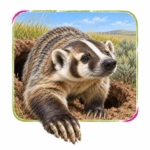
Honey Badger Fact Highlight
From the full animal facts page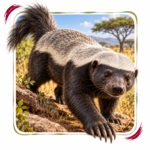
More Animal Comparisons
Pick another animal matchup and keep exploring. Compare appearances, habitats, diets, abilities, and surprising differences.


Make an Animal Story
Send an American Badger and a Honey Badger digging through two very different habitats in our free Animal Story Generator.
Source notes: References used for this comparison. See more See less
Try Another Matchup
Explore this comparison →