
Arctic Hare vs Snowshoe Hare for Kids
Arctic Hares and Snowshoe Hares both turn white in snowy winters, but they belong to different northern worlds. The Arctic Hare, Lepus arcticus, is a large, compact hare of open tundra and polar desert. The Snowshoe Hare, Lepus americanus, is smaller and lives among spruce, shrubs and tangled boreal forest. Both have furry feet and fast hind legs, yet the Snowshoe Hare has the more exaggerated snowshoe-shaped feet, while the Arctic Hare has the larger body and shorter heat-saving ears.
About Arctic Hare
- Type Living
- Diet Herbivore; eats mostly willow, plus grasses, flowers, roots, bark, mosses, lichens and seaweed
- Group Large northern hare in family Leporidae (Lepus arcticus)
- Known for Thick white winter fur, black ear tips, short heat-saving ears, large body, powerful running and huge seasonal groups
- Special skill Combines thick insulation, compact ears, snow-digging claws and bursts reported near 64 km/h to survive exposed tundra
About Snowshoe Hare
- Type Living
- Diet Herbivore; eats grasses and leafy growth in summer and buds, twigs, bark and conifer needles in winter
- Group North American forest hare in family Leporidae (Lepus americanus)
- Known for Enormous furry hind feet, brown summer coat, white winter coat, dense-forest hiding and dramatic population cycles
- Special skill Spreads its exceptionally large, heavily furred hind feet across soft snow like natural snowshoes
Quick Answer
An Arctic Hare is about 43–70 cm long and commonly weighs roughly 2.5–5.5 kg. It has short ears, strong claws and a thick coat for open tundra, and winter groups may contain hundreds. A Snowshoe Hare averages about 46–51 cm and 1.4–1.8 kg. Its extremely large furry hind feet spread its weight over deep forest snow, and its population often rises and falls in an 8–11-year cycle.
Arctic Hare vs Snowshoe Hare: Quick Comparison
| Feature | Arctic Hare | Snowshoe Hare |
|---|---|---|
| Scientific name | Lepus arcticus | Lepus americanus |
| Adult size | About 43–70 cm and commonly 2.5–5.5 kg | About 46–51 cm and 1.4–1.8 kg |
| Body build | Large, compact and heavily insulated with relatively short ears | Smaller and slimmer with longer ears and oversized hind feet |
| Winter coat | Bright white with black ear tips; far-northern animals may stay white all year | Nearly white with dark ear tips; most populations turn brown again in summer |
| Warm-season coat | Gray-brown in southern parts of the range; often white year-round in the High Arctic | Yellowish, reddish or gray-brown with a white belly |
| Hind feet | Large and furry, with strong claws for packed tundra snow | Extremely broad and densely furred, spreading weight across deep forest snow |
| Main home | Open treeless tundra, polar desert and rocky Arctic slopes | Boreal forest, wooded swamp and dense brush |
| Social life | Usually alone but may gather in winter herds of hundreds | Mostly solitary, although several may share good feeding habitat |
| Population pattern | Numbers vary, and some High Arctic hares make long synchronized fall movements | Famous 8–11-year boom-and-bust cycles linked to food and predators |
| Conservation | Least Concern globally; NWT ranks the species Secure, though High Arctic monitoring is limited | Least Concern globally; changing snow cover can create dangerous color mismatch |
How Are Arctic and Snowshoe Hares Alike?
- Both are true hares whose young are born furry, open-eyed and able to move soon after birth.
- Both grow pale winter coats that provide camouflage against snow.
- Both have large furred hind feet, long legs and powerful hopping muscles.
- Both eat grasses, willow, buds, twigs and other plant material.
- Both freeze when danger appears and then escape with fast zigzag bounds.
How Are Arctic and Snowshoe Hares Different?
- The Arctic Hare is larger and heavier than the Snowshoe Hare.
- Arctic Hares live on open tundra, while Snowshoe Hares live in dense northern forest and brush.
- The Arctic Hare has shorter heat-saving ears; the Snowshoe Hare has longer ears and more exaggerated hind feet.
- Arctic Hares may form winter groups of hundreds, while Snowshoe Hares are usually solitary.
- Snowshoe Hare numbers follow famous 8–11-year cycles, while some Arctic Hares make very long synchronized seasonal movements.
Arctic Hare vs Snowshoe Hare Showdown
- Size – Arctic Hare: It can exceed 5 kg, while a typical Snowshoe Hare weighs about 1.4–1.8 kg.
- Speed – Arctic Hare: Published accounts report bursts near 64 km/h, helped by long powerful hind legs.
- Strength – Arctic Hare: Its larger body, strong claws and robust legs give it more total power.
- Stealth – Tie: Both change coat color and freeze in place, matching snow in winter and earth or plants in warmer months.
- Social – Arctic Hare: Winter herds may contain hundreds, whereas Snowshoe Hares usually keep to themselves.
- Swimming – Tie: Both can cross water if necessary, but neither species is a swimming specialist.
- Weirdest – Arctic Hare: Some tracked hares moved hundreds of kilometres together—the longest movement yet recorded for any hare or rabbit relative.
Fun Arctic Hare vs Snowshoe Hare Facts
A Hare Migration Surprise
Satellite-tracked Arctic Hares on Ellesmere Island made synchronized fall journeys of several hundred kilometres.
A Moving Hillside
Arctic Hare groups of 100–300 are well documented, and observers have reported gatherings near 1,000 animals.
Feet That Spread the Load
Stiff hairs widen a Snowshoe Hare’s huge hind feet and help keep its body from sinking into powdery snow.
A Forest Population Pulse
Snowshoe Hare numbers often rise and crash every 8–11 years, affecting lynx, owls and other predators.
Color Change by Calendar
Shorter or longer daylight triggers seasonal molting, so warming winters can sometimes leave a white hare on dark ground.
Arctic Hare vs Snowshoe Hare Quiz
Which hare is usually larger? A) Arctic Hare B) Snowshoe Hare C) They are equal Answer: A) Arctic Hare
Which hare lives mainly in boreal forest? A) Arctic Hare B) Snowshoe Hare C) Neither Answer: B) Snowshoe Hare
Which has the most exaggerated snowshoe-like hind feet? A) Arctic Hare B) Snowshoe Hare C) Neither Answer: B) Snowshoe Hare
Which may gather in herds of hundreds? A) Arctic Hare B) Snowshoe Hare C) Both always do Answer: A) Arctic Hare
What are young hares called? A) Leverets B) Calves C) Chicks Answer: A) Leverets
Arctic Hare vs Snowshoe Hare FAQ
Are Arctic and Snowshoe Hares Rabbits?
They are close relatives of rabbits, but both are true hares. Their leverets are born furry, open-eyed and ready to move.
Which Hare Is Bigger?
The Arctic Hare is generally bigger and can weigh more than three times as much as a small Snowshoe Hare.
Do Both Hares Turn White?
Most do in snowy regions. Far-northern Arctic Hares may remain white all year, while some coastal Snowshoe Hare populations stay brown through winter.
Why Are Snowshoe Hare Feet So Big?
Their long, wide hind feet are lined with stiff fur that spreads body weight and reduces sinking into soft snow.
Do Arctic Hares Really Migrate?
A 2022 tracking study found synchronized fall movements of hundreds of kilometres in one High Arctic population. Scientists still need to learn how common this is.
Animal Words to Know
- Boreal forest: A northern belt of mainly conifer trees, wetlands and cold snowy winters.
- Camouflage: Colors or patterns that help an animal blend into its surroundings.
- Leveret: A young hare born with fur, open eyes and the ability to move.
- Molting: Shedding an old coat and replacing it with a new one.
- Tundra: A cold, mostly treeless habitat with low plants and often frozen ground.
Build a Hare Snow-Track Test
Build a Hare Snow-Track Test
Draw equal patches of open tundra and dense spruce forest. Cut one larger Arctic Hare footprint and one extra-wide Snowshoe Hare hind footprint from paper. Press each gently into flour or soft sand and compare how much it sinks. Then add winter and summer coat colors, ear length, habitat and group size to a two-column observation card.
Meet Each Animal
Want the full fact file? Here are quick highlights from each animal’s own facts page.
Arctic Hare Fact Highlight
From the full animal facts page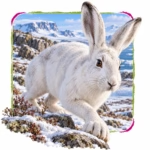
Snowshoe Hare Fact Highlight
From the full animal facts page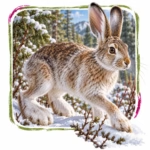
More Animal Comparisons
Pick another animal matchup and keep exploring. Compare appearances, habitats, diets, abilities, and surprising differences.




Make an Animal Story
Create a snowy adventure about a tough tundra hare and a forest hare with giant feet!