
Axolotl vs Newt: Salamander Branch Comparison
Axolotls and newts are both salamanders, but they follow different life-cycle patterns. An axolotl normally remains in water for life and keeps feathery external gills as an adult. Many newts hatch as aquatic larvae, transform into air-breathing juveniles or adults, and may alternate between land and breeding ponds, although newt lifestyles vary greatly by species.
About Axolotl
- Type Amphibian
- Diet Carnivore
- Group Mole Salamander
- Known for Feathery external gills, lifelong aquatic living, neoteny, regeneration, and Mexican freshwater habitat
- Special skill Retaining external gills and other larval traits while becoming a reproductive adult
About Newt
- Type Amphibian
- Diet Carnivore
- Group Salamander
- Known for Complex water-and-land life cycles, tail swimming, skin toxins in many species, regeneration, and seasonal migrations
- Special skill Switching between aquatic and terrestrial stages and using defensive skin chemicals in many species
Axolotl vs Newt: Quick Answer
Axolotls are fully aquatic Mexican salamanders that normally keep larval gills and a tail fin as adults. Newts are another salamander branch; most lose external gills during metamorphosis and use lungs and skin for breathing, while many move between terrestrial and aquatic stages. Both can regenerate tissues, but their skin, range, and life cycles differ.
Where Do They Fit?
Follow the branches to see how Axolotl and Newt are classified and related.
Axolotl vs Newt: Quick Comparison
| Feature | Axolotl | Newt |
|---|---|---|
| Animal type | Amphibian | Amphibian |
| Animal group | Mole salamander | Salamander commonly placed in family Salamandridae |
| Known for | Neoteny, external gills, aquatic life, and regeneration | Water-and-land stages, tail swimming, toxins, and regeneration |
| Main habitat | Cool freshwater canals and wetlands near Mexico City | Ponds, lakes, wetlands, streams, moist forests, and nearby land |
| Adult lifestyle | Fully aquatic | Aquatic, terrestrial, or seasonally both depending on species and stage |
| Adult breathing | External gills, skin, and lungs | Usually lungs and skin after external gills are lost |
| Skin | Soft, delicate, and continuously aquatic | Often firmer or more granular, with defensive toxins in many species |
| Natural range | Tiny native range in Mexico | Parts of North America, Europe, Asia, and northern Africa |
| Baby name | Larva or juvenile | Larva; terrestrial juvenile may be called an eft |
| Special skill | Retaining larval anatomy and regenerating complex tissues | Changing habitats across life stages and chemical defense |
How Are Axolotls and Newts Alike?
- Both axolotls and newts are tailed amphibians in the salamander order Caudata.
- Both have moist permeable skin and require clean, suitable moisture or water.
- Both are carnivores that eat worms, insects, crustaceans, mollusks, and other small prey.
- Both lay shell-less eggs in aquatic or very damp environments.
- Both can regenerate tails, limbs, or other tissues, although abilities vary.
How Are Axolotls and Newts Different?
- Axolotls normally remain fully aquatic, while many newts alternate between water and land.
- Adult axolotls keep feathery external gills, while most adult newts breathe using lungs and skin.
- Axolotls retain a larval body through neoteny, while newts usually undergo more obvious metamorphosis.
- Axolotls are native to a tiny area in Mexico, while newts collectively range across several continents.
- Many newts have conspicuous skin toxins and warning colors, while axolotls rely more on concealment and aquatic escape.
Axolotl vs Newt Showdown
Salamander showdown: Size and strength are ties because axolotls and the largest newts overlap broadly and both have delicate amphibian bodies. The newt wins speed and stealth across varied terrain because many species can walk on land, swim, and use seasonal camouflage. Social life is a tie because both are mainly solitary outside breeding. The axolotl takes swimming for its lifelong aquatic body and tail fin. It wins our weirdest-fact prize because a breeding adult can still look like the gilled larva of another salamander.
Fun Axolotl vs Newt Facts
Both Are Salamanders
Axolotls are mole salamanders, while animals commonly called true newts are salamanders mainly within the family Salamandridae. Neither animal is a fish or reptile, despite old names such as Mexican walking fish and water lizard.
Permanent Gills vs Changing Breathing Gear
Axolotls keep feathery external gills throughout normal adult life, while also using skin and lungs. Most newts begin with external gills but lose them during metamorphosis, then rely on lungs, skin, and the mouth lining.
One Aquatic Life vs Several Stages
An axolotl normally stays in water continuously. Many newts hatch as aquatic larvae, enter a land-dwelling juvenile stage called an eft, and later return to ponds as breeding adults, though some species skip or shorten stages.
Soft Camouflage vs Chemical Warning
Wild axolotls use dark mottling to blend with muddy water. Many newts produce unpleasant or toxic skin chemicals, and some display bright orange, red, or yellow undersides as warnings when threatened.
Both Can Repair Body Parts
Axolotls are famous laboratory models for regenerating limbs and complex tissues. Newts can also replace limbs, tails, eye lenses, and certain heart tissues in some species, making both groups important to regeneration research.
Axolotl vs Newt Quiz
- Are axolotls and newts both salamanders? Answer: Yes.
- Which animal keeps feathery external gills as an adult? Answer: Axolotl.
- What is a land-dwelling juvenile newt sometimes called? Answer: An eft.
- Which animal normally remains aquatic for life? Answer: Axolotl.
- What defense do many newts carry in their skin? Answer: Toxic or bad-tasting chemicals.
Axolotl vs Newt FAQ
What is the main difference between an axolotl and a newt?
An axolotl normally remains aquatic and keeps external gills throughout adulthood. Most newts lose external gills during metamorphosis and may move between aquatic and terrestrial stages.
Is an axolotl a newt?
No. Both are salamanders, but axolotls are mole salamanders in family Ambystomatidae, while true newts are mainly members of family Salamandridae.
Can newts regrow limbs like axolotls?
Yes, many newts regenerate limbs and other tissues. The exact speed, body parts, and accuracy vary by species, age, and conditions.
Do axolotls and newts have poisonous skin?
Many newts have strong defensive skin toxins. Axolotls have delicate mucus-covered amphibian skin but are not known for the same powerful newt-style chemical defense.
Can an axolotl live on land with a newt?
No. Axolotls normally require a fully aquatic environment and should not be removed from water. Newt habitat needs also vary by species and life stage.
Animal Words to Know
- Newt: A common name for certain salamanders, especially members of the family Salamandridae.
- Eft: The land-dwelling juvenile stage found in the life cycle of some newts.
- Neoteny: Reproductive maturity reached while juvenile body features remain.
- External gill: A feathery breathing organ projecting outside the head.
- Metamorphosis: A major developmental transformation from larval form to adult form.
Axolotl and Newt Life-Cycle Activity
Axolotl and Newt Life-Cycle Activity
Draw an adult axolotl underwater beside an eastern newt life cycle. Keep feathery external gills on the axolotl. Show the newt as an aquatic larva, an orange land-dwelling eft, and an adult returning to water. Add a note that the eft stage belongs to certain newts and is not universal. Label axolotl, newt, salamander, gills, eft, and adult.
Meet Each Animal
Want the full fact file? Here are quick highlights from each animal’s own facts page.
Axolotl Fact Highlight
From the full animal facts page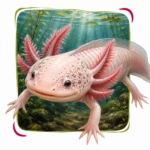
Newt Fact Highlight
From the full animal facts page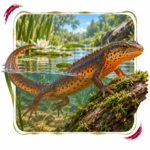
More Animal Comparisons
Pick another animal matchup and keep exploring. Compare appearances, habitats, diets, abilities, and surprising differences.





Make an Animal Story
Turn this axolotl vs newt comparison into a pond-and-lake salamander adventure with our free Animal Story Generator.
Source notes: References used for this comparison. See more See less
Try Another Matchup
Explore this comparison →