
Baboon vs Monkey: Primate Comparison
Baboons and monkeys are not two completely separate animal groups because a baboon is itself a monkey. Baboons are large Old World monkeys with dog-like muzzles, powerful limbs, and a ground-focused lifestyle. The word monkey also includes many smaller tree-dwelling species with different tails, faces, diets, and climbing styles.
About Baboon
- Type Mammal
- Diet Omnivore
- Group Old World Monkey
- Known for Dog-like muzzle, powerful body, large troops, ground travel, and loud calls
- Special skill Traveling confidently on the ground while using teamwork, sharp canine teeth, and many social signals
About Monkey
- Type Mammal
- Diet Omnivore or herbivore depending on species
- Group Primate
- Known for Grasping hands, climbing, intelligence, social behavior, and varied tails
- Special skill Climbing, leaping, grasping, and adapting to many forest or open-country habitats
Baboon vs Monkey: Quick Answer
A baboon is a type of monkey. Compared with the smaller tree-dwelling monkeys people often imagine, baboons are larger, heavier, more ground-focused, and have long dog-like muzzles. Monkeys are a broad primate group containing many species, including baboons.
Where Do They Fit?
Follow the branches to see how Baboon and Monkey are classified and related.
Baboon vs Monkey: Quick Comparison
| Feature | Baboon | Monkey |
|---|---|---|
| Animal type | Mammal | Mammal |
| Animal group | Old World monkey | Broad primate group |
| Known for | Dog-like muzzle, ground travel, troops, and strength | Climbing, grasping hands, intelligence, and varied tails |
| Main habitat | Savannas, grasslands, woodlands, rocks, and semi-deserts | Rainforests, woodlands, mountains, grasslands, and mangroves |
| Where found | Africa and the Arabian Peninsula | Africa, Asia, Central America, and South America |
| Diet | Omnivore | Omnivore or herbivore depending on species |
| Baby name | Infant | Infant |
| Usual movement | Walks and runs mostly on the ground | Often climbs and leaps, though some live mainly on the ground |
| Face | Long, dog-like muzzle | Highly varied among species |
| Special skill | Ground travel and troop teamwork | Grasping, climbing, and habitat flexibility |
How Are Baboons and Monkeys Alike?
- Both baboons and other monkeys are mammals and primates.
- Both have grasping hands, forward-facing eyes, flexible limbs, and large brains.
- Both communicate with calls, facial expressions, scents, touch, and body postures.
- Both are usually social and care for babies called infants.
- Both can learn, solve problems, remember individuals, and use objects in clever ways.
How Are Baboons and Monkeys Different?
- A baboon is one particular kind of Old World monkey, while monkey is a broad name covering many species.
- Baboons are usually larger and heavier than the small tree monkeys children often picture.
- Baboons spend much of their time on the ground, while many monkeys spend more time in trees.
- Baboons have long dog-like muzzles, while monkey faces vary greatly among species.
- Baboons have non-prehensile tails, while some New World monkeys can grip branches with prehensile tails.
Baboon vs Monkey Showdown
Primate showdown: The baboon wins for typical size and strength when compared with familiar smaller monkeys. Speed, social life, and swimming are ties because monkey species vary enormously. Tree-dwelling monkeys take stealth through the canopy. The baboon wins our weirdest-fact prize for built-in sitting pads called ischial callosities.
Fun Baboon vs Monkey Facts
A Baboon Is a Monkey
Baboons belong to the Old World monkey family Cercopithecidae. They share this family with macaques, mandrills, mangabeys, colobus monkeys, and many other African and Asian primates.
Ground Traveler vs Tree Climber
Baboons spend much of the day walking on all fours across open ground while searching for food. Many other monkeys are more arboreal and use grasping hands, feet, and sometimes tails to travel through branches.
Dog-Like Muzzle vs Many Face Shapes
A baboon has a long projecting muzzle containing large canine teeth. Monkey faces range from the flat dark face of a capuchin to the colorful muzzle of a mandrill and the tiny features of a marmoset.
Both Have Complex Social Lives
Baboon troops contain friendships, family bonds, rank relationships, grooming partnerships, and warning systems. Other monkeys also form complex groups, though their troop sizes and social rules vary by species.
Baboons Have Built-In Sitting Pads
Baboons and many other Old World monkeys have tough hairless areas on the rump called ischial callosities. These pads allow them to sit comfortably on branches, rocks, or hard ground for long periods.
Baboon vs Monkey Quiz
- Is a baboon a type of monkey? Answer: Yes.
- Which animal is usually more ground-focused? Answer: Baboon.
- What are baby baboons and monkeys called? Answer: Infants.
- What is a social group of baboons called? Answer: A troop.
- What are the tough sitting pads on a baboon called? Answer: Ischial callosities.
Baboon vs Monkey FAQ
What is the main difference between a baboon and a monkey?
A baboon is one specific type of Old World monkey. The word monkey describes a much broader group containing many species of different sizes, habitats, colors, and lifestyles.
Is a baboon really a monkey?
Yes. Baboons belong to the Old World monkey family and are close relatives of macaques, mandrills, and other monkeys.
Which is bigger, a baboon or a monkey?
Baboons are larger than many familiar monkeys, but monkey is a broad term. Mandrills can be heavier than some baboons, while marmosets are far smaller.
Can baboons climb trees?
Yes. Baboons climb trees and rocky cliffs for food, safety, play, or sleep, but they spend more time on the ground than many monkey species.
Do baboons have prehensile tails?
No. Baboon tails help with balance and signaling but cannot grip branches like the prehensile tails of some Central and South American monkeys.
Animal Words to Know
- Primate: A mammal group containing monkeys, apes, lemurs, lorises, tarsiers, and humans.
- Old World monkey: A monkey native to Africa or Asia with downward-facing nostrils and a non-prehensile tail.
- Troop: A social group of baboons or other monkeys.
- Ischial callosity: A tough sitting pad on the rump of some primates.
- Arboreal: Adapted for living or moving in trees.
Baboon and Tree Monkey Family Activity
Baboon and Tree Monkey Family Activity
Begin with the fact that a baboon is a kind of monkey. Draw a baboon beside a spider monkey as two different examples. Give the baboon a long muzzle, sturdy limbs, and rocky savanna habitat; give the spider monkey long arms, a gripping tail, and rainforest branches. Label monkey, muzzle, tail, habitat, and movement.
Meet Each Animal
Want the full fact file? Here are quick highlights from each animal’s own facts page.
Baboon Fact Highlight
From the full animal facts page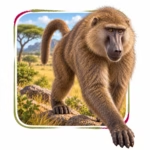
Monkey Fact Highlight
From the full animal facts page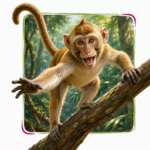
More Animal Comparisons
Pick another animal matchup and keep exploring. Compare appearances, habitats, diets, abilities, and surprising differences.


Make an Animal Story
Turn this baboon vs monkey comparison into a lively primate adventure with our free Animal Story Generator.
Source notes: References used for this comparison. See more See less
Try Another Matchup
Explore this comparison →