
Badger vs Red Fox for Kids: European Mammal Comparison
The European Badger and Red Fox often share woods, fields, and even towns, and both explore mainly after dark. A badger is the heavier digging specialist, built for strength and clan life around a large sett. A fox is lighter and faster, with long legs, large ears, and a flexible hunting style.
About European Badger
- Type Mammal
- Diet Omnivore with a strong preference for earthworms
- Group Weasel family, Mustelidae
- Known for Black-and-white face stripes and enormous underground setts
- Special skill Digs powerful tunnel systems with broad paws and long front claws
About Red Fox
- Type Mammal
- Diet Omnivore and predator
- Group Dog family, Canidae
- Known for A bushy white-tipped tail, sharp senses, and adaptable hunting
- Special skill Locates small prey by sound and springs high in a precise pounce
Quick Answer
Quick answer: A European Badger is a sturdy mustelid with a striped face, strong digging claws, and a large underground home called a sett. A Red Fox is a slimmer canid with pointed ears, long legs, and a bushy white-tipped tail. The badger is bigger and stronger, while the fox is faster and stealthier.
European Badger vs Red Fox: Quick Comparison
| Feature | European Badger | Red Fox |
|---|---|---|
| Scientific name | Meles meles | Vulpes vulpes |
| Animal family | Mustelidae, the weasel family | Canidae, the dog family |
| Typical UK size | About 75 to 100 cm long plus a 15 cm tail; roughly 8 to 12 kg | About 62 to 72 cm long plus a 40 cm tail; roughly 5 to 7 kg |
| Best identification clue | Stocky grey body and bold black-and-white striped face | Red coat, pointed black-backed ears, dark feet, and bushy white-tipped tail |
| Main food | Especially earthworms, plus insects, slugs, fruit, roots, carrion, and small animals | Rodents, rabbits, birds, insects, fruit, worms, and carrion |
| Home | A sett with tunnels, chambers, bedding, and several entrances | A den or earth, especially for raising pups |
| Movement | Strong digger with a low, sturdy walk or run | Agile runner and jumper that can reach about 48 km/h |
| Social life | Clans may share a sett, scent range borders, and use communal latrines | Usually hunts alone but may form a pair or small family group |
| Young | Usually two or three cubs in a litter, born underground | Often about five pups, born blind in a den |
| Key senses | Powerful smell and hearing; scent marks organize clan life | Keen hearing, smell, and vision locate prey and communicate |
How Badgers and Red Foxes Are Alike
- Both are furry mammals that occur across much of Europe and parts of Asia.
- Both are adaptable omnivores that eat animal prey, invertebrates, fruit, and carrion.
- Both are mainly active from dusk through the night and rest in sheltered places by day.
- Both use scent marks and several sounds to communicate.
- Both may dig underground homes and raise helpless young inside them.
How Badgers and Red Foxes Are Different
- A European Badger is usually stockier and heavier than a British Red Fox.
- Badgers belong to the weasel family, while foxes belong to the dog family.
- A badger has short legs and powerful digging claws, while a fox has longer legs built for agile running and pouncing.
- Badger clans may maintain huge shared setts for generations, while foxes usually use smaller dens, especially when raising pups.
- Earthworms are central to a badger’s diet, while a fox more often hunts rodents, rabbits, and birds.
Badger vs Red Fox Adaptation Showdown
Adaptation showdown: European Badger wins size because its sturdy body commonly outweighs a UK Red Fox. Red Fox wins speed because it can run about 48 km/h and leap with agility. European Badger wins strength because broad paws, long claws, and a muscular body excavate large tunnel networks. Red Fox wins stealth because quiet steps, sensitive ears, and a precise pounce suit hidden prey. European Badger wins social behavior because clans share, maintain, and scent-mark a sett and territory. Swimming is a Tie because both can cross water but neither is an aquatic specialist. European Badger wins weirdest for a multi-generation sett that may stretch for scores of metres with dozens of entrances.
Fun European Badger vs Red Fox Facts
An Underground Inheritance
A main badger sett can contain many tunnels and entrances and may be used by generations of the same clan. Some known setts are more than a century old.
A Living Earthmover
A badger’s broad front paws and long claws shift soil while its low, sturdy body powers through tunnels. Bedding such as dry grass may be carried underground.
A Tail Called a Brush
A Red Fox’s long, bushy tail is called a brush. It helps with balance, warmth, signaling, and making the fox’s outline easy to recognize.
The Listening Pounce
A Red Fox can pause, listen for a small animal hidden under plants or snow, then spring high and land front feet first. Its large ears help aim the pounce.
Winter Strategies
European Badgers add body fat in autumn and may spend longer resting underground during cold weather. They can enter short periods of torpor but do not truly hibernate.
Badger vs Red Fox Quiz
- Which animal belongs to the weasel family? Answer: The European Badger.
- What is a badger’s underground home called? Answer: A sett.
- Which animal is the faster runner? Answer: The Red Fox.
- What food is especially important to European Badgers? Answer: Earthworms.
- What is the Red Fox’s bushy tail sometimes called? Answer: A brush.
European Badger vs Red Fox FAQ
Is a badger bigger than a Red Fox?
A European Badger is usually heavier and stockier than a typical Red Fox in Britain.
Can a fox use a badger sett?
Yes. Foxes and other animals sometimes use parts of a large sett, and they may even share the wider system with badgers.
Do European Badgers hibernate?
No. They may become less active and enter short torpor during cold spells, but they do not truly hibernate.
Are badgers and foxes dangerous to children?
Wild badgers and foxes normally avoid people. Watch quietly from a distance and never feed, corner, or touch them.
Which animal adapts better to cities?
Both can live near people, but Red Foxes are especially famous for using parks, gardens, railways, and city streets.
Animal Words to Know
- Sett: An underground badger home made of tunnels, chambers, and entrances.
- Canid: A member of the dog family, including foxes, wolves, and domestic dogs.
- Mustelid: A member of the weasel family, including badgers, otters, and stoats.
- Torpor: A short period when an animal lowers activity and body processes to save energy.
- Territory: An area an animal or group uses and may mark or defend.
Map a Sett and a Fox Trail
Map a Sett and a Fox Trail
Draw exactly one adult European Badger and exactly one adult Red Fox at honest relative scale in a shared woodland-edge map. Add a cutaway badger sett with several entrances, one smaller fox den, a badger route to earthworms, and a fox route to a listening spot. Label tracks and field clues, but never approach a wild den or sett.
Meet Each Animal
Want the full fact file? Here are quick highlights from each animal’s own facts page.
European Badger Fact Highlight
From the full animal facts page
Red Fox Fact Highlight
From the full animal facts page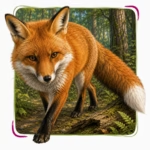
More Animal Comparisons
Pick another animal matchup and keep exploring. Compare appearances, habitats, diets, abilities, and surprising differences.






Make an Animal Story
Send a strong Badger and a clever Red Fox through a moonlit woodland mystery with our free Animal Story Generator.