
Bald Eagle vs Red-Tailed Hawk for Kids
Bald Eagles and Red-Tailed Hawks are both North American raptors in family Accipitridae, but they are built for different hunting worlds. The Bald Eagle is a much larger waterside bird with long broad wings, a heavy bill, and an adult white head and tail. The Red-Tailed Hawk is smaller, broad-winged, and especially at home over fields, roadsides, and woodland edges. It watches for mammals from a perch or circles on rising warm air. Their sizes, markings, foods, nests, social gatherings, and flight styles make a clear comparison without imagining a fight.
About Bald Eagle
- Type Bird
- Diet Carnivore and scavenger
- Group Sea eagle; family Accipitridae
- Known for Huge broad wings, a white adult head and tail, fish eating, and waterside nests
- Special skill Floating and using its wings to row across deep water
About Red-Tailed Hawk
- Type Bird
- Diet Carnivore
- Group Buteo hawk; family Accipitridae
- Known for Broad rounded wings, an adult rusty-red tail, thermal soaring, and perch hunting
- Special skill Thermal soaring followed by a slow controlled dive toward ground prey
Quick Answer
Quick answer: The Bald Eagle is much larger and more closely tied to large bodies of water, where fish and carrion are important foods. The Red-Tailed Hawk is a smaller open-country hunter with broad rounded wings and an adult rusty-red tail. Both are sharp-taloned Accipitridae raptors, but the eagle can gather in large winter groups and even row across water with its wings, while the hawk is famous for thermal soaring and its raspy movie-star call.
Bald Eagle vs Red-Tailed Hawk: Quick Comparison
| Feature | Bald Eagle | Red-Tailed Hawk |
|---|---|---|
| Scientific identity | Haliaeetus leucocephalus | Buteo jamaicensis |
| Raptor group | Sea eagle in family Accipitridae | Buteo hawk in family Accipitridae |
| Published adult length | About 71-96 cm | About 45-65 cm |
| Published adult mass | About 3,000-6,300 g | About 690-1,460 g |
| Published wingspan | About 204 cm in the cited guide | About 114-133 cm |
| Adult appearance | Dark brown body with white head and tail; yellow bill | Usually brown above and pale below with an adult cinnamon-red tail |
| Main habitat | Large waters with nearby trees, coasts, marshes, and reservoirs | Open country, fields, deserts, roadsides, parks, and broken woodland |
| Main foods | Mostly fish, plus birds, mammals, other animals, and carrion | Mostly mammals, plus birds, snakes, and carrion |
| Nest | An enormous reusable stick nest, usually in a tall tree near water | A reusable stick nest in a tall tree, or sometimes on a cliff or structure |
| Special movement | Can float and wing-row across water | Soars on thermals and makes a slow controlled hunting dive |
How Are Bald Eagles and Red-Tailed Hawks Alike?
- Both are birds of prey in family Accipitridae, the family that includes many eagles, hawks, and kites.
- Both have hooked bills, strong feet, curved talons, excellent distance vision, and broad wings for soaring.
- Both eat animal foods and may also take carrion when it is available.
- Both form breeding pairs, defend nesting areas, build large stick nests, and raise helpless chicks.
- Both can use rising air to save energy while searching wide areas for food.
How Are Bald Eagles and Red-Tailed Hawks Different?
- A Bald Eagle is far larger and heavier, with a wingspan around 204 centimetres in the cited guide, while Red-Tailed Hawks span about 114-133 centimetres.
- An adult Bald Eagle has a white head and tail, while an adult Red-Tailed Hawk usually has a cinnamon-red tail and a brown-and-pale body.
- Bald Eagles are strongly associated with large waters and fish, while Red-Tailed Hawks often watch fields and roadsides for mammals.
- Bald Eagles may gather by scores or hundreds in winter, while Red-Tailed Hawks are more often seen alone or as a territorial pair.
- A Bald Eagle can use its wings to row while floating, while a Red-Tailed Hawk is known for thermal circles, controlled dives, and a raspy call often used in films.
Bald Eagle vs Red-Tailed Hawk Showdown
Adaptation showdown: Bald Eagle wins size because its cited length, mass, and wingspan greatly exceed those of the Red-Tailed Hawk. Speed is a Tie because the two birds use different flight modes and no same-condition race supports a fair overall winner. Bald Eagle wins whole-body strength because its much greater mass powers a larger bill, feet, wings, and body; this is not a fight prediction. Stealth is a Tie because both use watchful approaches rather than a matched concealment test. Bald Eagle wins social behavior because it forms winter roosts and feeding gatherings of scores or hundreds, beyond the hawk’s usual solitary or paired life. Bald Eagle wins swimming because wing-rowing while afloat is directly documented. Red-Tailed Hawk wins weirdest for lending its raspy scream to many movie hawks and eagles.
Fun Bald Eagle vs Red-Tailed Hawk Facts
Bald Does Not Mean Featherless
A Bald Eagle is not bald. The old word bald could mean white-headed. Young Bald Eagles are mostly brown and mottled, and they take about five years to gain the clean white head and tail of an adult. That means a large brown eagle near water can still be a Bald Eagle.
A Red Tail Takes Time Too
Young Red-Tailed Hawks do not yet show the classic adult cinnamon-red tail. Their tails are usually brown and banded. Adults also vary from pale to very dark across the continent, so bird watchers use wing shape, belly markings, tail pattern, age, and location together.
An Eagle Nest Can Become Enormous
Bald Eagle pairs may reuse and add sticks to the same nest year after year. Typical nests can be about 1.5-1.8 metres wide, and record nests have grown far larger. The nest needs a strong tree or other secure support close to useful feeding habitat.
Eagles Can Row Without Oars
A Bald Eagle that lands in water can float and beat its wings in a rowing motion toward shore. This does not make it a duck or a specialised swimming bird. It is an emergency movement that helps the eagle cross water too deep for wading.
Hollywood Borrowed the Hawk’s Voice
The Red-Tailed Hawk gives a long, raspy scream that sounds dramatic. Movie makers often play that call when almost any hawk or eagle appears on screen. A real Bald Eagle has a higher, weaker-sounding whinny, so the soundtrack can be a clue from the wrong species.
Bald Eagle vs Red-Tailed Hawk Quiz
- Which bird is much larger in published length, mass, and wingspan? Answer: The Bald Eagle.
- Which adult usually has a cinnamon-red tail? Answer: The Red-Tailed Hawk.
- Which bird is especially linked with lakes, rivers, coasts, and fish? Answer: The Bald Eagle.
- How can a floating Bald Eagle move across deep water? Answer: It can row with its wings.
- Whose call is often used for movie eagles? Answer: The Red-Tailed Hawk’s raspy scream.
Bald Eagle vs Red-Tailed Hawk FAQ
Is a Bald Eagle a kind of hawk?
Bald Eagles and Red-Tailed Hawks are different species in the same raptor family, Accipitridae. The eagle belongs to genus Haliaeetus, while the hawk belongs to genus Buteo.
Which is bigger, a Bald Eagle or Red-Tailed Hawk?
Bald Eagle wins. The cited Bald Eagle range is about 71-96 centimetres long and 3,000-6,300 grams, compared with about 45-65 centimetres and 690-1,460 grams for the hawk.
Do Bald Eagles and Red-Tailed Hawks eat the same food?
Their menus overlap, but not completely. Bald Eagles focus heavily on fish and also scavenge. Red-Tailed Hawks eat many mammals and also take birds, snakes, and carrion.
Why is speed a tie?
A Peregrine-style measured race is not available for this pair, and soaring, level travel, and hunting dives are different kinds of movement. A single number would not make a fair overall comparison.
Can Bald Eagles really swim?
They can float and use their wings to row across water. This is useful, but they are not specialised swimmers like waterfowl.
Animal Words to Know
- Raptor: A bird that hunts or scavenges and usually has a hooked bill, strong feet, and curved talons.
- Accipitrid: A member of family Accipitridae, which includes many eagles, hawks, and kites.
- Wingspan: The distance from one wingtip to the other when the wings are spread.
- Thermal: A column of rising warm air that a soaring bird can ride upward.
- Carrion: The body of an animal that has died and can be eaten by scavengers.
Build a Waterside-or-Field Raptor Board
Build a Waterside-or-Field Raptor Board
Draw an adult Bald Eagle and adult Red-Tailed Hawk at honest relative scale. Give the eagle a 204-centimetre wingspan line and the hawk a 114-133-centimetre line. Add a lake and tall nest tree for the eagle, then a field, roadside perch, and thermal arrows for the hawk. Sort cards for size, adult colours, food, nest, social gathering, wing-rowing, controlled diving, and call. Finish by writing why speed and stealth remain ties instead of staging a race.
Meet Each Animal
Want the full fact file? Here are quick highlights from each animal’s own facts page.
Bald Eagle Fact Highlight
From the full animal facts page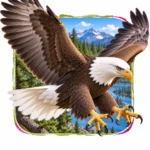
Red-Tailed Hawk Fact Highlight
From the full animal facts page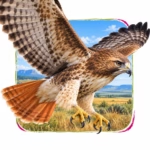
More Animal Comparisons
Pick another animal matchup and keep exploring. Compare appearances, habitats, diets, abilities, and surprising differences.


Make an Animal Story
Send a giant waterside eagle and a sharp-eyed field hawk into a sky-high adventure with our free Animal Story Generator.