
Bengal Tiger vs Snow Leopard for Kids: Stripes or Snow Ghost?
Bengal Tigers and Snow Leopards are Asian cats in the genus Panthera, yet they occupy very different worlds. The Bengal Tiger is several times heavier and lives in forests, grasslands, river country, and mangroves. The Snow Leopard lives on cold, dry mountain slopes where gray rosettes match stone and snow. Both are solitary ambush hunters whose survival depends on healthy habitats and wild prey.
About Bengal Tiger
- Type Very large Asian big cat
- Diet Carnivore
- Group Cat family, Felidae
- Known for Orange fur with unique black stripes, immense strength, a roar, and confident swimming
- Special skill Stalks through dense cover, overpowers large hoofed prey, and swims strongly across rivers and wetlands
About Snow Leopard
- Type Mountain-adapted Asian big cat
- Diet Carnivore
- Group Cat family, Felidae
- Known for Smoky rosettes, enormous furry paws, powerful leaps, and a very long thick tail
- Special skill Crosses steep snow and broken rock using wide paws, long hind legs, and a balancing tail
Quick Answer
Quick answer: A Bengal Tiger is a massive orange-and-black cat that commonly hunts deer, wild pigs, and other large prey in lowland forests and grasslands. It can roar and is an excellent swimmer. A Snow Leopard is much smaller, pale gray, and covered in dark rosettes. Wide furry paws, short ears, long hind legs, a large nasal cavity, and an extra-long tail help it climb, leap, balance, and conserve warmth high in Asian mountains. It can yowl and chuff but not roar.
Bengal Tiger vs Snow Leopard: Quick Comparison
| Feature | Bengal Tiger | Snow Leopard |
|---|---|---|
| Scientific name | Panthera tigris tigris | Panthera uncia |
| Adult mass | Females often about 100 to 160 kg; males about 180 to 260 kg | Usually about 27 to 55 kg |
| Coat pattern | Orange to ochre coat with black vertical stripes and white underside | Pale smoky-gray coat with dark spots and open rosettes |
| Main habitat | Forest, tall grassland, riverine woodland, and mangrove swamp | Cold dry cliffs, rocky ridges, alpine meadows, and mountain valleys |
| Modern range | Mainly India, Bangladesh, Nepal, and Bhutan | High mountains across twelve countries of Central and South Asia |
| Main prey | Deer, wild pigs, wild cattle, and other medium to large animals | Blue sheep, ibex, argali, marmots, pikas, hares, and other mountain animals |
| Hunting style | Stalks through cover and attacks from close range with power | Uses ridges and rocks for cover, then leaps onto prey on steep ground |
| Special movement | Powerful swimmer that crosses rivers and patrols wetlands | Sure-footed climber and leaper with long hind legs and broad paws |
| Voice | Can roar, growl, chuff, moan, and communicate with scent marks | Yowls, growls, hisses, chuffs, and purrs but cannot roar |
| Conservation | Tiger species is Endangered, with habitat loss, poaching, and prey decline continuing | Vulnerable, threatened by poaching, prey loss, habitat change, and conflict with livestock owners |
How Bengal Tigers and Snow Leopards Are Alike
- Both are Asian big cats in the genus Panthera.
- Both are solitary ambush hunters that rely on camouflage and close-range attacks.
- Both use scent marks, scrapes, calls, and claw marks to communicate across large territories.
- In both species, the mother raises her cubs without help from the male.
- Both need large connected habitats, healthy wild prey, and protection from poaching and conflict.
How Bengal Tigers and Snow Leopards Are Different
- A Bengal Tiger is several times heavier and far more powerfully built than a Snow Leopard.
- The tiger has an orange striped coat, while the Snow Leopard has a thick gray coat with spots and rosettes.
- Bengal Tigers live mainly in lowland forest, grassland, and wetlands, while Snow Leopards occupy cold high mountains.
- The tiger is an excellent swimmer, while the Snow Leopard is more specialized for climbing cliffs, crossing snow, and leaping.
- A tiger can roar, while a Snow Leopard communicates with yowls, growls, chuffs, and purrs instead.
Bengal Tiger vs Snow Leopard Adaptation Showdown
Adaptation showdown: Bengal Tiger wins size because a large male may weigh roughly four or five times as much as an adult Snow Leopard. Speed is a Tie because terrain, distance, and motivation change sprint results and no reliable matched race exists. Bengal Tiger wins strength because its heavier muscular body can overpower very large hoofed prey. Stealth is a Tie because stripes break up the tiger in grass and forest while gray rosettes erase the Snow Leopard among mountain rocks. Social behavior is a Tie because both are mainly solitary and mothers raise cubs alone. Bengal Tiger wins swimming because tigers readily cross rivers, patrol wetlands, and cool themselves in water. Snow Leopard wins weirdest for using paws like furry snowshoes and wrapping an almost body-length tail around its face as a balancing pole and winter scarf.
Fun Bengal Tiger vs Snow Leopard Facts
Every Tiger Wears a Different Barcode
A Bengal Tiger’s stripe pattern is unique, and the skin beneath the fur is striped too. Researchers can identify individuals from clear camera-trap photographs.
A Big Cat That Likes Water
Bengal Tigers often enter rivers, pools, and mangrove channels. They can cross broad stretches of water while moving through a territory.
A Quiet Hunter With a Huge Voice
A tiger stalks silently, but its roar can advertise presence across a great distance. Chuffs, growls, moans, scent, and scrapes carry other messages.
Built-In Snowshoes
A Snow Leopard’s wide paws spread its weight over snow. Thick fur beneath the feet adds warmth, cushioning, and grip on rock and ice.
A Tail That Does Three Jobs
The Snow Leopard’s thick tail may approach the length of its body. It balances the cat during leaps, stores fat, and wraps around the face and body at rest.
Bengal Tiger vs Snow Leopard Quiz
- Which cat is much larger? Answer: The Bengal Tiger.
- Which cat has a pale coat with rosettes? Answer: The Snow Leopard.
- Why are a Snow Leopard’s paws so wide? Answer: They spread its weight over snow and improve grip on steep ground.
- Which cat is especially comfortable swimming across rivers? Answer: The Bengal Tiger.
- Can a Snow Leopard roar like a tiger? Answer: No. It yowls, growls, hisses, chuffs, and purrs instead.
Bengal Tiger vs Snow Leopard FAQ
Do Bengal Tigers and Snow Leopards meet in the wild?
Their broad ranges approach one another in parts of Asia, but they usually occupy different elevations and habitats, so encounters are unusual.
Which cat would win a fight?
Wild cats avoid needless injury. A Bengal Tiger is far larger, but this comparison is about adaptations, not arranging a fight.
Are Snow Leopards actually leopards?
They are a separate species in the genus Panthera and are genetically closer to tigers than their common name suggests.
Do all Bengal Tigers live in hot jungles?
No. They also live in grasslands, riverine forests, dry forests, foothills, and mangrove wetlands.
How can people help both cats?
Support protected habitats and wildlife corridors, never buy wildlife products, protect natural prey, and back community programs that reduce conflict with predators.
Animal Words to Know
- Rosette: A flower-like ring of spots found on the coats of several wild cats.
- Territory: An area an animal uses and may mark or defend against others.
- Ambush predator: A hunter that approaches under cover or waits hidden before a sudden attack.
- Wildlife corridor: Connected habitat that lets animals move safely between larger areas.
- Retaliatory killing: Killing wildlife after real or feared loss of livestock or property.
Map Two Asian Big Cat Toolkits
Map Two Asian Big Cat Toolkits
Draw exactly one adult Bengal Tiger and exactly one adult Snow Leopard at honest relative scale, making the tiger dramatically larger. Place them in one educational cutaway landscape with lowland forest leading toward high rocky mountains, but keep the cats separated. Label the tiger’s vertical stripes, massive shoulders, broad jaw, strong swimming paws, and long tail. Label the Snow Leopard’s gray rosettes, short ears, broad furry paws, long hind legs, wide nose, and extra-long thick tail. Add prey and habitat icons without drawing a chase or fight.
Meet Each Animal
Want the full fact file? Here are quick highlights from each animal’s own facts page.
Bengal Tiger Fact Highlight
From the full animal facts page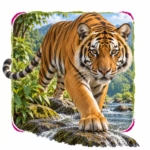
Snow Leopard Fact Highlight
From the full animal facts page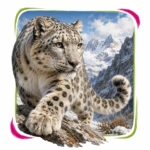
More Animal Comparisons
Pick another animal matchup and keep exploring. Compare appearances, habitats, diets, abilities, and surprising differences.





Make an Animal Story
Send a striped river swimmer and a mountain snow ghost across Asia with our free Animal Story Generator.