
Binturong vs Red Panda: Asian Tree Mammal Comparison
Binturongs and Red Pandas are tree-climbing Asian mammals in the order Carnivora, but neither is a bear. The Binturong belongs to the civet family and lives in warm tropical forests. The Red Panda is the only living member of its own family and lives in cool mountain forests with bamboo. Both have long furry tails, but only the Binturong can wrap its tail around a branch and grip it.
About Binturong
- Type Large shaggy tree-dwelling viverrid
- Diet Omnivore with a fruit-heavy diet
- Group Civet family, Viverridae
- Known for A muscular prehensile tail, popcorn-like scent, shaggy dark fur, and slow tree climbing
- Special skill Uses the last part of its thick tail like a gripping fifth limb while climbing
About Red Panda
- Type Small bamboo-eating mountain carnivoran
- Diet Bamboo specialist that also eats fruit, insects, eggs, and small animals
- Group Red panda family, Ailuridae
- Known for Rust-red fur, a ringed tail, a false thumb, bamboo eating, and agile climbing
- Special skill Grips bamboo and branches with a wrist-bone false thumb and can climb down trees headfirst
Binturong vs Red Panda: Quick Answer
A Binturong is much larger, dark and shaggy, with a tail almost as long as its body. The last part of that tail is prehensile, and scent from glands beneath it often smells like buttered popcorn. A Red Panda is smaller, rusty red, and marked with a pale face and ringed tail. Its tail balances the body and wraps around it for warmth but cannot grasp. A false thumb helps the Red Panda hold bamboo.
Where Do They Fit?
Follow the branches to see how Binturong and Red Panda are classified and related.
Binturong vs Red Panda: Quick Comparison
| Feature | Binturong | Red Panda |
|---|---|---|
| Scientific name | Arctictis binturong | Ailurus fulgens |
| Animal family | Viverridae, with civets and genets | Ailuridae, with no other living species |
| Adult size | About 11 to 36 kg; females are generally larger | About 3.6 to 7.7 kg |
| Coat | Long shaggy dark brown to black fur with pale-tipped hairs | Thick rusty-red upper fur, dark underside, white face markings, and ringed tail |
| Main habitat | Warm tropical and subtropical forests | Cool temperate mountain forests with a bamboo understory |
| Range | Scattered across South and Southeast Asia | Eastern Himalayas and mountains of southwestern China |
| Tail | Thick and prehensile, with a gripping bare patch near the tip | Long, furry, ringed, and useful for balance and warmth but not prehensile |
| Main food | Fruit, especially figs, plus leaves, eggs, insects, carrion, and small animals | Mostly bamboo leaves and shoots, plus fruit, insects, eggs, and small animals |
| Special grip | Tail acts as a fifth limb while climbing | False thumb helps grasp bamboo stems and branches |
| Conservation | Vulnerable because of forest loss, hunting, and wildlife trade | Endangered because of forest and bamboo loss, fragmentation, disease, and poaching |
How Binturongs and Red Pandas Are Alike
- Both are Asian mammals in the order Carnivora, even though fruit or bamboo forms much of the diet.
- Both spend a great deal of time climbing, resting, and feeding in trees.
- Both have thick fur and long tails that help with life above the ground.
- Both use scent marks to communicate while usually living alone.
- Both are threatened when forests are cut into small disconnected patches.
How Binturongs and Red Pandas Are Different
- A Binturong is several times heavier than a Red Panda and has dark shaggy fur instead of rust-red fur.
- The Binturong lives mainly in warm tropical forest, while the Red Panda lives in cool mountain forest with bamboo.
- A Binturong has a prehensile gripping tail, while a Red Panda uses its non-gripping tail for balance and warmth.
- Binturongs favor fruit and varied foods, while Red Pandas specialize in bamboo leaves and shoots.
- The Binturong is a viverrid related to civets, while the Red Panda is the only living member of Ailuridae.
Binturong vs Red Panda Adaptation Showdown
Adaptation showdown: Binturong wins size because a large adult can weigh several times as much as a Red Panda. Speed is a Tie because both are deliberate forest climbers rather than specialized sprinters. Binturong wins strength because its heavier body, strong limbs, claws, and muscular tail support demanding climbs. Stealth is a Tie because dark shaggy fur blends into tropical shade while rusty fur blends among red moss and pale lichen. Social behavior is a Tie because both are usually solitary and rely strongly on scent. Binturong wins swimming because it is a capable swimmer, although its main world is the canopy. Binturong wins weirdest for combining a popcorn-like scent with one of the only prehensile tails among carnivorans.
Fun Binturong vs Red Panda Facts
A Tail That Works Like a Hand
The last section of a Binturong’s thick tail can curl around a branch. A bare leathery patch near the tip improves its grip.
Why a Binturong Smells Like Popcorn
Scent glands beneath the tail produce an oily chemical mixture that people often compare with hot buttered popcorn.
A Rainforest Seed Planter
Binturongs swallow fruits such as figs and later deposit seeds in their droppings as they move through the forest.
A Panda With a False Thumb
An enlarged wrist bone acts like an extra thumb on a Red Panda’s front paw, helping it grip bamboo and branches.
A Tail That Becomes a Blanket
A Red Panda’s long ringed tail balances it in trees. In cold weather, the animal curls up and wraps the furry tail around its body and face.
Binturong vs Red Panda Quiz
- Which animal is much larger? Answer: The Binturong.
- Which animal has a prehensile tail? Answer: The Binturong.
- What food makes up most of a Red Panda’s diet? Answer: Bamboo leaves and shoots.
- What helps a Red Panda grip bamboo? Answer: An enlarged wrist bone called a false thumb.
- Why are Binturongs important seed dispersers? Answer: They eat fruit and deposit intact seeds elsewhere in the forest.
Binturong vs Red Panda FAQ
Is a Binturong a bear or a cat?
Neither. The nickname bearcat is misleading because Binturongs belong to the civet family, Viverridae.
Is a Red Panda a bear?
No. It is the only living member of the family Ailuridae.
Can a Red Panda hang by its tail?
No. Its tail helps with balance and warmth but cannot grip a branch.
Do Binturongs really smell like popcorn?
Many people describe their scent that way because their scent secretion contains a compound also associated with cooked popcorn.
Can either animal be kept as a pet?
No. Both are protected wild animals with complex habitat, diet, space, and welfare needs, and trade threatens them.
Animal Words to Know
- Prehensile: Able to curl around and firmly grasp an object.
- Viverrid: A member of the mammal family that includes Binturongs, civets, and genets.
- False thumb: An enlarged wrist bone that works like an extra digit for gripping.
- Seed disperser: An animal that moves seeds away from the parent plant.
- Arboreal: Adapted for spending much of life in trees.
Invent Two Tree-Climbing Tail Tests
Invent Two Tree-Climbing Tail Tests
Draw exactly one adult Binturong and exactly one adult Red Panda at honest relative scale, making the Binturong much larger. Put them on separate sturdy trees in a split tropical-and-mountain forest scene. Label the Binturong’s shaggy dark fur, whiskers, flat-footed stance, long gripping tail, and scent-marking route. Label the Red Panda’s rusty fur, white face mask, false thumb, ringed balancing tail, and bamboo. Show the Binturong tail wrapped safely around a branch and the Red Panda tail lying freely for balance, never gripping.
Meet Each Animal
Want the full fact file? Here are quick highlights from each animal’s own facts page.
Binturong Fact Highlight
From the full animal facts page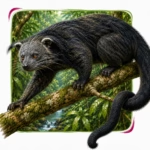
Red Panda Fact Highlight
From the full animal facts page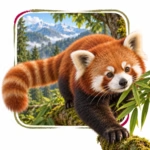
More Animal Comparisons
Pick another animal matchup and keep exploring. Compare appearances, habitats, diets, abilities, and surprising differences.
Make an Animal Story
Send a popcorn-scented bearcat and a bamboo acrobat through the treetops with our free Animal Story Generator.
Source notes: References used for this comparison. See more See less
Try Another Matchup
Explore this comparison →