
Black Bear vs Polar Bear: Forest Omnivore-to-Sea-Ice Carnivore Comparison
American black bears and polar bears are both North American members of genus Ursus, but they solve almost opposite food and habitat problems. The smaller, color-variable black bear is a forest-and-mountain omnivore, nimble tree climber, seasonal plant forager, and winter denner. The much larger polar bear is a white-looking Arctic marine predator with black skin, transparent pigment-free hair, huge swimming paws, thick fat, and a life tied to sea ice and seals.
About Black Bear
- Type Mammal
- Diet A flexible omnivore whose wild diet is mostly plant material: spring grasses and shoots, summer berries and fruit, and autumn nuts and acorns, plus ants, beetles, grubs, carrion, fish, eggs, and occasional vertebrate prey; feeding it human food is dangerous because food-conditioned bears may approach people
- Group American black bear (Ursus americanus), the only living bear species native only to North America; its common name describes the species, not a guaranteed coat color, because wild individuals may be black, chocolate brown, cinnamon, blond, blue-gray, or creamy white depending on population and genetics
- Known for A medium-to-large bear with adult body length roughly 1.2–2 meters and an exceptionally broad recorded mass range around 39–409 kilograms across both sexes; adult males are usually much heavier than females, food-rich coastal animals can grow large, and record endpoints should never be mistaken for the everyday bear
- Special skill Strong curved claws and mobile forelimbs for climbing and tearing logs, compact forest agility, plantigrade feet, an extraordinary sense of smell, color-variable camouflage, seasonal food memory, flexible omnivory, fat storage, delayed implantation, and winter torpor or hibernation help it survive habitats from humid forest to mountain and desert edge.
About Polar Bear
- Type Mammal
- Diet A highly carnivorous, fat-dependent diet centered on ringed seals and bearded seals hunted from sea ice, especially at breathing holes and ice edges; it may also take walrus, birds, eggs, fish, vegetation, or whale carrion, but land foods generally cannot replace reliable access to energy-rich seal blubber
- Group Polar bear (Ursus maritimus), whose scientific name means “sea bear”; it is a circumpolar Arctic bear, an ice-dependent marine mammal under United States law, and a different species from the American black bear despite both belonging to genus Ursus
- Known for The largest living bear by typical body mass, with most adult males around 300–635 kilograms and most adult females around 150–250 kilograms in a widely used zoo reference; body length is often about 1.8–2.7 meters, and pregnant females can temporarily become far heavier before denning
- Special skill Two insulating fur layers, pigment-free hair that appears white, black skin, a thick fat layer, small ears and tail, a long neck, large paddle-like forepaws, rudder-like hind feet, furred soles, gripping papillae, curved claws, strong smell, patient still-hunting, delayed implantation, and the ability to fast make a bear specialized for cold sea ice and water.
Black Bear vs Polar Bear: Quick Answer
A polar bear is usually much larger, more carnivorous, more insulated, and far better adapted to long-distance swimming and sea-ice hunting. An American black bear is smaller, may be black, brown, cinnamon, blond, or even creamy white, climbs trees far better, eats mostly plants, and uses forests, mountains, swamps, and other North American habitats. Polar bears live only in the Arctic—not Antarctica.
Where Do They Fit?
Follow the branches to see how Black Bear and Polar Bear are classified and related.
Black Bear vs Polar Bear: Quick Comparison
| Feature | American Black Bear | Polar Bear |
|---|---|---|
| Scientific name | Ursus americanus | Ursus maritimus |
| Main region | Alaska and Canada through much of the United States to northern Mexico | Circumpolar Arctic across Alaska, Canada, Greenland, Norway, and Russia |
| Habitat | Forest, mountain, swamp, meadow, shrubland, and some desert-edge habitat | Sea ice, ice edges, coastal tundra, islands, and Arctic shorelines |
| Broad adult mass | About 39–409 kg across recorded males and females; most are far below the upper record | Most females about 150–250 kg; most males about 300–635 kg |
| Coat color | Black, brown, cinnamon, blond, blue-gray, or creamy white | Appears white or cream because pigment-free hairs scatter light |
| Skin clue | Usually light to dark beneath the coat, varying with the individual | Black beneath the fur |
| Diet | Omnivore eating mostly seasonal plant foods plus insects and other animal matter | Carnivore dependent mainly on energy-rich seals and blubber |
| Feet | Strong climbing claws and comparatively compact forest feet | Huge broad paws with fur, gripping papillae, and paddle-like forefeet |
| Winter strategy | Most populations den and enter winter hibernation or deep torpor | Most remain active; pregnant females use maternity dens |
| Best-known skill | Climbing, adaptable foraging, sprinting, and seasonal food memory | Sea-ice hunting, long swimming, insulation, and patient seal ambush |
How Are Black Bears and Polar Bears Alike?
- Both are warm-blooded mammals in family Ursidae and genus Ursus, with plantigrade feet, non-retractable claws, powerful shoulders, short tails, keen noses, and cubs that depend on their mothers.
- Both are usually solitary but communicate through scent, sounds, touch, and posture, and both can gather temporarily where a concentrated food source makes tolerance worthwhile.
- Both walk, run, dig, swim, stand on the hind legs to investigate, learn routes and food locations, and use fat reserves when dependable food becomes scarce.
- Both reproduce through delayed implantation, so embryo development begins only after the mother’s body condition and seasonal timing are suitable.
- Both need large safe habitats and careful human food management; climate change, development, attractants, and conflict can turn natural movement into dangerous encounters.
How Are Black Bears and Polar Bears Different?
- American black bears are forest-centered North American land bears; polar bears are circumpolar Arctic marine mammals whose hunting and movement depend strongly on sea ice.
- Polar bears are much larger by typical mass and have long necks, small ears, thick fat, dense pale fur, and huge paws; black bears are more compact, have larger-looking ears, less insulation, and shorter climbing claws.
- A black bear may be black, brown, cinnamon, blond, blue-gray, or creamy white; a polar bear looks white or yellowish because pigment-free hairs scatter light over black skin.
- Black bears are omnivores that eat mostly grasses, fruits, berries, and nuts plus insects and animal foods; polar bears are specialized carnivores that depend mainly on seals and blubber.
- Black bears—especially young ones—are excellent tree climbers and fast land sprinters; adult polar bears are poor tree climbers but exceptional swimmers with paddle-like forepaws.
- Black bears usually den through winter across cold parts of their range; most polar bears stay active and hunt in winter, while pregnant females are the bears that use long maternity dens.
Black Bear vs Polar Bear Adaptation Showdown
Forest climber versus sea-ice swimmer adaptation showdown: Polar bear wins size and strength because adult males are normally far heavier and carry a massive seal-hunting, ice-travel body; this is anatomy, not a fight prediction. Black bear receives a cautious land-speed and agility win because its lighter body, shorter limbs, rapid sprint, and tree-climbing escape system suit wooded terrain, while polar bears overheat easily when running and conserve energy on ice. Stealth is a tie: black-bear color morphs disappear into forest shadow, while a polar bear’s pale outline and patient still-hunt conceal it on ice. Social behavior is a tie because both are mostly solitary yet gather, play, communicate, and form long mother-cub families. Polar bear wins swimming through paddle-like forepaws, rudder hind feet, buoyant fat, and documented long crossings. Polar bear wins strangest adaptation for pigment-free fur over black skin, dinner-plate paws with gripping papillae, and a seal-hunting life on moving sea ice. These fields compare adaptations, not combat.
Fun Black Bear vs Polar Bear Facts
A Black Bear Does Not Have to Be Black
The species name stays the same across a surprising paint box. Eastern animals are often black, while brown, cinnamon, and blond coats become more common in parts of western North America. The Kermode or “spirit bear” is a rare creamy-white color form of the American black bear in coastal British Columbia—not a polar bear, albino, or separate species.
Polar Bear Fur Is Not White Pigment
Each polar-bear hair lacks colored pigment and scatters visible light, so the coat usually looks white or cream. Beneath it lies black skin. Dense underfur, water-shedding guard hairs, and a thick fat layer reduce heat loss; the coat can look yellowish from oils, sunlight, staining, or the season.
Their Paws Are Built for Different Jobs
Black bears have strong, curved, comparatively short claws and flexible forelimbs that make young animals superb tree climbers and help every age dig or tear apart logs. Polar bears spread enormous paws across thin snow and ice; forepaws paddle, hind feet steer, fur insulates the soles, and tiny papillae plus claws improve grip.
Winter Sleep Works Differently
Most black bears in cold regions enter a den and dramatically slow heart rate and metabolism for winter, a form of mammalian hibernation even though body temperature falls less than in tiny hibernators. Most polar bears remain active and hunt seals through winter. Pregnant polar bears are the main exception, fasting in maternity dens while giving birth and nursing.
A Polar Bear Is More Closely Related to a Brown Bear
All three are Ursus bears, but genetic family trees place polar bears closest to brown bears, and the two can produce fertile hybrids where their ranges overlap. American black bears sit on an older separate branch. Similar names and North American maps do not mean the black bear is the polar bear’s nearest living relative.
Black Bear vs Polar Bear Quiz
- Does every American black bear have black fur? Answer: No. The coat may also be brown, cinnamon, blond, blue-gray, or creamy white.
- Which bear is normally larger? Answer: The polar bear.
- What is a polar bear’s main prey? Answer: Seals, especially ringed and bearded seals.
- Which bear is the much better tree climber? Answer: The American black bear.
- Do polar bears live in Antarctica? Answer: No. They live only around the Arctic in the Northern Hemisphere.
Black Bear vs Polar Bear FAQ
Is a polar bear bigger than a black bear?
Yes, by typical adult mass. Most male polar bears weigh roughly 300–635 kilograms, whereas most black bears are far lighter even though unusually large males can overlap the lower polar-bear range. Record animals do not describe every member of either species.
Who is faster, a black bear or polar bear?
The black bear gets a cautious land-speed and agility win because reliable wildlife guidance describes sprints up to about 35 miles per hour and rapid climbing. Polar bears can run but their heavy insulated bodies overheat easily, so they usually conserve energy. There is no ethical head-to-head race.
Can black bears and polar bears swim?
Yes. Black bears can cross water, but polar bears are the true specialists. Their broad forepaws paddle, hind feet steer, fat adds buoyancy and insulation, and individuals can make very long ocean crossings—although longer swims caused by sea-ice loss are costly and dangerous.
Can a black bear be white?
Yes. Rare Kermode or spirit bears are creamy-white American black bears caused by a recessive color variant in coastal British Columbia. They are not polar bears and are not albinos.
Would black bears and polar bears normally meet?
Their broad ranges can approach or overlap around parts of Alaska and northern Canada, especially as polar bears spend time ashore, but they use very different core habitats and foods. Never approach either species; follow local bear-safety rules and secure all food.
Animal Words to Know
- Plantigrade: Walking with the whole sole and heel on the ground, as bears and humans do.
- Papillae: Tiny gripping bumps on a polar bear’s footpads that add traction on ice.
- Guard hair: A long outer hair that protects dense underfur and helps shed water.
- Delayed implantation: A pause before a fertilized egg attaches and begins full development.
- Torpor: A controlled lowering of activity and metabolism that helps an animal save energy.
Black Bear and Polar Bear Habitat Activity
Black Bear and Polar Bear Habitat Activity
Draw an American black bear and polar bear on the same ground line. Make the polar bear much larger, with a long neck, small ears, huge paws, and a pale coat on sea ice. Give the black bear taller ears, a straighter face, shorter curved claws, and a forest setting; add a brown or cinnamon coat swatch to show that black bears are not always black. Label size, ears, paws, claws, habitat, and cub.
Meet Each Animal
Want the full fact file? Here are quick highlights from each animal’s own facts page.
Black Bear Fact Highlight
From the full animal facts page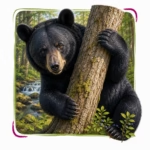
Polar Bear Fact Highlight
From the full animal facts page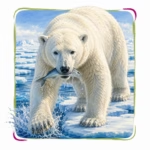
More Animal Comparisons
Pick another animal matchup and keep exploring. Compare appearances, habitats, diets, abilities, and surprising differences.


Make an Animal Story
Turn this black bear vs polar bear comparison into a berry-forest and drifting-sea-ice survival mystery with our free Animal Story Generator.
Source notes: References used for this comparison. See more See less
Try Another Matchup
Explore this comparison →