
Blackbird vs Starling for Kids
Common Blackbirds and European Starlings can both look black from far away, but sunlight reveals the clues. An adult male blackbird is truly black with a long tail and orange-yellow bill. A starling is smaller and shorter-tailed, with pointed wings and glossy feathers that shine green and purple. Its winter plumage is sprinkled with pale spots.
About Common Blackbird
- Type Bird
- Diet Omnivore; earthworms, insects, spiders, snails, berries, and fruit
- Group Thrush; family Turdidae
- Known for The male’s black feathers and yellow bill, the female’s brown plumage, and a mellow fluting song
- Special skill Turns leaf litter and probes soil for hidden food, then switches easily to berries and fruit
About European Starling
- Type Bird
- Diet Omnivore; insects, spiders, worms, fruit, berries, seeds, and other varied foods
- Group Starling; family Sturnidae
- Known for Iridescent feathers, winter spots, sound mimicry, fast direct flight, and huge murmurations
- Special skill Copies birds, animals, and mechanical noises, while coordinated flocks twist through the sky
Quick Answer
Quick answer: The Common Blackbird is usually larger, averaging about 101.8 grams in BTO records compared with about 85 grams for the European Starling. Blackbirds are thrushes that hop through leaf litter and sing clear flute-like phrases. Starlings walk confidently, fly fast and directly, imitate many noises, and gather in swirling winter flocks called murmurations.
Common Blackbird vs European Starling: Quick Comparison
| Feature | Common Blackbird | European Starling |
|---|---|---|
| Scientific identity | Turdus merula | Sturnus vulgaris |
| Bird family | Turdidae, the thrushes | Sturnidae, the starlings |
| Average adult weight | About 101.8 g in BTO records | About 85 g in BTO records |
| Body shape | Longer-tailed thrush with a rounded head | Compact, short-tailed bird with pointed head and triangular wings |
| Color clue | Adult male is black with yellow-orange bill and eye-ring; female is brown | Glossy green-purple sheen; pale speckles are strongest in winter |
| Ground movement | Usually hops, pauses, and turns leaves | Walks and runs confidently while probing turf |
| Voice | Rich, mellow, flute-like phrases plus sharp alarm calls | Clicks, whistles, creaks, chatters, and copied sounds |
| Food | Earthworms, insects, snails, fruit, and berries | Insects, worms, fruit, seeds, and many other foods |
| Nest | Open cup of grass, leaves, and mud in dense cover | Grass-lined cavity in a tree, building, roof, or nest box |
| Social pattern | Often territorial, solitary, or paired | Highly social flocks and enormous communal roosts |
How Are Blackbirds and Starlings Alike?
- Both are medium-size songbirds that often feed on lawns, in gardens, and around farms.
- Both are omnivores that eat insects, worms, berries, fruit, and other available foods.
- Both can look dark from a distance and may show a yellow bill during the breeding season.
- Both nest near people and have two parents that help feed growing chicks.
- Both use varied calls and songs and can adjust successfully to towns and cities.
How Are Blackbirds and Starlings Different?
- The Common Blackbird is a thrush, while the European Starling belongs to the starling family.
- The blackbird is heavier and longer-tailed; the starling is smaller with pointed triangular wings.
- Adult male blackbirds are plain black with an orange-yellow bill; starlings shine green-purple and carry pale spots.
- Blackbirds hop and turn leaves, while starlings often walk or run and pry into turf with the bill.
- Blackbirds are often territorial or paired; starlings form large flocks, roosts, and murmurations.
Blackbird vs Starling Showdown
Adaptation showdown: Common Blackbird wins size because its average BTO weight is higher and its body is longer. European Starling wins speed because it is specifically described as a fast, direct flier, while no fair matched number is available. Strength is a Tie because their bills and bodies solve different feeding tasks without a matched measure. Stealth is a Tie because the blackbird uses dark or brown cover and the starling’s spots and sheen change with light and season. European Starling wins social behavior because flocks and winter roosts can contain enormous numbers. Swimming is a Tie because neither is a water specialist. European Starling wins weirdest for copying animal and machine sounds and forming shape-shifting murmurations.
Fun Common Blackbird vs European Starling Facts
Black Is Only Half the Blackbird Story
Adult male Common Blackbirds are black with orange-yellow bills and yellow eye-rings. Females are brown, often with streaks or spots below, so a female blackbird can look nothing like the bird’s name suggests.
Mud Glues the Nest
A female blackbird twists grasses, leaves, and twigs into a sturdy cup and binds the structure with mud. She may build a new nest for another clutch later in the season.
Stars Hidden in the Feathers
A European Starling looks dark from far away, but close feathers reflect green and purple. In winter, pale tips create many bright spots, making the bird look sprinkled with tiny stars.
A Bird That Copies Machines
Starling songs can include whistles, clicks, creaks, gurgles, and sounds copied from other birds, frogs, mammals, or machinery. Each performance can sound like a busy audio scrapbook.
A Sky Full of Moving Shapes
Starlings can gather in huge winter roosts. Before landing, a flock may wheel and ripple through the air as a murmuration, with nearby birds reacting quickly to one another.
Blackbird vs Starling Quiz
- Which bird is heavier on average in BTO records? Answer: The Common Blackbird.
- Which bird has glossy green and purple feather sheen? Answer: The European Starling.
- How does a blackbird strengthen its cup nest? Answer: It uses mud to bind the plant material.
- Which bird is famous for copying many sounds? Answer: The European Starling.
- What is a murmuration? Answer: A large coordinated flock of starlings turning and flowing through the sky.
Common Blackbird vs European Starling FAQ
Is a starling a type of blackbird?
No. The Common Blackbird is a thrush, while the European Starling belongs to Sturnidae.
Which bird is bigger?
The Common Blackbird is generally larger and averages about 101.8 grams compared with about 85 grams for the starling in BTO records.
Why do starlings look spotted in winter?
Pale tips on their fresh feathers create bright speckles that stand out strongly in winter plumage.
Do both birds eat worms?
Yes. Both take earthworms and insects, and both also eat plant foods such as fruit or berries.
Which bird forms murmurations?
The European Starling forms the famous large, swirling flocks called murmurations.
Animal Words to Know
- Iridescent: Showing colors that seem to change as light or viewing angle changes.
- Murmuration: A large coordinated flock of starlings moving together in the air.
- Mimicry: Copying a sound, movement, or appearance.
- Thrush: A member of the songbird family Turdidae.
- Communal roost: A place where many birds gather to rest or sleep.
Decode Two Dark Garden Birds
Decode Two Dark Garden Birds
Draw exactly one adult male Common Blackbird and exactly one adult European Starling on neighboring lawn and hedge areas at honest relative scale, with the blackbird slightly larger. Add clue cards for long tail, short tail, plain black, purple-green sheen, mud cup, cavity nest, flute song, and copied clicks. Sort and explain each clue. Watch birds quietly without people handling them.
Meet Each Animal
Want the full fact file? Here are quick highlights from each animal’s own facts page.
Common Blackbird Fact Highlight
From the full animal facts page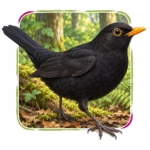
European Starling Fact Highlight
From the full animal facts page
More Animal Comparisons
Pick another animal matchup and keep exploring. Compare appearances, habitats, diets, abilities, and surprising differences.





Make an Animal Story
Send a flute-singing Blackbird and a sound-copying Starling into a garden performance with our free Animal Story Generator.