
Blue-ringed Octopus vs Stonefish for Kids: Rings or Rock?
Blue-ringed Octopuses and Reef Stonefish are small Indo-Pacific predators with extremely effective venom, but they are not closely related. The octopus is a soft-bodied mollusk with eight sucker-lined arms and a beak. The stonefish is a bony fish with fins, gills, scales buried under rough skin, and venom glands connected to sharp dorsal spines. Both avoid conflict by hiding, and neither chases people.
About Blue-ringed Octopus
- Type Small venomous cephalopod mollusk
- Diet Carnivore
- Group Blue-ringed octopus genus, Hapalochlaena
- Known for Flashing electric-blue rings when disturbed and carrying powerful tetrodotoxin in its saliva
- Special skill Changes from mottled camouflage to brilliant blue warning rings in a fraction of a second
About Reef Stonefish
- Type Venomous bottom-dwelling bony fish
- Diet Carnivore
- Group Stonefish family, Synanceiidae
- Known for Rock-like camouflage and venomous dorsal spines
- Special skill Disappears against reef rubble, then opens its mouth to suck in passing prey with a rapid ambush
Quick Answer
Quick answer: A Blue-ringed Octopus is tiny, flexible, and usually mottled brown or yellow until disturbance makes its blue markings flash. It bites with a beak and delivers tetrodotoxin in saliva. A Reef Stonefish can grow beyond 30 cm, looks like an algae-covered rock, and carries venom in dorsal spines that can inject it when pressed. The octopus is the more mobile color changer; the stonefish is the larger, more patient ambush hunter.
Blue-ringed Octopus vs Reef Stonefish: Quick Comparison
| Feature | Blue-ringed Octopus | Reef Stonefish |
|---|---|---|
| Scientific identity | Hapalochlaena species, a genus of several blue-marked octopuses | Synanceia verrucosa, the Reef Stonefish |
| Animal group | Cephalopod mollusk related to squid and cuttlefish | Ray-finned bony fish in the stonefish family |
| Adult size | Body about 4 to 6 cm; arms may reach about 7 to 10 cm | Often 30 to 40 cm long |
| Normal appearance | Mottled tan, brown, or yellow and easy to overlook | Knobbly gray-brown skin that resembles coral rubble or stone |
| Warning or defense | Brilliant blue rings or lines flash when the animal is disturbed | Thirteen stout dorsal spines can deliver venom when pushed |
| How venom enters | A small beak bite introduces venomous saliva | Pressure on a dorsal spine pushes venom through the puncture |
| Main food | Small crabs, shrimp, and small or injured fish | Small fish, shrimp, and other passing crustaceans |
| Hunting style | Crawls from cover, grabs prey with arms, and bites through the shell | Waits almost motionless and rapidly sucks passing prey into its mouth |
| Movement | Crawls, squeezes through tiny gaps, and escapes by jet propulsion | Usually rests on the bottom but can make a short swimming burst |
| Egg care | Female holds and cleans eggs until they hatch, then dies | Eggs develop in the water without guarding by the adult fish |
How Blue-ringed Octopuses and Stonefish Are Alike
- Both are venomous predators found in warm Indo-Pacific coastal habitats.
- Both rely heavily on camouflage and usually remain still or hidden rather than chasing prey.
- Both eat small crustaceans and fish.
- Both use venom mainly for capturing prey or defense rather than seeking people.
- Both should be observed from a safe distance and never touched, even if they appear motionless.
How Blue-ringed Octopuses and Stonefish Are Different
- The Blue-ringed Octopus is a mollusk with eight arms, while the Reef Stonefish is a vertebrate fish with fins and a backbone.
- The octopus is tiny and flexible, while the stonefish is several times longer and much heavier.
- The octopus delivers venom through a beak bite, while the stonefish delivers venom through dorsal spines when they are pressed.
- Blue rings act as a vivid warning display, while the stonefish stays disguised as reef rock.
- The octopus can crawl and jet through narrow spaces, while the stonefish normally waits on the bottom for prey to pass.
Blue-ringed Octopus vs Stonefish Adaptation Showdown
Adaptation showdown: Reef Stonefish wins size because it often reaches 30 to 40 cm, several times the body-and-arm span of a Blue-ringed Octopus. Speed is a Tie because the octopus can jet away while the stonefish can launch an extremely fast feeding strike, but matched travel speeds are unavailable. Reef Stonefish wins strength because its much larger body powers a forceful suction ambush. Reef Stonefish wins stealth because rough skin, algae, and irregular color can make it nearly vanish among rocks. Social behavior is a Tie because both are mainly solitary. Swimming is a Tie because the octopus jets and the fish swims, but neither relies on sustained open-water pursuit. Blue-ringed Octopus wins weirdest for combining three hearts, blue blood, a doughnut-shaped brain, shape shifting, and flashing rings with potent venom in a body small enough to hide in a shell.
Fun Blue-ringed Octopus vs Reef Stonefish Facts
Blue Rings Are a Final Warning
A resting Blue-ringed Octopus may look plain brown or yellow. When disturbed, special skin structures make dozens of bright blue rings or lines appear suddenly.
Three Hearts and Blue Blood
Two octopus hearts pump blood past the gills, while a third pumps it around the body. Copper-based hemocyanin makes the blood appear blue.
Venom Hidden in Saliva
Blue-ringed Octopus saliva contains tetrodotoxin, which blocks nerve signals. The animal uses a small beak to bite prey such as crabs.
A Fish Disguised as the Seafloor
The Reef Stonefish has a lumpy body, wide mouth, upward-set eyes, and colors that match coral rubble, sand, algae, and rock.
Spines That Work Only When Pressed
Venom glands sit at the bases of the stonefish’s dorsal spines. Pressure forces the spine into a threat and squeezes venom into the puncture.
Blue-ringed Octopus vs Stonefish Quiz
- Which animal flashes bright blue markings? Answer: The Blue-ringed Octopus.
- Which animal is a fish? Answer: The Reef Stonefish.
- How does the octopus deliver venom? Answer: Through a bite from its small beak and venomous saliva.
- How does the stonefish deliver venom? Answer: Through dorsal spines when pressure pushes them into another animal.
- What is the safest rule around either animal? Answer: Do not touch it and give it plenty of space.
Blue-ringed Octopus vs Reef Stonefish FAQ
Is every blue-ringed octopus one species?
No. Blue-ringed octopus is the common name for several species in the genus Hapalochlaena.
Do the blue rings show all the time?
No. The markings are much brighter when the octopus is disturbed, while its resting colors are usually duller and camouflaged.
Does a stonefish shoot venom?
No. Venom is delivered when pressure pushes one or more dorsal spines into another animal.
Do these animals attack swimmers?
They normally avoid people or remain hidden. Injuries usually happen when someone handles an octopus or steps on or presses a stonefish.
What should a child do after seeing one?
Move away calmly, tell an adult, and observe only from a safe distance without touching nearby rocks, shells, cans, or animals.
Animal Words to Know
- Venom: A toxin delivered by a bite, sting, spine, or similar structure.
- Cephalopod: A mollusk group containing octopuses, squid, cuttlefish, and nautiluses.
- Tetrodotoxin: A powerful nerve-blocking toxin present in several unrelated animals.
- Dorsal: Located along the back or upper surface of an animal.
- Ambush: A hunting method in which a predator waits hidden and strikes suddenly.
Make a Hidden Predator Safety Poster
Make a Hidden Predator Safety Poster
Draw exactly one Blue-ringed Octopus and exactly one Reef Stonefish at honest relative scale, making the stonefish much longer. Show the octopus safely exposed beside, not inside, a rocky crevice, and label eight arms, suckers, mantle, beak position, blue warning rings, and jet funnel. Label the stonefish’s upward eyes, broad mouth, rough camouflage, pectoral fins, and thirteen dorsal spines without showing contact. Add one large rule: look, step carefully, and never touch hidden marine life.
Meet Each Animal
Want the full fact file? Here are quick highlights from each animal’s own facts page.
Blue-ringed Octopus Fact Highlight
From the full animal facts page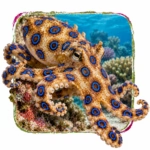
Reef Stonefish Fact Highlight
From the full animal facts page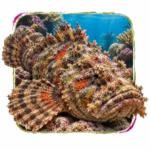
More Animal Comparisons
Pick another animal matchup and keep exploring. Compare appearances, habitats, diets, abilities, and surprising differences.






Make an Animal Story
Send a flashing reef escape artist and a rock-like ambush fish through an ocean puzzle with our free Animal Story Generator.