
Blue-tongued Skink vs Leopard Gecko for Kids
Common Blue-tongued Skinks and Leopard Geckos are ground-dwelling lizards, but they come from different regions and are easy to tell apart. The Australian Skink, Tiliqua scincoides, can approach 60 cm and is thick, smooth and active by day. The South Asian Leopard Gecko, Eublepharis macularius, is usually about 22 cm, spotted and most active in low light. Unlike many geckos, it has movable eyelids and clawed toes instead of sticky pads.
About Common Blue-tongued Skink
- Type Living
- Diet Omnivore; eats snails, slugs, insects, flowers, fruit and other plant material
- Group Large Australian skink in family Scincidae (Tiliqua scincoides), also called the Common Bluetongue
- Known for A thick smooth body, tiny legs and a startling cobalt-blue tongue
- Special skill Flashes a broad bright-blue tongue from a pink mouth to shock a possible predator
About Leopard Gecko
- Type Living
- Diet Insectivore; hunts insects, spiders and other small invertebrates on the ground
- Group Small eyelid gecko in family Eublepharidae (Eublepharis macularius)
- Known for A yellow-and-black spotted coat, movable eyelids, clawed toes and a thick fat-storing tail
- Special skill Stores energy in a thick segmented tail, which it can drop to escape; a shorter replacement grows later
Quick Answer
The Common Blue-tongued Skink is much larger and heavier, eats both animals and plants, gives birth to live young and warns danger with a blue tongue. The Leopard Gecko is a small spotted insect hunter that lays eggs and shelters through the day. It can blink with movable eyelids, cannot climb smooth glass with sticky toe pads and stores energy in its thick detachable tail.
Common Blue-tongued Skink vs Leopard Gecko: Quick Comparison
| Feature | Common Blue-tongued Skink | Leopard Gecko |
|---|---|---|
| Scientific name | Tiliqua scincoides | Eublepharis macularius |
| Adult length | Can reach nearly 60 cm, with a thick body and tail | Usually about 22 cm and sometimes near 25 cm, including the tail |
| Main pattern | Gray or brown bands across a broad smooth body | Yellow or tan with irregular dark spots; young are more strongly banded |
| Eyes | Small eyes with movable lids | Large eyes with vertical pupils and unusual movable eyelids |
| Feet | Very short sturdy legs with clawed toes | Longer slim legs with clawed toes but no adhesive toe pads |
| Main food | Snails, slugs, insects, flowers, fruit and other plant matter | Insects, spiders and other small invertebrates |
| Busy time | Daytime; often basks in morning warmth | Dusk and night; hides under rocks during the day |
| Defense | Shows its blue tongue, hisses, flattens the body and may bite if cornered | Drops its tail, hides in a crack or waves the tail as a distraction |
| Babies | Gives birth to live young | Lays eggs, commonly two in a clutch |
| Wild habitat | Australian woodland, heath, grassland and gardens | Dry rocky ground and sparse grass or scrub in South Asia |
How Are Blue-tongued Skinks and Leopard Geckos Alike?
- Both are scale-covered lizards that spend most of their time on the ground.
- Both warm their bodies using heat from the environment.
- Both have clawed feet and do not use sticky pads to climb smooth walls.
- Both hide under rocks, logs or other cover when resting or avoiding danger.
- Both can shed and regrow part of the tail, though a regrown tail is not identical to the first one.
How Are Blue-tongued Skinks and Leopard Geckos Different?
- The Common Blue-tongued Skink can be more than twice as long and far heavier than the Leopard Gecko.
- The Skink has broad bands and a blue tongue; the Gecko has leopard-like spots and a pale tongue.
- The Skink is active by day, while the Leopard Gecko emerges mainly at dusk and night.
- The Skink eats animal and plant foods; the Leopard Gecko mainly hunts small invertebrates.
- The Skink gives birth to live young, while the Leopard Gecko lays eggs.
Blue-tongued Skink vs Leopard Gecko Showdown
- Size – Common Blue-tongued Skink: It can approach 60 cm, more than twice the usual total length of a Leopard Gecko.
- Speed – Tie: Both can hurry into cover, but their different sizes and habitats make a fair race impossible.
- Strength – Common Blue-tongued Skink: Its much heavier body, broad head and strong jaws give it the clear power advantage.
- Stealth – Leopard Gecko: Spots, night activity and a habit of hiding in rocky cracks make this small hunter hard to detect.
- Social – Tie: Both are mostly solitary and should not be imagined as naturally living in friendly groups.
- Swimming – Tie: Neither benchmark species is adapted for aquatic life or long-distance swimming.
- Weirdest – Leopard Gecko: It is a gecko that blinks, has no sticky toe pads and carries an emergency energy store in its tail.
Fun Blue-tongued Skink vs Leopard Gecko Facts
A Gecko That Blinks
Leopard Geckos have movable eyelids, unlike many geckos whose eyes stay behind a clear fixed covering.
No Wall-Climbing Pads
A Leopard Gecko has ordinary clawed toes instead of the broad adhesive pads used by many climbing geckos.
A Tail Pantry
Fat stored in a Leopard Gecko’s thick tail can help it through times when food is scarce.
A Giant Blue Warning
The Common Blue-tongued Skink keeps its brilliant blue tongue hidden until it opens a pink mouth at danger.
Two Ways to Have Babies
The Skink gives birth to live babies, while a Leopard Gecko usually lays two eggs at a time.
Blue-tongued Skink vs Leopard Gecko Quiz
Which lizard is much larger? A) Common Blue-tongued Skink B) Leopard Gecko C) They are equal Answer: A) Common Blue-tongued Skink
Which lizard has dark spots? A) Common Blue-tongued Skink B) Leopard Gecko C) Neither Answer: B) Leopard Gecko
Which animal is mainly active at night? A) Common Blue-tongued Skink B) Leopard Gecko C) Both only by day Answer: B) Leopard Gecko
Which lizard gives birth to live young? A) Common Blue-tongued Skink B) Leopard Gecko C) Both lay eggs Answer: A) Common Blue-tongued Skink
What unusual eye feature does the Gecko have? A) Movable eyelids B) No eyes C) Four pupils Answer: A) Movable eyelids
Blue-tongued Skink vs Leopard Gecko FAQ
Is a Blue-tongued Skink a Gecko?
No. It belongs to the skink family Scincidae. The Leopard Gecko belongs to the eyelid-gecko family Eublepharidae.
Which Lizard Is Bigger?
The Common Blue-tongued Skink. It can approach 60 cm, while a Leopard Gecko is usually around 22 cm long.
Why Can’t a Leopard Gecko Climb Glass?
It lacks the microscopic adhesive toe pads used by many climbing geckos. Its clawed toes work better on rough ground and rock.
Can a Leopard Gecko Regrow Its Tail?
Yes, after dropping the tail to escape. The replacement is usually shorter, smoother and shaped differently from the original.
Can These Lizards Live Together?
No. They come from different continents, differ greatly in size and need different conditions. Under human care, each needs expert species-specific housing.
Animal Words to Know
- Adhesive: Able to stick to a surface.
- Autotomy: Dropping a body part, such as a tail, to escape danger.
- Crepuscular: Most active around dawn or dusk.
- Insectivore: An animal that mainly eats insects and other small invertebrates.
- Neonate: A newborn animal.
Design Two Ground-Lizard Feet
Design Two Ground-Lizard Feet
Make two paper lizards at a shared scale so the size difference is clear. Give the Skink a broad body, tiny clawed feet and a folding blue tongue. Give the Leopard Gecko a spotted body, slim clawed toes without sticky pads and a detachable paper tail. Place both on textured cardboard and explain why each is a ground traveler.
Meet Each Animal
Want the full fact file? Here are quick highlights from each animal’s own facts page.
Common Blue-tongued Skink Fact Highlight
From the full animal facts page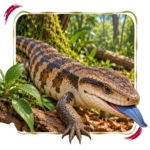
Leopard Gecko Fact Highlight
From the full animal facts page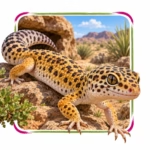
More Animal Comparisons
Pick another animal matchup and keep exploring. Compare appearances, habitats, diets, abilities, and surprising differences.



Make an Animal Story
Create a lizard adventure about a blue-tongued giant and a spotted night hunter!