
Bongo vs Greater Kudu: Antelope Species Comparison
Bongos and Greater Kudus are close spiral-horned antelope relatives, but they are built for different kinds of cover. The Bongo, Tragelaphus eurycerus, is a stocky forest animal with a chestnut coat, 10 to 15 pale stripes and horns on both sexes. This page uses the Greater Kudu, Tragelaphus strepsiceros, for the broad name kudu. It is taller and slimmer, usually has 6 to 10 stripes, and only males grow its enormous open corkscrew horns.
About Bongo
- Type Living
- Diet Herbivore; browses leaves, flowers, twigs and young shoots and also eats herbs and grass
- Group Large forest antelope in the spiral-horned genus Tragelaphus (Tragelaphus eurycerus)
- Known for Rich chestnut coat, 10-15 thin pale stripes, white face chevrons, huge ears and spiral horns on males and females
- Special skill Tilts its nose upward so the horns lie along its back while it slips through tangled forest plants
About Greater Kudu
- Type Living
- Diet Herbivore and browser; eats leaves, shoots, vines, flowers, fruit, herbs and a little new grass
- Group Very tall spiral-horned antelope in genus Tragelaphus (Tragelaphus strepsiceros)
- Known for Gray-brown coat, 6-10 white stripes, very large ears and spectacular open corkscrew horns on adult males
- Special skill Freezes in cover so its pale stripes break up its outline, then clears tall obstacles with powerful bounds
Bongo vs Greater Kudu: Quick Answer
A Bongo is the stockier and usually heavier animal. It wears a rich chestnut coat with many narrow white stripes, and both males and females have spiral horns. A Greater Kudu stands taller on longer legs and is gray-brown with fewer stripes. Only male Greater Kudus grow the famous long, open twists. Bongos hide in dense forest; Greater Kudus favor woodland, brush and thickets.
Where Do They Fit?
Follow the branches to see how Bongo and Greater Kudu are classified and related.
Bongo vs Greater Kudu: Quick Comparison
| Feature | Bongo | Greater Kudu |
|---|---|---|
| Scientific name | Tragelaphus eurycerus | Tragelaphus strepsiceros |
| Adult mass | About 210-405 kg | About 120-315 kg |
| Body shape | Stocky, with relatively short legs for a large antelope | Tall and slim, up to about 150 cm at the shoulder |
| Main coat color | Chestnut red; older males can become very dark | Reddish-brown to blue-gray; males darken with age |
| White stripes | Usually 10-15 narrow vertical stripes | Usually 6-10 vertical stripes |
| Horns | Long spirals on both males and females | Very long open spirals on males only |
| Ears and face | Broad ears and a strong white chevron between the eyes | Huge ears, pale face marks and a throat fringe on males |
| Habitat | Dense lowland and mountain forest | Woodland, bushland and river thickets |
| Food | Leaves, shoots, flowers, herbs and some grass | Leaves, vines, fruit, flowers, herbs and some new grass |
| Social life | Small herds are common; adult males may be solitary | Small female herds and solitary or bachelor males |
How Are Bongos and Greater Kudus Alike?
- Both are African antelopes in the spiral-horned genus Tragelaphus.
- Both carry pale body stripes that help break up their shape among stems and shadows.
- Both have large ears and sharp hearing for detecting danger in thick cover.
- Both are plant eaters that browse leaves, twigs, flowers and fruit.
- Both often live in small female groups while mature males spend more time alone.
How Are Bongos and Greater Kudus Different?
- Bongos are stockier and can be heavier, while Greater Kudus stand taller on longer legs.
- A Bongo usually has 10 to 15 pale stripes; a Greater Kudu usually has 6 to 10.
- Male and female Bongos grow horns, but only male Greater Kudus normally do.
- Bongos are deep-forest specialists; Greater Kudus use more open woodland, brush and thickets.
- Bongo horns form tighter, shorter spirals, while a male Greater Kudu’s horns open into much longer twists.
Bongo vs Greater Kudu Adaptation Showdown
- Size – Bongo: Its published adult mass reaches about 405 kg, above the Greater Kudu’s usual upper range, although the Kudu is taller.
- Speed – Tie: Both can move quickly through cover, but no fair matched test shows a dependable winner.
- Strength – Bongo: Its heavier, stockier body gives it more total pushing power; this is an adaptation comparison, not a fight prediction.
- Stealth – Bongo: Its many narrow stripes and rich brown coat are especially suited to the stems and broken light of dense forest.
- Social – Tie: Both use flexible small groups, with females more social and many mature males spending time alone.
- Swimming – Tie: Neither is a swimming specialist, and direct matched evidence is not available.
- Weirdest – Bongo: It raises its chin so its horns lie along its back, helping the large antelope thread through tangled vegetation.
Fun Bongo vs Greater Kudu Facts
Horns on Her Too
Bongos are unusual among close Tragelaphus relatives because adult males and females both grow spiral horns.
A Forest Comb
When a Bongo pushes through thick plants, its horns may catch and break branches. It can then browse the newly lowered leaves.
Kudu Corkscrews
A mature male Greater Kudu can carry horns that make about two and a half graceful turns and grow far longer than Bongo horns.
Stripe Counting Clue
A Bongo usually shows 10 to 15 pale stripes, while a Greater Kudu usually shows 6 to 10. Individual patterns still vary.
Mineral-Lick Visitors
Bongos visit natural mineral licks and may even eat burned wood to gain salt or other minerals.
Bongo vs Greater Kudu Quiz
Which animal usually has more body stripes? A) Bongo B) Greater Kudu C) Neither Answer: A) Bongo
Which females normally grow horns? A) Bongo females B) Greater Kudu females C) Neither Answer: A) Bongo females
Which animal is taller on longer legs? A) Bongo B) Greater Kudu C) They are identical Answer: B) Greater Kudu
Where does a Bongo usually live? A) Dense African forest B) Arctic sea ice C) Open ocean Answer: A) Dense African forest
What do both animals mainly eat? A) Plants B) Fish C) Insects only Answer: A) Plants
Bongo vs Greater Kudu FAQ
Is a Bongo a type of Kudu?
No. They are different species, but both belong to the same spiral-horned antelope genus, Tragelaphus.
Which Kudu does this page compare?
It uses the Greater Kudu. Lesser Kudu is a different, smaller species and would change several answers.
Which is heavier, a Bongo or a Greater Kudu?
Bongos have the higher published mass range, although a male Greater Kudu can stand taller at the shoulder.
Do female Greater Kudus have horns?
No. Greater Kudu horns normally grow only on males, while both sexes of Bongo have horns.
Why do both animals have white stripes?
The pale bars break up the outline of the body among grass, branches, stems and patches of light.
Animal Words to Know
- Antelope: A varied group of hoofed mammals in the cattle family Bovidae.
- Browser: An animal that eats leaves, twigs, shoots, flowers and other plant parts above the ground.
- Mineral lick: A place where animals eat or lick soil and rock rich in needed minerals.
- Spiral: A shape that winds around a center or axis.
- Camouflage: Colors, patterns or behavior that help an animal blend into its surroundings.
Build a Spiral-Horn Forest Guide
Build a Spiral-Horn Forest Guide
Draw one stocky chestnut Bongo with 12 thin white stripes and horns on a female silhouette. Beside it, draw one taller gray-brown male Greater Kudu with 8 stripes and much longer open spirals. Add forest behind the Bongo and bush woodland behind the Kudu, then cover the names and identify each animal from three clues.
Meet Each Animal
Want the full fact file? Here are quick highlights from each animal’s own facts page.
Bongo Fact Highlight
From the full animal facts page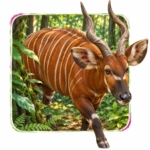
Greater Kudu Fact Highlight
From the full animal facts page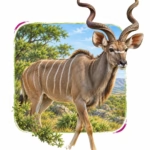
More Animal Comparisons
Pick another animal matchup and keep exploring. Compare appearances, habitats, diets, abilities, and surprising differences.



Make an Animal Story
Create a forest story about a striped Bongo and a towering Greater Kudu comparing their spiral horns!
Source notes: References used for this comparison. See more See less
Try Another Matchup
Explore this comparison →