
Burmese Python vs Indian Rock Python: Asian Python Comparison
Burmese pythons and Indian rock pythons are close cousins that were once treated as forms of one species. Today they are usually recognized as two species. Both are giant, nonvenomous constrictors with blotched camouflage and heat-sensing pits along the lips. The Burmese Python is generally darker and larger. The Indian Rock Python is usually paler and lives mainly across the Indian subcontinent.
About Burmese Python
- Type Living
- Diet Carnivore
- Group Large python species (Python bivittatus)
- Known for Huge size, dark saddle-shaped blotches, wetland living and egg-warming muscle shivers
- Special skill Detects warm animals with lip pits and coils around eggs to warm them with muscle contractions
About Indian Rock Python
- Type Living
- Diet Carnivore
- Group Large python species (Python molurus)
- Known for Pale blotched camouflage, heavy body, ambush hunting and life close to water
- Special skill Uses heat-sensitive lip pits, camouflage and constriction to ambush warm-blooded prey
Burmese Python vs Indian Rock Python: Quick Answer
The Burmese Python is usually the larger, darker snake. It often has bold brown saddle-shaped blotches and a complete arrow-like mark on top of the head. The Indian Rock Python is usually lighter, with tan or brown blotches and a less complete head marking. Both wait in ambush, grab prey with backward-curving teeth, coil around it and swallow it whole. Neither species is venomous.
Where Do They Fit?
Follow the branches to see how Burmese Python and Indian Rock Python are classified and related.
Burmese Python vs Indian Rock Python: Quick Comparison
| Feature | Burmese Python | Indian Rock Python |
|---|---|---|
| Scientific name | Python bivittatus | Python molurus |
| Native range | Southern China and much of mainland Southeast Asia, with parts of Indonesia | India, Pakistan, Nepal and Sri Lanka, with nearby parts of South Asia |
| Typical adult length | Often about 3-4.9 m; animals over 4.6 m are well known | Often around 2.4-3.3 m; exceptional animals can grow longer |
| Overall color | Usually darker brown, tan or gray | Usually lighter cream, yellowish or pale brown |
| Back pattern | Large dark brown or olive saddle-like blotches edged in cream or gold | Tan to dark-brown blotches that can match rocks, leaf litter and dry ground |
| Head clue | Usually a bold, complete arrow-shaped marking | Usually a paler or less complete arrow-shaped marking |
| Main habitat | Wet forests, marshes, swamps, river valleys and grasslands | Forests, scrub, marshes, rocky slopes and river country |
| Hunting method | Ambush, heat sensing, gripping teeth and constriction | Ambush, heat sensing, gripping teeth and constriction |
| Egg care | Female coils around the clutch and can warm it with muscle shivers | Female coils around and guards the clutch until hatching |
| Conservation clue | Vulnerable in its native range but invasive in southern Florida | Near Threatened and strongly protected in parts of its native range |
How Are Burmese and Indian Rock Pythons Alike?
- Both are large, heavy-bodied pythons from warm parts of Asia.
- Both are nonvenomous constrictors that swallow prey whole.
- Both have heat-sensitive pits along the lips and forked tongues for sensing their surroundings.
- Both use blotched patterns to disappear among leaves, rocks and shadows.
- Both lay eggs, and the mother coils around the clutch during incubation.
How Are Burmese and Indian Rock Pythons Different?
- The Burmese Python is generally longer and heavier.
- Burmese pythons are usually darker; Indian rock pythons are usually paler.
- A Burmese Python often shows a complete arrow-like head mark; the Indian species’ mark is usually less complete.
- The Burmese Python ranges mainly east of India through Southeast Asia; the Indian Rock Python centers on the Indian subcontinent.
- Burmese pythons have formed an invasive population in Florida, far outside their native range.
Burmese Python vs Indian Rock Python Adaptation Showdown
- Size – Burmese Python: It reaches a greater typical length and mass, although a large Indian Rock Python is still a giant snake.
- Speed – Tie: Both are patient ambush hunters rather than distance racers, and no fair same-course speed test is available.
- Strength – Burmese Python: Its larger average body gives it more total constricting muscle; this is an anatomy comparison, not a fight prediction.
- Stealth – Tie: Dark Burmese markings suit wet forest shadows, while the Indian species’ paler pattern suits leaf litter, scrub and rock.
- Social – Tie: Both normally live alone and show their longest social behavior when females guard egg clutches.
- Swimming – Tie: Both live near water and swim well, but the sources do not provide a controlled species-to-species contest.
- Weirdest – Burmese Python: A brooding female can twitch her muscles repeatedly, producing heat that keeps dozens of eggs warmer than the surrounding air.
Fun Burmese Python vs Indian Rock Python Facts
They Used to Share One Name
The Burmese Python was once widely treated as a subspecies of Python molurus. Most modern authorities recognize Python bivittatus as its own species.
Lips That Sense Heat
Small pits along a python’s lips detect warmth from birds and mammals, helping the snake aim even in dim light.
A Mother Makes Her Own Heat
A brooding Burmese Python can rapidly contract her muscles around the eggs and raise their temperature by several degrees.
A Jaw That Opens Sideways
Flexible ligaments and moving jaw bones let a python widen its mouth around prey. The jaws do not come completely unhinged.
Native Here, Invasive There
Burmese pythons belong in Asian ecosystems. Released or escaped animals formed a breeding population in Florida, where they eat native wildlife.
Burmese Python vs Indian Rock Python Quiz
Which python is generally larger? A) Burmese Python B) Indian Rock Python C) They are always equal Answer: A) Burmese Python
Are either of these pythons venomous? A) Both B) Only the Burmese Python C) Neither Answer: C) Neither
What helps both pythons detect warm animals? A) Lip pits B) Antlers C) Whiskers Answer: A) Lip pits
Which python has become invasive in Florida? A) Burmese Python B) Indian Rock Python C) Both Answer: A) Burmese Python
How does a python subdue prey? A) With venom B) By constriction C) With a stinger Answer: B) By constriction
Burmese Python vs Indian Rock Python FAQ
Are Burmese and Indian rock pythons the same species?
No. They are close relatives, but modern authorities usually recognize Python bivittatus and Python molurus as separate species.
Which python is bigger?
The Burmese Python is generally longer and heavier, although individual sizes overlap.
How can I tell them apart?
Look at several clues together: Burmese pythons are usually darker, larger and have a stronger complete arrow mark on the head.
Do these pythons have venom?
No. They use backward-curving teeth to grip and muscular coils to constrict prey.
Should children approach a wild python?
No. Observe from far away, never touch or corner it, and tell a responsible adult or wildlife authority.
Animal Words to Know
- Ambush predator: An animal that waits quietly before making a sudden attack.
- Constrictor: A snake that subdues prey by wrapping and tightening its body around it.
- Ectotherm: An animal that gets most of its body heat from its surroundings.
- Invasive species: A non-native organism that spreads and harms its new ecosystem.
- Labial pit: A heat-sensitive hollow along a snake’s lip.
Design Two Python Camouflage Patterns
Design Two Python Camouflage Patterns
Draw two long S-shaped snakes without touching real wildlife. Color the Burmese Python with dark brown saddle blotches for a wet forest. Color the Indian Rock Python with lighter tan and brown blotches for dry leaves and rocks. Add labels for lip pits, head mark, camouflage and muscular coils.
Meet Each Animal
Want the full fact file? Here are quick highlights from each animal’s own facts page.
Burmese Python Fact Highlight
From the full animal facts page
Indian Rock Python Fact Highlight
From the full animal facts page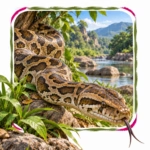
More Animal Comparisons
Pick another animal matchup and keep exploring. Compare appearances, habitats, diets, abilities, and surprising differences.




Make an Animal Story
Create a python story with two camouflaged cousins following different forest trails!
Source notes: References used for this comparison. See more See less
Try Another Matchup
Explore this comparison →