
Burrowing Owl vs Screech Owl for Kids
Burrowing Owls and Eastern Screech-Owls are both small American owls, but they live on different floors of the landscape. The Burrowing Owl, Athene cunicularia, is long-legged, active in daylight and often stands beside an underground burrow in open grassland. The Eastern Screech-Owl, Megascops asio, is stocky, tufted and mainly nocturnal. It hides against tree bark and uses an existing tree cavity because it cannot dig one itself.
About Burrowing Owl
- Type Living
- Diet Carnivore; catches many insects plus rodents, reptiles, amphibians, birds and other small animals
- Group Small long-legged true owl in family Strigidae (Athene cunicularia)
- Known for Very long bare-looking legs, yellow eyes, white eyebrows and a nest hidden inside an underground burrow
- Special skill Runs on long legs, hunts at many hours and uses underground burrows for nesting and shelter
About Eastern Screech-Owl
- Type Living
- Diet Carnivore; eats insects, earthworms, crayfish, frogs, lizards, rodents, bats and small birds
- Group Small stocky true owl in family Strigidae (Megascops asio), used here as the screech-owl benchmark
- Known for Short feather ear tufts, yellow eyes, bark-like gray or reddish plumage and trilling or whinnying calls
- Special skill Presses its patterned feathers against bark and becomes extremely difficult to see beside a tree cavity
Quick Answer
Both owls are about 16–25 cm long, so size alone is a poor clue. The Burrowing Owl has longer legs, no ear tufts and a ground-level life in prairie or desert. It may hunt by day. The Eastern Screech-Owl has a round, stocky body, short feather tufts and gray or reddish bark camouflage. It hunts mostly at night and sleeps or nests in tree holes.
Burrowing Owl vs Eastern Screech-Owl: Quick Comparison
| Feature | Burrowing Owl | Eastern Screech-Owl |
|---|---|---|
| Scientific name | Athene cunicularia | Megascops asio |
| Adult size | About 19–25 cm long, around 150 g, with a wingspan near 55 cm | About 16–25 cm long, 121–244 g, with a 48–61 cm wingspan |
| Body shape | Slim, flat-headed look with very long legs, white eyebrows and no ear tufts | Short and stocky with a large head, almost no neck and short pointed feather tufts |
| Color | Sandy brown with pale spots, barred belly, white throat and yellow eyes | Gray, reddish or brown with complex bark-like streaks, spots and yellow eyes |
| Main habitat | Treeless prairie, pasture, desert, shrubsteppe, farmland and other open ground | Woodland, wooded stream edges, orchards, parks and leafy suburbs |
| Busy time | Active by day and night; often stands outside in daylight | Mostly active at night, dawn and dusk and hidden in a cavity by day |
| Nest | An underground burrow, often first dug by a mammal; some populations dig their own | An existing tree hole or nest box; it never carves the cavity itself |
| Food | Many insects plus mice, voles, shrews, reptiles, frogs, birds and other small animals | Insects, earthworms, crayfish, frogs, lizards, rodents, bats and birds |
| Voice | Cooing calls, rattles, clucks and a hiss that can resemble a rattlesnake | A mellow tremolo and a descending whinny, despite the name screech-owl |
| Defense clue | Bobs up and down, runs to a burrow or gives warning calls near the entrance | Freezes beside bark, slips into a cavity or uses sharp calls and talons if cornered |
How Are Burrowing Owls and Screech-Owls Alike?
- Both are small true owls with yellow eyes and hooked bills.
- Both eat insects, rodents, reptiles, amphibians and small birds.
- Both use cavities for nesting instead of building an open stick nest.
- Both form breeding pairs and care for helpless, downy owlets.
- Both use camouflage, quiet flight and sensitive hearing to catch prey and avoid danger.
How Are Burrowing Owls and Screech-Owls Different?
- A Burrowing Owl has very long legs and no ear tufts; an Eastern Screech-Owl is stocky with short tufts.
- The Burrowing Owl lives in open grassland and desert, while the Screech-Owl needs trees.
- The Burrowing Owl nests below ground; the Screech-Owl nests inside a tree hole or box.
- Burrowing Owls are often active by day, while Eastern Screech-Owls are mainly nocturnal.
- Burrowing Owls may nest near other pairs, while Screech-Owl pairs defend separated wooded territories.
Burrowing Owl vs Screech-Owl Showdown
- Size – Tie: Their length and weight ranges overlap, so either species may be larger in an individual comparison.
- Speed – Tie: Both fly and pounce quickly, but no fair matched race shows one is always faster.
- Strength – Tie: Each overpowers prey suited to its size, and their overlapping weights offer no clear power winner.
- Stealth – Eastern Screech-Owl: Its gray or reddish pattern can almost vanish against matching tree bark.
- Social – Burrowing Owl: Pairs may nest near other pairs in loose colonies and spend visible time together around burrows.
- Swimming – Tie: Neither species is adapted to an aquatic life.
- Weirdest – Burrowing Owl: A daylight owl with long legs, an underground nest and manure around its doorway is wonderfully unusual.
Fun Burrowing Owl vs Screech Owl Facts
An Owl Under the Ground
Most Burrowing Owls move into tunnels made by prairie dogs, ground squirrels, tortoises or other diggers.
A Name That Tricks You
Eastern Screech-Owls are best known for soft trills and whinnies rather than one harsh screech.
Dung at the Door
Burrowing Owls often carry livestock manure to the nest entrance, where it can attract beetles and other insects.
Two Natural Color Forms
Eastern Screech-Owls may be mostly gray or mostly reddish, and both patterns blend with tree bark.
The Upright Alarm Dance
A worried Burrowing Owl may jerk its body rapidly up and down while watching danger.
Burrowing Owl vs Screech-Owl Quiz
Which owl has very long legs? A) Burrowing Owl B) Eastern Screech-Owl C) Both Answer: A) Burrowing Owl
Where does an Eastern Screech-Owl nest? A) Tree cavity or nest box B) Open ocean C) Snow bank Answer: A) Tree cavity or nest box
Which owl is often active by day? A) Burrowing Owl B) Eastern Screech-Owl C) Neither Answer: A) Burrowing Owl
Which owl has gray or reddish color forms? A) Burrowing Owl B) Eastern Screech-Owl C) Both are always white Answer: B) Eastern Screech-Owl
What do both owls eat? A) Small animals B) Only grass C) Only fruit Answer: A) Small animals
Burrowing Owl vs Screech Owl FAQ
Is a Burrowing Owl a Screech-Owl?
No. Both are small true owls, but they belong to different genera and use very different habitats and nest sites.
Which Screech-Owl Does This Page Compare?
The Eastern Screech-Owl, Megascops asio. Other screech-owl species differ in range, calls and markings.
Which Owl Is Bigger?
Neither always wins. Their length and weight ranges overlap, although the Burrowing Owl looks taller because of its long legs.
Do Burrowing Owls Dig Their Own Burrows?
Most use tunnels made by mammals or tortoises and then enlarge them. Florida and Caribbean Burrowing Owls more often dig their own.
Can Either Owl Be a Pet?
No. They are protected wild raptors with special hunting, nesting and space needs. Observe them quietly without approaching a nest or burrow.
Animal Words to Know
- Burrow: A tunnel or chamber under the ground.
- Cavity: A hollow space inside a tree, rock or structure.
- Colony: A group of animals nesting or living near one another.
- Morph: One of two or more naturally occurring appearances within the same species.
- Tremolo: A call made of rapid repeated notes that seem to quiver.
Place the Owl on the Right Floor
Place the Owl on the Right Floor
Draw a cutaway habitat with open grass above ground, one underground burrow and one nearby tree with a hollow. Make a long-legged Burrowing Owl card and a stocky tufted Screech-Owl card. Place each owl, its food and its daytime shelter in the correct part of the scene, then explain the clues.
Meet Each Animal
Want the full fact file? Here are quick highlights from each animal’s own facts page.
Burrowing Owl Fact Highlight
From the full animal facts page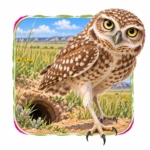
Eastern Screech-Owl Fact Highlight
From the full animal facts page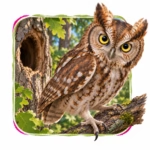
More Animal Comparisons
Pick another animal matchup and keep exploring. Compare appearances, habitats, diets, abilities, and surprising differences.





Make an Animal Story
Create a tiny-owl adventure about a prairie burrow and a secret woodland tree hole!