
Centipede vs Millipede: Myriapod Comparison
Centipedes and millipedes are long, many-legged myriapods that often hide beneath logs and leaves, but they lead very different lives. Centipedes are flattened, quick predators with one pair of legs on each leg-bearing segment and venom claws near the head. Millipedes are usually rounder, slower recyclers with two pairs of legs on most body rings and defensive chemicals instead of venom claws.
About Centipede
- Type Invertebrate
- Diet Carnivore
- Group Chilopod Myriapod
- Known for Fast movement, flattened body, one leg pair per leg-bearing segment, venom claws, and active hunting
- Special skill Grabbing prey with modified venom-injecting front legs called forcipules
About Millipede
- Type Invertebrate
- Diet Detritivore
- Group Diplopod Myriapod
- Known for Rounded segmented body, many legs, slow crawling, leaf-litter recycling, coiling, and chemical defense
- Special skill Curling into a protective coil and releasing defensive chemicals from pores along the body
Centipede vs Millipede: Quick Answer
Centipedes are usually flat, fast carnivores with one pair of legs per leg-bearing segment and venom-injecting forcipules. Millipedes are usually rounded, slow detritivores with two pairs of legs on most body rings and chemical defenses. Neither group is an insect, because both have far more than six legs.
Where Do They Fit?
Follow the branches to see how Centipede and Millipede are classified and related.
Centipede vs Millipede: Quick Comparison
| Feature | Centipede | Millipede |
|---|---|---|
| Animal type | Invertebrate | Invertebrate |
| Animal group | Chilopod myriapod | Diplopod myriapod |
| Known for | Speed, hunting, one leg pair per segment, and venom claws | Many legs, coiling, plant recycling, and chemical defense |
| Main habitat | Soil, leaf litter, logs, caves, gardens, and other shelters | Moist soil, leaf litter, rotting wood, forests, and gardens |
| Body shape | Usually flattened | Usually rounded or cylindrical |
| Leg arrangement | One pair per leg-bearing segment | Two pairs on most fused body rings |
| Diet | Mostly insects, spiders, worms, and other small animals | Mostly decaying leaves, wood, fungi, and plant material |
| Defense | Speed, hiding, and venomous forcipules | Coiling, hard body rings, and defensive chemicals |
| Baby name | Juvenile | Juvenile |
| Special skill | Fast predatory pursuit | Breaking down dead plant material |
How Are Centipedes and Millipedes Alike?
- Both centipedes and millipedes are invertebrate myriapods with many body segments.
- Both have jointed legs, antennae, exoskeletons, and bodies divided into a head and trunk.
- Both molt their outer skeletons as they grow.
- Both usually hide in sheltered places where they avoid drying out.
- Both lay eggs, and many young hatch with fewer segments and legs than adults.
How Are Centipedes and Millipedes Different?
- Centipedes usually have one pair of legs per leg-bearing segment, while millipedes have two pairs on most body rings.
- Centipedes are flattened and fast, while millipedes are usually rounded and slower.
- Centipedes are predators, while most millipedes eat decaying plant material.
- Centipedes use venomous forcipules to subdue prey, while millipedes use coiling and defensive chemicals.
- Centipede legs stick out to the sides, while millipede legs point more downward beneath the body.
Centipede vs Millipede Showdown
Myriapod showdown: Size is a tie because both groups range from tiny species to giants around the length of a ruler. The centipede wins speed, strength, and stealth through fast legs, predatory senses, hiding behavior, and venomous forcipules. Social life and swimming are ties because most species are solitary land animals. The millipede wins our weirdest-fact prize because one known species carries more than 1,000 legs, finally making the name millipede almost literally true.
Fun Centipede vs Millipede Facts
One Leg Pair vs Two Leg Pairs
A centipede carries one pair of legs on each leg-bearing trunk segment. A millipede has two pairs on most body rings because many of those rings formed when two ancestral segments fused together.
Venom Hunter vs Forest Recycler
Centipedes chase insects, spiders, worms, and other small animals. Most millipedes chew decaying leaves, soft wood, fungi, and other plant material, helping nutrients return to the soil.
Flat Runner vs Round Crawler
Most centipedes have flattened bodies with long legs projecting sideways, which supports quick movement through cracks. Many millipedes have cylindrical bodies with shorter legs tucked underneath for steady crawling and burrowing.
Forcipules vs Chemical Armor
The first pair of centipede legs is modified into forcipules that grip prey and inject venom. Millipedes lack these venom claws and often defend themselves by coiling and releasing irritating or bad-smelling chemicals.
A Millipede With More Than 1,000 Legs
Most millipedes have far fewer than 1,000 legs, but the underground species Eumillipes persephone has been recorded with as many as 1,306. It was the first known animal to truly pass the thousand-leg mark.
Centipede vs Millipede Quiz
- Which animal usually has one pair of legs per leg-bearing segment? Answer: Centipede.
- Which animal usually has two pairs of legs on most body rings? Answer: Millipede.
- Which animal is mainly a predator? Answer: Centipede.
- Which animal often curls into a coil for defense? Answer: Millipede.
- What are a centipede’s venom claws called? Answer: Forcipules.
Centipede vs Millipede FAQ
What is the main difference between a centipede and a millipede?
Centipedes are usually fast, flattened predators with one pair of legs per leg-bearing segment. Millipedes are usually slower, rounded plant recyclers with two pairs of legs on most body rings.
Which has more legs, a centipede or a millipede?
Millipedes usually have more legs because most body rings carry two pairs. The exact number varies greatly, and centipedes never have exactly 100 legs because their number of leg pairs is always odd.
Do centipedes and millipedes bite people?
Large centipedes can pierce skin with their forcipules and inject venom, causing pain and swelling. Millipedes do not bite or sting, but their defensive chemicals can irritate skin or eyes, so both should be observed without handling.
Are centipedes and millipedes insects?
No. They are myriapods. Insects have six legs and three main body sections, while centipedes and millipedes have many trunk segments and many legs.
Are centipedes and millipedes useful?
Yes. Centipedes help control populations of small animals, while millipedes break down dead plant material and return nutrients to soil.
Animal Words to Know
- Myriapod: A many-legged arthropod such as a centipede or millipede.
- Forcipule: One of the modified venom-injecting front legs of a centipede.
- Diplosegment: A millipede body ring formed from two fused segments and usually carrying two leg pairs.
- Detritivore: An animal that eats dead and decaying organic material.
- Exoskeleton: A hard outer covering that supports and protects an arthropod’s body.
Centipede and Millipede Leg Detective Activity
Centipede and Millipede Leg Detective Activity
Draw a centipede and millipede at the same enlarged scale. Give the centipede a flatter body, long sideways legs, and one leg pair on each leg-bearing segment. Give the millipede a rounder body, shorter downward-pointing legs, and two leg pairs on most body rings. Label body shape, segment, leg pairs, antennae, and defensive coil.
Meet Each Animal
Want the full fact file? Here are quick highlights from each animal’s own facts page.
Centipede Fact Highlight
From the full animal facts page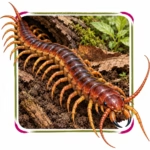
Millipede Fact Highlight
From the full animal facts page
More Animal Comparisons
Pick another animal matchup and keep exploring. Compare appearances, habitats, diets, abilities, and surprising differences.






Make an Animal Story
Turn this centipede vs millipede comparison into a many-legged forest-floor adventure with our free Animal Story Generator.
Source notes: References used for this comparison. See more See less
Try Another Matchup
Explore this comparison →