
Chameleon vs Gecko: Branch-Gripping-Chameleon-to-Wall-Climbing-Gecko Lizard Comparison
Chameleons and geckos are both lizards, but they solved tree-and-wall life in very different ways. A typical tree chameleon grips a branch with divided toe bundles and a curling tail, scans with rotating eyes, stalks slowly by day, and launches a projectile tongue. Many geckos flatten close to bark or walls, run quickly on spreading toes, hunt at night with sensitive eyes, call to one another, and shed the tail in an emergency. Neither group has one universal color, size, habitat, or lifestyle, so the Meller’s chameleon and tokay gecko appear only as named examples.
About Chameleon
- Type Reptile
- Diet Mostly a visual carnivore taking insects, spiders, worms, and other invertebrates; larger species may also take small lizards or other vertebrates, and some species nibble leaves, flowers, or fruit. A fast projectile tongue captures much of the prey.
- Group Chameleons are the specialized Old World lizards of family Chamaeleonidae. The family contains many species with very different sizes and colors; Meller’s chameleon Trioceros melleri is used as the clearly named large example for exact measurements and artwork, not as an average chameleon.
- Known for A laterally compressed lizard with turret-like eyes, grasping feet whose five toes form opposing bundles, and—in many tree-living species—a curled prehensile tail. Chameleons range from tiny leaf-dwellers to large species; the Meller’s chameleon example reaches about 61–76 centimeters and has a small rostral horn, green-and-yellow pattern, and a tail about one-third of its length.
- Special skill Opposing toe bundles grip narrow branches, a prehensile tail adds a fifth anchor in many species, independently movable eyes scan widely before aiming together, and an elastic tongue system launches a sticky tip at prey. Natural coloration supplies camouflage, while color shifts also communicate and regulate heat.
About Gecko
- Type Reptile
- Diet Most eat insects, spiders, and other small invertebrates, but the group also includes fruit, nectar, snail, small-vertebrate, and mixed feeders. Tokay geckos mainly catch invertebrates and can also take small vertebrates when available.
- Group Geckos are a diverse lizard lineage called Gekkota, spread across several families rather than one species. The tokay gecko Gekko gecko in family Gekkonidae is used as the clearly named representative for exact measurements and artwork; many geckos lack some of its features.
- Known for Usually a small-to-medium lizard with a broad head, soft-looking granular scales, large eyes, and a body suited to climbing, running, or hiding in cracks. The tokay example is a stout blue-gray gecko with orange-red spots, transparent fused eyelids, vertical pupils, and adhesive toe pads; males measure about 35–40 centimeters and females about 20–30 centimeters.
- Special skill Millions of microscopic setae on the toe pads let many species grip vertical or overhanging surfaces without glue. Nocturnal species can see extremely well in dim light, many communicate vocally, and many can release a wriggling tail and later grow a replacement.
Chameleon vs Gecko: Quick Answer
A chameleon usually has grasping two-versus-three toe bundles, independently moving turret eyes, a slow swaying walk, and a prehensile tail that normally cannot be shed. Many geckos have adhesive toe pads, large night-adapted eyes with no movable lids, quick wall-running movement, vocal calls, and a tail that can break away. Both are scaled, ectothermic lizards, and exceptions occur in each large group.
Where Do They Fit?
Follow the branches to see how Chameleon and Gecko are classified and related.
Chameleon vs Gecko: Quick Comparison
| Feature | Chameleon | Gecko |
|---|---|---|
| Scientific scope | Family Chamaeleonidae; Meller’s chameleon used as the large example | Lizard lineage Gekkota; tokay gecko used as the representative example |
| Representative size | Meller’s chameleon about 61–76 cm | Tokay males about 35–40 cm; females about 20–30 cm |
| Typical activity | Mostly daytime, though species vary | Many are nocturnal, but day geckos and other exceptions exist |
| Eyes | Turret-like eyes can scan independently and aim together at prey | Often large and night-sensitive; most geckos have a clear eye covering instead of movable lids |
| Feet | Five toes form opposing two-and-three-toe gripping bundles | Many have adhesive pads with microscopic setae; others have ordinary clawed toes |
| Tail | Often prehensile and normally not shed or regrown | Many can release the tail and grow a different replacement |
| Food capture | Often stalks and fires a projectile tongue | Usually lunges, snaps, or grabs prey with the jaws |
| Color | Natural camouflage plus controlled display and heat-related shifts within a species’ range | Camouflage varies; some species lighten or darken, and leaf-tailed geckos break up their outline |
| Sound | Relies heavily on visual displays; can hiss or make limited sounds | Many species chirp, click, bark, squeak, croak, or hiss |
| Reproduction | Most lay eggs, while some give birth to live young | Most lay eggs, while a smaller number give birth to live young |
How Are Chameleons and Geckos Alike?
- Both are squamate reptiles and true lizards with scales, lungs, clawed toes, and body temperatures controlled mainly through their surroundings.
- Both groups contain superb climbers, camouflage specialists, insect hunters, egg layers, and species adapted to tropical forests, dry country, gardens, or human-altered habitats.
- Both use vision, scent, posture, and skin pattern to detect food, avoid danger, recognize rivals, and find mates, although they emphasize those channels differently.
- Both shed old skin as they grow, can be harmed by habitat loss and wildlife trafficking, and should be watched in the wild without touching, collecting, feeding, or moving them.
- Both names cover many species, so no one size, color, diet, activity period, foot design, or reproductive rule describes every chameleon or every gecko.
How Are Chameleons and Geckos Different?
- Chameleons form family Chamaeleonidae, while geckos form the broader Gekkota lineage across several families; neither animal is simply a color form of the other.
- A chameleon’s five toes are bundled into opposing groups that clamp around a branch. Many geckos spread adhesive toe pads across a surface, though ground geckos may have no sticky pads.
- Chameleon eyes sit in scaly turrets and can scan in different directions before converging on prey. Most geckos have large eyes behind a clear covering and clean that surface with the tongue because they cannot blink.
- Chameleons usually stalk slowly and capture prey with a rapidly projected tongue. Geckos generally rush or wait, then seize prey directly with the jaws.
- Many chameleons use a prehensile tail that cannot be dropped and regrown. Many geckos use tail autotomy as an escape trick and later make a replacement that is not identical.
- Chameleons communicate especially through color, posture, and movement. Geckos are unusually vocal for lizards, and many species use chirps, clicks, barks, or croaks.
Chameleon vs Gecko Adaptation Showdown
Branch-gripping visual hunter versus wall-climbing night caller showdown: Chameleon wins representative and family maximum size because large species such as Meller’s chameleon reach well beyond the tokay example and the largest well-known geckos, while tiny species exist in both groups. Gecko wins speed because tokays and many other geckos sprint rapidly across bark or walls, whereas chameleons specialize in slow, controlled stalking; this is not one standardized race across every species. Strength is a tie because gripping toes, tongue machinery, jaws, and body size cannot be reduced to one fair group-wide test. Stealth is a tie: chameleons use natural camouflage and slow rocking movement, while leaf-tailed and bark geckos can nearly erase their outlines. Gecko wins social behavior for unusually rich vocal communication and examples of pair or egg guarding, although many remain solitary. Swimming is a tie because neither lineage is defined by aquatic specialization and individual species vary. Chameleon wins strangest adaptation for independently scanning turret eyes working with a ballistic tongue and two-and-three-toe branch clamps. These fields compare survival tools, not a fight.
Fun Chameleon vs Gecko Facts
A Chameleon Foot Works Like Two Opposing Mittens
Each chameleon foot still has five toes, but the toes are fused or closely joined into a bundle of two facing a bundle of three. The arrangement reverses between the front and rear feet, helping the animal pinch narrow twigs securely while moving one careful step at a time.
Many Gecko Feet Stick Without Glue
Under a climbing gecko’s toes, rows called lamellae support millions of microscopic hairs called setae. Their tiny tips make extremely close contact with a wall, allowing weak molecular attractions to add into a powerful dry grip. Ground-dwelling geckos show why the word many matters: some have ordinary clawed toes instead.
A Chameleon Does Not Copy Any Background
A chameleon can display only the colors and patterns permitted by its species and body. Natural coloring supplies much of its camouflage, while color shifts can signal stress, courtship, rivalry, temperature changes, or body condition. It cannot sit on a checkerboard and manufacture matching squares.
Most Geckos Clean an Eye Window With the Tongue
In most geckos the eyelids are fused into a transparent protective covering, often called a spectacle or brille. The animal cannot blink that covering clean, so it sweeps away dust and moisture with its tongue. Eyelid geckos are a real exception, which is why the rule is not universal.
Their Tails Follow Opposite Emergency Rules
Most tree chameleons use the tail as a strong prehensile anchor and do not release or regrow it. Many geckos have built-in break zones that let a wriggling tail detach while the lizard escapes; a replacement may grow, but it usually differs in shape, scales, color, or internal support.
Chameleon vs Gecko Quiz
- Which lizard usually grips a branch with opposing two-and-three-toe bundles? Answer: The chameleon.
- What microscopic structures help many gecko toes grip walls? Answer: Setae supported on toe-pad lamellae.
- Can a chameleon copy every color and pattern around it? Answer: No; each species has a limited display range.
- Why do most geckos lick their eyes? Answer: To clean the clear covering because they lack movable eyelids.
- Which group is especially famous for chirps, clicks, barks, and croaks? Answer: Geckos.
Chameleon vs Gecko FAQ
Is a chameleon a gecko?
No. Both are lizards in order Squamata, but chameleons belong to family Chamaeleonidae and geckos form a different lizard lineage called Gekkota. Their shared lizard ancestry does not make either one a type of the other.
Which is bigger, a chameleon or gecko?
The largest chameleons are longer than the largest well-documented geckos, but both groups range widely. The named Meller’s chameleon example reaches about 61–76 centimeters, while tokay gecko males reach about 35–40 centimeters. Many species in both groups are far smaller.
Can all geckos climb glass?
No. Many climbing geckos have adhesive toe pads with microscopic setae, but leopard geckos, knob-tailed geckos, and other ground specialists rely on ordinary clawed toes.
Do all chameleons change color?
Chameleons can adjust color and brightness to different degrees, but each species has a limited palette. Communication, temperature, light, stress, and condition can matter; they do not perfectly copy any background.
Can chameleons and geckos regrow their tails?
Many geckos can shed and regrow a tail, although the replacement differs from the original. Chameleons normally cannot use tail autotomy and do not regrow a lost tail, because the tail is an important climbing anchor.
Animal Words to Know
- Chamaeleonidae: The lizard family containing chameleons.
- Gekkota: The evolutionary lizard lineage containing geckos and their closest relatives.
- Prehensile: Able to curl around and grip an object, as many chameleon tails grip branches.
- Seta: One microscopic hairlike structure that helps many gecko toe pads contact a surface.
- Autotomy: The controlled release of a body part, such as a gecko tail, as an escape defense.
Chameleon and Gecko Grip Activity
Chameleon and Gecko Grip Activity
Draw a Meller’s chameleon and tokay gecko beside enlarged views of their feet. Give the chameleon independently moving turret eyes, toe bundles gripping a branch, a curled prehensile tail, and a long tongue reaching toward an insect. Give the gecko large lidless eyes, broad adhesive toe pads, a detachable tail, and a night wall or tree scene. Label lizard, eyes, branch grip, toe pad, tail, and activity time.
Meet Each Animal
Want the full fact file? Here are quick highlights from each animal’s own facts page.
Chameleon Fact Highlight
From the full animal facts page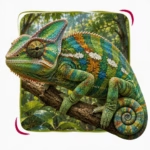
Gecko Fact Highlight
From the full animal facts page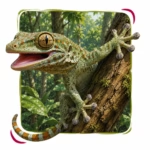
More Animal Comparisons
Pick another animal matchup and keep exploring. Compare appearances, habitats, diets, abilities, and surprising differences.






Make an Animal Story
Turn this chameleon vs gecko comparison into a branch-grip and moonlit-wall mystery with our free Animal Story Generator.
Source notes: References used for this comparison. See more See less
Try Another Matchup
Explore this comparison →