
Chamois vs Ibex: Mountain Caprine Comparison
For a precise comparison, chamois here means the Northern Chamois, Rupicapra rupicapra, and ibex means the Alpine Ibex, Capra ibex. Both are goat relatives built for steep mountains, but they do not look alike up close. A chamois is smaller and slimmer, with a dark face stripe and short horns ending in sharp hooks. An adult male Alpine Ibex is much heavier and carries enormous ridged horns that sweep backward.
About Chamois
- Type Living
- Diet Herbivore and ruminant
- Group Northern chamois species (Rupicapra rupicapra)
- Known for A bold dark face mask, slim build, quick movement and short black horns hooked at the tips
- Special skill Springs rapidly across steep ground on hooves with hard rims and grippy softer centers
About Alpine Ibex
- Type Living
- Diet Herbivore and ruminant
- Group Wild goat species (Capra ibex)
- Known for Sure-footed cliff climbing and the male’s huge backward-curving horns with bold front ridges
- Special skill Balances on tiny rock ledges using split hooves with hard outer rims and flexible gripping pads
Chamois vs Alpine Ibex: Quick Answer
The Chamois is the smaller, lighter and quicker-looking mountaineer. Both females and males have slim black horns with hooked tips and a bold dark stripe through the eye. The Alpine Ibex is a heavier wild goat. Adult males can weigh close to 100 kg and grow massive ridged horns, while females are much smaller with shorter horns. Both have clever gripping hooves.
Where Do They Fit?
Follow the branches to see how Chamois and Alpine Ibex are classified and related.
Chamois vs Alpine Ibex: Quick Comparison
| Feature | Chamois | Alpine Ibex |
|---|---|---|
| Scientific name | Rupicapra rupicapra | Capra ibex |
| Animal group | Goat-antelope relative in genus Rupicapra | Wild goat in genus Capra |
| Typical adult mass | Often about 20-50 kg, with males usually heavier | Females often 30-50 kg; adult males commonly 70-100 kg and may reach about 90 kg in the Swiss National Park |
| Build | Smaller, slim and lightly built | Stockier, especially the powerful adult male |
| Horns | Both sexes have short, slender black horns with sharply hooked tips | Both sexes have horns; adult males grow huge backward-curving horns with strong ridges |
| Face | Pale face crossed by a dark stripe from eye toward muzzle | Brown-gray face without the chamois’s bold black-and-white mask |
| Coat | Reddish or yellow-brown in summer; darker and thicker in winter | Usually brown-gray, with males often darker and bearded |
| Habitat | Alpine grassland, broken rock, scrub and mountain forest | High alpine rock, cliffs and grassland, often above the tree line |
| Social life | Females and young form herds; many adult males spend long periods alone | Females and kids herd together; males commonly form separate bachelor herds |
| Hooves | Hard outer edges and soft, grippy centers for steep rock | Split hooves with hard rims and flexible pads for balancing on ledges |
How Are Chamois and Alpine Ibex Alike?
- Both are bovids in the goat-and-antelope subfamily Caprinae.
- Both are plant-eating ruminants that chew food a second time as cud.
- Both have permanent horns in males and females instead of annually shed antlers.
- Both use split hooves with hard rims and softer gripping areas on steep mountain ground.
- Both often separate into female-and-young herds and male groups outside the breeding season.
How Are Chamois and Alpine Ibex Different?
- The Chamois is much smaller and more lightly built than an adult male Alpine Ibex.
- Chamois horns are short and sharply hooked; a male ibex’s horns are huge, ridged and curved backward.
- A chamois has a bold dark eye stripe and pale face pattern that an Alpine Ibex lacks.
- Chamois commonly use mountain forest as well as open alpine ground; ibex are more strongly tied to high rocky slopes.
- The Alpine Ibex is a true wild goat in Capra, while the Chamois belongs to the separate genus Rupicapra.
Chamois vs Alpine Ibex Adaptation Showdown
- Size – Alpine Ibex: A mature male can be several times heavier than a Chamois, although female ibex are much smaller than males.
- Speed – Chamois: Its light body and springy legs suit rapid dashes and leaps across broken slopes; this is an adaptation judgment, not a timed race.
- Strength – Alpine Ibex: The adult male’s heavier body, thick neck and enormous horns require more total muscle and bone.
- Stealth – Chamois: Its smaller body, dark facial markings and use of scrub or forest provide more chances to vanish from view.
- Social – Tie: Both form herds, and both often keep adult males apart from female-and-young groups outside the rut.
- Swimming – Tie: Neither is a swimming specialist, and no fair controlled comparison supports a winner.
- Weirdest – Alpine Ibex: Growth rings form on its permanent horns, letting trained observers estimate age without waiting for antlers to fall.
Fun Chamois vs Ibex Facts
Hooks and Sweeping Curves
A chamois horn rises almost straight and hooks backward at the tip. A male ibex horn sweeps far back in a broad curve and carries knobby ridges along the front.
Four Natural Climbing Shoes
Each animal’s cloven hoof has hard outer edges that catch tiny rock ledges and softer inner areas that grip rough ground.
A Huge Size Difference Between Sexes
Female Alpine Ibex are far smaller than adult males and have much shorter, thinner horns. This is called sexual dimorphism.
The Chamois Changes Coats
Its summer coat is shorter and warmer brown. A dense winter coat becomes much darker and helps hold warm air close to the body.
Saved From a Tiny Population
Alpine ibex were hunted almost to extinction. Protection and carefully managed reintroductions helped return them to mountain ranges across the Alps.
Chamois vs Alpine Ibex Quiz
Which animal is usually smaller? A) Chamois B) Adult male Alpine Ibex C) They are always equal Answer: A) Chamois
Which animal has short horns with hooked tips? A) Chamois B) Alpine Ibex C) Neither Answer: A) Chamois
Which animal’s adult male has enormous ridged horns? A) Chamois B) Alpine Ibex C) Red Deer Answer: B) Alpine Ibex
Do their horns fall off every year? A) Yes B) No C) Only in summer Answer: B) No
What helps both animals grip rock? A) Webbed toes B) Split hooves with gripping surfaces C) Sticky feathers Answer: B) Split hooves with gripping surfaces
Chamois vs Ibex FAQ
Is a chamois a type of ibex?
No. Both are caprines, but the Northern Chamois is Rupicapra rupicapra and the Alpine Ibex is Capra ibex.
Which ibex does this page compare?
It compares the Alpine Ibex. Other ibex species live in different mountain regions and can differ in size and appearance.
Do female chamois and ibex have horns?
Yes. Females of both species have permanent horns, but a female ibex’s horns are much smaller than a mature male’s.
Which animal lives higher in the mountains?
Both use high slopes, but Alpine Ibex are more strongly associated with open rocky alpine habitat; chamois also use scrub and mountain forest.
Can horn rings tell an ibex’s age?
Trained observers can use the annual growth pattern to estimate age. Small decorative ridges alone should not simply be counted as exact years.
Animal Words to Know
- Caprine: An animal in the goat-and-antelope subfamily Caprinae.
- Cloven hoof: A hoof split into two main toes.
- Ruminant: A plant eater that brings food back up and chews it again as cud.
- Rut: The seasonal breeding period when males compete for mates.
- Sexual dimorphism: A noticeable difference in appearance between adult males and females of one species.
Design Mountain-Grip Hooves
Design Mountain-Grip Hooves
Press two blocks of modeling clay onto a rough stone to make a split-hoof shape. Give each half a hard drawn rim and a softer textured center. Sketch a light Chamois above one track and a heavy Alpine Ibex above the other, then label how the same basic hoof plan helps both.
Meet Each Animal
Want the full fact file? Here are quick highlights from each animal’s own facts page.
Chamois Fact Highlight
From the full animal facts page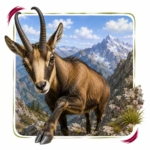
Alpine Ibex Fact Highlight
From the full animal facts page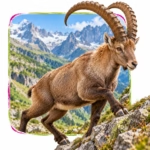
More Animal Comparisons
Pick another animal matchup and keep exploring. Compare appearances, habitats, diets, abilities, and surprising differences.


Make an Animal Story
Create a mountain story about a quick Chamois and a sure-footed Alpine Ibex sharing a rocky trail!
Source notes: References used for this comparison. See more See less
Try Another Matchup
Explore this comparison →