
Coconut Crab vs Hermit Crab for Kids: Giant or Shell Carrier?
Coconut Crabs and Hermit Crabs are close relatives, and neither is a true crab. The coconut crab is actually the most land-adapted and largest member of the land hermit crab family. A young coconut crab begins life using a borrowed snail shell, but its abdomen later develops hard protective plates. Most familiar hermit crabs keep a softer, curved abdomen and carry a shell throughout life.
About Coconut Crab
- Type Giant land-adapted hermit crab
- Diet Omnivorous scavenger
- Group Land hermit crab family, Coenobitidae
- Known for Being the largest land-living arthropod, climbing trees, and using immensely powerful claws
- Special skill Hardens its abdomen as it grows, so the giant adult no longer needs to carry a borrowed shell
About Hermit Crab
- Type Shell-carrying anomuran crustacean
- Diet Mostly omnivore and scavenger
- Group Hermit crab superfamily, Paguroidea
- Known for Protecting a soft curved abdomen inside an empty snail shell
- Special skill Moves into larger borrowed shells as its body grows
Quick Answer
Quick answer: A Coconut Crab is a giant land hermit crab that can weigh up to about 4 kg and span close to 1 m from leg tip to leg tip. Adults have a hardened abdomen, breathe with specialized lung-like chambers, climb, dig burrows, and do not carry shells. A typical Hermit Crab is much smaller and protects its soft spiral abdomen in an empty snail shell that must be replaced as it grows. Both are omnivorous crustaceans with ocean-living larvae.
Coconut Crab vs Hermit Crab: Quick Comparison
| Feature | Coconut Crab | Hermit Crab |
|---|---|---|
| Scientific identity | Birgus latro, one land hermit crab species | Paguroidea, a superfamily containing hundreds of species |
| Relationship | A highly land-adapted hermit crab, not a true crab | Anomuran crustaceans related to coconut crabs, not true crabs |
| Adult size | Up to about 4 kg and nearly 1 m across the legs | Usually far smaller; size varies greatly among species |
| Abdomen protection | Juveniles borrow shells; large adults develop hard plates and stop carrying one | Soft curved abdomen normally remains tucked inside a borrowed shell |
| Main habitat | Humid tropical islands, forests, burrows, and rocky coastal ground | Marine seafloors or humid tropical land near the coast, depending on species |
| Breathing | Adults use specialized lung-like chambers and can drown if kept underwater | Marine species use gills; land species use modified gills and must keep them moist |
| Main food | Fruit, nuts, seeds, carrion, discarded food, and other available material | Algae, plant scraps, carrion, tiny animals, and other available material |
| Movement | Walks on land, digs deep burrows, and can climb trees | Walks while carrying a shell; some marine species climb rocks and reefs |
| Social behavior | Mostly solitary, with size-based dominance around food | Many species gather and may form orderly shell-exchange chains |
| Early life | Female releases eggs at sea; larvae develop in water before young crabs return to land | Larvae develop in seawater before settling into species-specific adult habitats |
How Coconut Crabs and Hermit Crabs Are Alike
- Both are decapod crustaceans in the anomuran group rather than true crabs.
- Both have unequal claws, with one often larger than the other.
- Both are flexible omnivores and scavengers that recycle available food.
- Both grow by molting and are vulnerable while a new exoskeleton hardens.
- Both begin life as tiny larvae in seawater, even when the adults live on land.
How Coconut Crabs and Hermit Crabs Are Different
- The Coconut Crab is the largest land-living arthropod, while most other hermit crabs are much smaller.
- An adult Coconut Crab has a hardened abdomen and carries no shell, while a typical Hermit Crab keeps its abdomen inside a borrowed shell.
- Coconut Crabs live almost entirely on land, while most hermit crab species are marine.
- The Coconut Crab has powerful lung-like breathing chambers, while marine hermit crabs breathe with gills underwater.
- Typical Hermit Crabs may queue and swap shells, while Coconut Crabs mainly compete over food and burrow space.
Coconut Crab vs Hermit Crab Adaptation Showdown
Adaptation showdown: Coconut Crab wins size because it can weigh about 4 kg and span nearly 1 m, dwarfing most shell-carrying hermit crabs. Speed is a Tie because the broad hermit crab group has no fair matched land-speed comparison. Coconut Crab wins strength because its massive claws can tear tough food and produce an exceptionally forceful pinch. Hermit Crab wins stealth because it can withdraw its soft body into a camouflaged borrowed shell. Hermit Crab wins social behavior because many species gather and may organize shell-exchange chains. Swimming is a Tie because adults in this comparison are mainly crawlers, although their larvae live and swim in the sea. Coconut Crab wins weirdest for starting in a borrowed shell, abandoning it, growing into the largest land arthropod, and breathing air with lung-like chambers.
Fun Coconut Crab vs Hermit Crab Facts
A Hermit Crab That Outgrows Its House
A young Coconut Crab uses an empty snail shell like other land hermit crabs. As it grows, hard plates strengthen the abdomen and the adult stops carrying a shell.
The Largest Arthropod on Land
A very large Coconut Crab may weigh about 4 kg and measure close to 1 m from the tip of one leg to the opposite tip.
A Nose That Works in Air
Coconut Crabs use their antennules to detect airborne odors, helping them locate ripe fruit, carrion, and other food across a dark forest floor.
A Borrowed Spiral Suit
A typical Hermit Crab has a long, soft, curved abdomen shaped to grip the central spiral of a snail shell. Small appendages help anchor it inside.
The Shell Exchange Queue
When a useful empty shell appears, some social hermit crabs line up by size. Each crab may move into the shell vacated by the slightly larger crab ahead.
Coconut Crab vs Hermit Crab Quiz
- Is a Coconut Crab related to hermit crabs? Answer: Yes. It is a giant land hermit crab in the family Coenobitidae.
- Which animal normally carries a borrowed shell as an adult? Answer: The typical Hermit Crab.
- Why does an adult Coconut Crab not need a snail shell? Answer: Hard plates develop over its abdomen as it grows.
- Where do the larvae of both animals develop? Answer: In seawater.
- What must a Hermit Crab find as it grows? Answer: A larger suitable empty shell.
Coconut Crab vs Hermit Crab FAQ
Is a Coconut Crab a true crab?
No. It is an anomuran and a highly specialized member of the land hermit crab family.
Do Coconut Crabs eat only coconuts?
No. They eat many fruits, nuts, seeds, carrion, molted exoskeletons, and other available foods.
Can an adult Coconut Crab live underwater?
No. Its air-breathing chambers must stay moist, but prolonged submersion can drown it.
Do Hermit Crabs make their own shells?
No. They normally reuse empty shells made by snails and sometimes use other hollow objects.
Should people pick up either crab?
No. Give wild crabs space, never pull one from a shell, and leave natural empty shells where animals can use them.
Animal Words to Know
- Anomuran: A crustacean group that includes hermit crabs, coconut crabs, and squat lobsters.
- Arthropod: An animal with jointed legs, a segmented body, and an outer skeleton.
- Exoskeleton: A hard outer covering that supports and protects an animal’s body.
- Scavenger: An animal that eats dead organisms or leftover organic material.
- Molt: To shed an old outer covering so the body can grow.
Design Two Hermit Crab Survival Kits
Design Two Hermit Crab Survival Kits
Draw exactly one adult Coconut Crab and exactly one typical shell-carrying Hermit Crab at honest relative scale, making the Coconut Crab dramatically larger. Label the Coconut Crab’s large left claw, hardened abdomen, long climbing legs, smell-sensing antennules, and forest burrow. Label the Hermit Crab’s borrowed spiral shell, soft curved abdomen hidden inside, eyestalks, walking legs, and smaller claw. Add a tiny life-cycle strip showing ocean larvae without adding another adult. Never handle wild crabs or remove shells from their habitat.
Meet Each Animal
Want the full fact file? Here are quick highlights from each animal’s own facts page.
Coconut Crab Fact Highlight
From the full animal facts page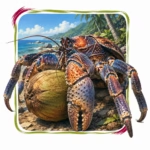
Hermit Crab Fact Highlight
From the full animal facts page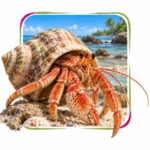
More Animal Comparisons
Pick another animal matchup and keep exploring. Compare appearances, habitats, diets, abilities, and surprising differences.




Make an Animal Story
Send a giant island climber and a clever shell carrier on a tropical mystery with our free Animal Story Generator.