
Short-beaked Echidna vs Sunda Pangolin: Convergent Mammal Comparison
The Short-beaked Echidna and Sunda Pangolin both have long sticky tongues, no useful chewing teeth, strong digging claws, and protective body coverings. Those similarities evolved separately. The echidna is an egg-laying monotreme with modified hairs called spines, while the pangolin is a placental mammal covered in overlapping keratin scales.
About Short-beaked Echidna
- Type Egg-laying mammal
- Diet Insectivore
- Group Monotreme family, Tachyglossidae
- Known for Spines, powerful digging claws, and laying one leathery egg
- Special skill Digs straight down and wedges a shield of spines into the soil
About Sunda Pangolin
- Type Scale-covered placental mammal
- Diet Ant and termite specialist
- Group Pangolin family, Manidae
- Known for Keratin armor, a very long sticky tongue, and rolling into a ball
- Special skill Curls into a tight armored ball and climbs with a gripping tail
Short-beaked Echidna vs Sunda Pangolin: Quick Answer
A Short-beaked Echidna is an Australian and New Guinean monotreme that lays one egg and carries the tiny puggle in a temporary pouch. A Sunda Pangolin is a Southeast Asian placental mammal that gives birth to a live pangopup and wears overlapping scales. Both eat ants and termites, dig powerfully, live mostly alone, and can curl up for defense.
Where Do They Fit?
Follow the branches to see how Short-beaked Echidna and Sunda Pangolin are classified and related.
Short-beaked Echidna vs Sunda Pangolin: Quick Comparison
| Feature | Short-beaked Echidna | Sunda Pangolin |
|---|---|---|
| Scientific name | Tachyglossus aculeatus | Manis javanica |
| Mammal branch | Monotreme, an egg-laying mammal | Placental mammal in order Pholidota |
| Body size | About 40 to 55 cm long | About 79 to 88 cm long including the long tail |
| Body covering | Sharp spines made from modified hairs, with fur between them | Overlapping hard scales made of keratin, with a soft belly |
| Native home | Australia, Tasmania, and parts of New Guinea | Tropical Southeast Asia |
| Main food | Ants, termites, and other small invertebrates | Almost entirely ants and termites |
| Feeding tool | Long sticky tongue, tubular snout, and hard grinding pads | Tongue that can extend about 25 cm, with no teeth |
| Defense | Digs down, wedges in place, or curls into a spiny ball | Curls into a tight scaled ball and may lash its sharp-edged tail |
| Movement | Strong ground digger that can also climb and swim | Ground walker, burrower, agile climber, and capable swimmer |
| Young | Lays one egg; a puggle drinks milk from skin pores | Usually one live-born pangopup that may ride on its mother’s tail |
How Echidnas and Pangolins Are Alike
- Both are mammals with strong claws, narrow snouts, and long sticky tongues.
- Both specialize in opening ant or termite nests and collecting small insects.
- Both lack normal chewing teeth and process food using other mouth or stomach structures.
- Both are usually solitary and rely strongly on smell while foraging.
- Both can protect the soft face and belly by curling into a defended shape.
How Echidnas and Pangolins Are Different
- The echidna has sharp spines mixed with fur, while the pangolin has overlapping keratin scales.
- The echidna lays an egg, while the pangolin gives birth to a live young after development in the uterus.
- Short-beaked Echidnas live in Australia and New Guinea, while Sunda Pangolins live in Southeast Asia.
- An echidna has a very short tail, while a Sunda Pangolin has a long gripping tail used while climbing.
- Echidnas may forage by day or night depending on conditions, while Sunda Pangolins are mainly nocturnal.
Echidna vs Pangolin Adaptation Showdown
Adaptation showdown: Sunda Pangolin wins size because its head, body, and long tail together can reach about 79 to 88 cm. Speed is a Tie because neither animal is a speed specialist and fair matched top speeds are unavailable. Strength is a Tie because the echidna digs and anchors itself powerfully while the pangolin opens nests, burrows, and climbs with strong claws and tail. Sunda Pangolin wins stealth because it is secretive, mainly nocturnal, and can move through tropical cover or trees. Social behavior is a Tie because both are mainly solitary. Swimming is a Tie because both can swim but neither is aquatic. Short-beaked Echidna wins weirdest for laying an egg, hatching a jelly-bean-sized puggle, and releasing milk through skin pores instead of nipples.
Fun Short-beaked Echidna vs Sunda Pangolin Facts
A Mammal That Lays an Egg
A female Short-beaked Echidna lays one soft, leathery egg into a temporary belly pouch. It hatches after about 10 days.
Milk Without Nipples
An echidna mother has no nipples. Milk seeps from special mammary pores onto hairs in the pouch, where the puggle laps it up.
Scales Made Like Fingernails
Pangolin scales are made of keratin, the same tough protein found in human fingernails and hair. Newborn scales begin soft and harden later.
A Tongue Anchored Deep Inside
A Sunda Pangolin can extend its narrow sticky tongue about 25 cm. Muscles for the enormous tongue reach deep through the chest and attach near the pelvis.
Two Separate Evolution Experiments
Echidnas and pangolins are distant relatives, yet both independently evolved claws, long tongues, reduced teeth, and armor for ant-eating lives.
Echidna vs Pangolin Quiz
- Which animal lays an egg? Answer: The Short-beaked Echidna.
- What are pangolin scales made of? Answer: Keratin, the same protein found in hair and fingernails.
- What do both animals mainly search for? Answer: Ants and termites.
- Which animal has a long prehensile tail? Answer: The Sunda Pangolin.
- What is convergent evolution? Answer: It is the separate evolution of similar features in organisms that are not close relatives.
Short-beaked Echidna vs Sunda Pangolin FAQ
Is a pangolin a type of echidna?
No. Pangolins are placental mammals, while echidnas are monotremes on a much older mammal branch.
Are pangolin scales the same as reptile scales?
No. Pangolin scales are keratin structures that developed from mammalian skin, and the animal still has hair on softer areas.
Can an echidna shoot its spines?
No. Its spines stay attached. It protects itself by digging, wedging into the ground, or curling.
Do pangolins have teeth?
No. A Sunda Pangolin catches insects with a sticky tongue and swallows grit that helps process food.
Can both animals swim?
Yes. Both have been observed swimming, although most of their lives are spent on land.
Animal Words to Know
- Monotreme: An egg-laying mammal, such as an echidna or platypus.
- Placental mammal: A mammal whose developing young receives nourishment through a placenta before birth.
- Keratin: A tough protein that forms hair, nails, claws, hooves, and pangolin scales.
- Prehensile: Able to curl around and grip something, as a Sunda Pangolin’s tail can.
- Convergent evolution: The separate evolution of similar features in organisms that are not close relatives.
Design Two Insect-Hunter Armors
Design Two Insect-Hunter Armors
Draw exactly one adult Short-beaked Echidna and exactly one adult Sunda Pangolin at honest relative scale. Label the echidna’s spines, short tail, digging claws, snout, egg, and milk patch. Label the pangolin’s overlapping scales, long gripping tail, claws, long tongue, and live-born young. Circle features that evolved separately but do similar jobs. Never touch, feed, buy, or handle wild animals or wildlife products.
Meet Each Animal
Want the full fact file? Here are quick highlights from each animal’s own facts page.
Short-beaked Echidna Fact Highlight
From the full animal facts page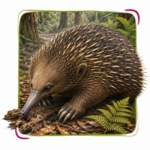
Sunda Pangolin Fact Highlight
From the full animal facts page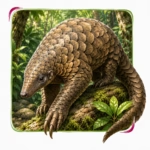
More Animal Comparisons
Pick another animal matchup and keep exploring. Compare appearances, habitats, diets, abilities, and surprising differences.




Make an Animal Story
Send a spiny Echidna and an armored Pangolin on an ant-hunting forest mystery with our free Animal Story Generator.
Source notes: References used for this comparison. See more See less
Try Another Matchup
Explore this comparison →