
Emu vs Cassowary: Flightless Bird Comparison
Emus and cassowaries are large flightless birds from Australia and nearby islands, but they are built for very different landscapes. Emus roam open country in shaggy brown feathers. Cassowaries move through dense rainforests with glossy black plumage, colorful neck skin, a helmet-like casque, and a long inner toe claw.
About Emu
- Type Bird
- Diet Omnivore
- Group Australian Ratite
- Known for Shaggy double-shafted feathers, three-toed feet, fast running, booming calls, and devoted fathers
- Special skill Walking long distances across dry country while the male incubates the eggs and raises striped chicks
About Cassowary
- Type Bird
- Diet Frugivore
- Group Casuariid Ratite
- Known for Helmet-like casque, glossy black feathers, colorful neck skin, powerful legs, and rainforest seed dispersal
- Special skill Swallowing large rainforest fruits and spreading their seeds far from the parent trees
Emu vs Cassowary: Quick Answer
Emus are tall, shaggy brown Australian runners that live mainly in open habitats. Cassowaries are heavier rainforest birds from New Guinea and northeastern Australia, with black feathers, colorful necks, a helmet-like casque, and a long claw on each inner toe. Both have three toes, cannot fly, and rely on males to incubate eggs and raise chicks.
Where Do They Fit?
Follow the branches to see how Emu and Cassowary are classified and related.
Emu vs Cassowary: Quick Comparison
| Feature | Emu | Cassowary |
|---|---|---|
| Animal type | Bird | Bird |
| Animal group | Australian ratite | Casuariid ratite |
| Known for | Shaggy feathers, fast running, booming calls, and devoted fathers | Casque, colorful neck, powerful legs, and rainforest seed dispersal |
| Natural range | Mainland Australia | New Guinea, nearby islands, and northeastern Australia depending on species |
| Main habitat | Woodlands, grasslands, scrub, and semi-arid plains | Tropical rainforest, swamp forest, and dense coastal vegetation |
| Typical build | Taller and slimmer | Shorter but often heavier and more powerfully built |
| Head | Small feathered head without a casque | Bare colorful skin and a helmet-like casque |
| Toes | Three toes on each foot | Three toes, including a long inner claw |
| Baby name | Chick | Chick |
| Main incubator | Male | Male |
How Are Emus and Cassowaries Alike?
- Both emus and cassowaries are large flightless birds called ratites.
- Both have three forward-pointing toes, strong legs, small wings, and loose feathers.
- Both eat fruit and other plant foods, although their exact diets differ.
- In both groups, males incubate the eggs and care for the striped chicks.
- Both can run quickly and swim when needed.
How Are Emus and Cassowaries Different?
- Emus live mainly in open Australian habitats, while cassowaries are rainforest birds from New Guinea and northeastern Australia.
- Emus are usually taller and slimmer, while southern cassowaries can be heavier and more powerfully built.
- Emus have shaggy brown feathers, while adult cassowaries have glossy black plumage and colorful bare neck skin.
- Cassowaries have a helmet-like casque, while emus do not.
- Cassowaries have a long inner toe claw and eat mostly fruit, while emus have more even-sized toes and a broader omnivorous diet.
Emu vs Cassowary Showdown
Flightless-bird showdown: Size is a tie because emus are generally taller, while southern cassowaries can be heavier. Speed is also a tie because both can run at roughly 50 kilometers per hour in short bursts. The cassowary wins strength, stealth, and swimming with its powerful body, dark rainforest camouflage, and ability to cross rivers and coastal channels. The emu takes social life because it more often travels in loose mobs. Cassowary wins our weirdest-fact prize for the casque, whose exact combination of display, sound, and protective functions is still being studied.
Fun Emu vs Cassowary Facts
Open-Country Runner vs Rainforest Walker
Emus cross woodlands, grasslands, scrub, and dry plains while searching for seasonal food and water. Cassowaries usually move through dense tropical forest, where compact bodies and powerful legs help them step over roots and push through vegetation.
Shaggy Brown vs Glossy Black
Emu feathers are shaggy and brown, helping the bird blend with dry grass and scrub. Adult cassowaries have coarse glossy black feathers plus bright blue, purple, or red bare skin on the head and neck depending on species and individual.
No Casque vs Helmet-Like Casque
An emu has a small head without a casque. A cassowary carries a tall keratin-covered structure on top of the head called a casque, which grows with age and may help with display, sound reception, or moving through vegetation.
Three Toes vs Three Toes With a Dagger Claw
Both birds have three toes on each foot. A cassowary’s inner toe bears an especially long, straight claw that can be used in defense, while an emu’s toe claws are shorter and more similar in size.
Two Remarkable Bird Fathers
Male emus incubate dark green eggs and raise the chicks. Male cassowaries also incubate eggs and protect striped chicks, teaching them where to find food until they become independent.
Emu vs Cassowary Quiz
- Which bird lives mainly in open Australian habitats? Answer: Emu.
- Which bird has a helmet-like casque? Answer: Cassowary.
- How many toes does each bird have on each foot? Answer: Three.
- Which parent incubates the eggs in both groups? Answer: The male.
- Which bird is an especially important rainforest seed disperser? Answer: Cassowary.
Emu vs Cassowary FAQ
What is the main difference between an emu and a cassowary?
Emus are tall, shaggy brown birds of open Australian country. Cassowaries are heavier rainforest birds with black feathers, colorful neck skin, a casque, and a long inner toe claw.
Which is bigger, an emu or a cassowary?
Emus are generally taller, but female southern cassowaries can be heavier. Size therefore depends on whether height or body mass is being compared.
Which is faster, an emu or a cassowary?
Both are fast runners and can reach roughly 50 kilometers per hour in short bursts, although estimates vary with species, individual, terrain, and measurement.
Are cassowaries dangerous?
Cassowaries are usually shy and avoid people, but they are powerful wild birds that can defend themselves with kicks and claws. Children should never approach, feed, chase, or corner one.
Do emus and cassowaries fly?
No. Both are flightless ratites with small wings and strong legs adapted for walking, running, and defense.
Animal Words to Know
- Ratite: A member of a group of mostly large flightless birds with a flat breastbone lacking the keel used by strong flying birds.
- Casque: A helmet-like structure on top of a cassowary’s head.
- Frugivore: An animal whose diet consists mainly of fruit.
- Seed dispersal: The movement of seeds away from a parent plant, often by animals.
- Incubate: To keep eggs warm and protected while embryos develop.
Emu and Cassowary Drawing Activity
Emu and Cassowary Drawing Activity
Draw a male emu and a male southern cassowary standing on the same ground line. Make the emu taller and slimmer, with shaggy brown feathers and long legs. Make the cassowary stockier, with glossy black feathers, a colorful neck, a helmet-like casque, and a long inner toe claw. Add striped chicks near each father. Label height, feathers, casque, claw, habitat, and chick care.
Meet Each Animal
Want the full fact file? Here are quick highlights from each animal’s own facts page.
Emu Fact Highlight
From the full animal facts page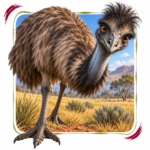
Cassowary Fact Highlight
From the full animal facts page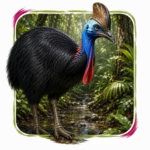
More Animal Comparisons
Pick another animal matchup and keep exploring. Compare appearances, habitats, diets, abilities, and surprising differences.




Make an Animal Story
Turn this emu vs cassowary comparison into a wild Australian rainforest adventure with our free Animal Story Generator.
Source notes: References used for this comparison. See more See less
Try Another Matchup
Explore this comparison →