
European Goldfinch vs American Goldfinch: Goldfinch Species Comparison
European and American goldfinches are both small seed-eating finches, but they are separate species in different genera. The European Goldfinch, Carduelis carduelis, has a red face, black-and-white head and bright yellow wing stripe. The American Goldfinch, Spinus tristis, lacks the red face. A breeding male turns lemon yellow with a black cap, then molts into duller olive-brown winter feathers.
About European Goldfinch
- Type Living
- Diet Mainly seed-eating herbivore; adults also bring some insects to chicks
- Group Finch species in genus Carduelis (Carduelis carduelis)
- Known for Red face, black-and-white head, tan body, bright yellow wing stripe and a fine bill for thistle seeds
- Special skill Uses a slim pointed bill and acrobatic balance to pull tiny seeds from prickly teasel and thistle heads
About American Goldfinch
- Type Living
- Diet Seed-specialist herbivore
- Group Finch species in genus Spinus (Spinus tristis)
- Known for A breeding male’s bright yellow body and black cap, bouncy flight, seed diet and dramatic seasonal color change
- Special skill Times nesting for late summer when thistle-like plants provide abundant seeds and soft fibers for nests
European Goldfinch vs American Goldfinch: Quick Answer
The European Goldfinch keeps a colorful red, black and white head pattern and flashes a yellow stripe across black wings. The American Goldfinch changes more with the seasons: the summer male is brilliant yellow with a black cap, while winter birds are much duller. Both are small social finches that hang from seed heads and gather in flocks.
Where Do They Fit?
Follow the branches to see how European Goldfinch and American Goldfinch are classified and related.
European Goldfinch vs American Goldfinch: Quick Comparison
| Feature | European Goldfinch | American Goldfinch |
|---|---|---|
| Scientific name | Carduelis carduelis | Spinus tristis |
| Native range | Europe, North Africa and western to central Asia | Canada, the United States and northern Mexico |
| Length | Usually about 12-13.5 cm | Usually about 11-13 cm |
| Mass | Often about 14-19 g | Often about 11-20 g |
| Head clue | Bright red face inside a black-and-white head pattern | Breeding male has a black forehead cap; no red face |
| Body color | Warm tan or buff body with white underparts | Male bright yellow in breeding plumage; winter birds dull olive-brown |
| Wing clue | Black wing crossed by one broad golden-yellow stripe | Blackish wings with pale white wing bars |
| Bill | Longer, fine and pale for reaching narrow seed heads | Shorter, sturdy and conical for opening seeds |
| Nesting time | Mostly spring into summer, varying with region | Often waits until mid-to-late summer when seed plants mature |
| Social life | Often forms flocks and may nest in loose groups | Often forms flocks, especially outside nesting |
How Are European and American Goldfinches Alike?
- Both are small songbirds in the finch family Fringillidae.
- Both eat mostly seeds and are especially skilled at feeding from tall seed heads.
- Both have black wings marked by bright yellow or pale bars that flash in flight.
- Both have bouncy flight patterns and musical twittering calls.
- Both commonly gather in flocks outside the most territorial part of nesting.
How Are European and American Goldfinches Different?
- The European Goldfinch belongs to Carduelis, while the American Goldfinch belongs to Spinus.
- The European bird has a red face and black-and-white head; the American bird never has that face mask.
- A male American Goldfinch changes from dull winter colors to brilliant yellow for breeding.
- The European Goldfinch has a longer, finer bill for probing narrow seed heads.
- American Goldfinches often nest later in summer than European Goldfinches.
European vs American Goldfinch Adaptation Showdown
- Size – Tie: Their normal length and mass ranges overlap greatly, so individual birds matter more than species.
- Speed – Tie: Both have quick, dipping flights, but no controlled same-course test identifies a faster species.
- Strength – Tie: Each has feet and a seed-cracking bill suited to its body size, with no useful evidence for a stronger bird.
- Stealth – American Goldfinch: Its muted olive-brown winter plumage blends neatly with dry stems and dormant fields after summer ends.
- Social – Tie: Both regularly travel and feed in flocks and become more focused on pairs or nests during breeding.
- Swimming – Tie: Neither is adapted for swimming, so this category has no meaningful winner.
- Weirdest – American Goldfinch: It replaces body feathers in spring and again after breeding, changing the male from dull olive to bright yellow and back.
Fun European Goldfinch vs American Goldfinch Facts
Two Genera, One Golden Name
European and American goldfinches share the finch family, a love of seeds and flashes of yellow, but scientists place them in Carduelis and Spinus.
A Red Mask and Golden Wings
The European species combines a red face with a black-and-white head. Its black wing carries a broad yellow band visible even when it flies.
A Seasonal Feather Switch
An American male wears brilliant yellow breeding feathers with a black cap, then becomes dull olive-brown for winter. Females stay subtler all year.
Seed-Head Acrobatics
Both goldfinches cling to flexible plant stems and may hang at steep angles while pulling out tiny seeds. Their feet work like clamps.
The Late-Nesting Finch
American Goldfinches often wait until thistles, milkweeds and other plants produce seeds and soft down. The female uses fibers to build a tight cup nest.
European Goldfinch vs American Goldfinch Quiz
Which goldfinch has a red face? A) European Goldfinch B) American Goldfinch C) Both Answer: A) European Goldfinch
Which breeding male turns bright yellow with a black cap? A) European Goldfinch B) American Goldfinch C) Neither Answer: B) American Goldfinch
What do both species eat most often? A) Fish B) Seeds C) Large mammals Answer: B) Seeds
Are they in the same genus? A) Yes B) No C) Only in winter Answer: B) No
Which species often waits until mid-to-late summer to nest? A) European Goldfinch B) American Goldfinch C) Neither Answer: B) American Goldfinch
European Goldfinch vs American Goldfinch FAQ
Are European and American goldfinches the same species?
No. The European Goldfinch is Carduelis carduelis, while the American Goldfinch is Spinus tristis.
Which goldfinch is bigger?
Their size ranges overlap. Neither species is consistently large enough to be a reliable size winner.
Does an American Goldfinch stay bright yellow all year?
No. Breeding males are brightest in spring and summer, then molt into much duller winter plumage.
Why do goldfinches visit thistles?
Thistles produce many small seeds, and the birds can cling to the stems while using specialized bills to pull the seeds free.
Should people remove every dry seed head in autumn?
Leaving some safe, pesticide-free native seed heads can provide natural food, but gardeners should choose plants suitable for their own region.
Animal Words to Know
- Finch: A small songbird in the family Fringillidae, often adapted for eating seeds.
- Genus: A scientific group containing one or more closely related species.
- Molt: The process of replacing old feathers with new ones.
- Plumage: All the feathers covering a bird’s body.
- Seed head: The part of a plant that holds mature seeds.
Make a Goldfinch Season Spinner
Make a Goldfinch Season Spinner
Cut two paper circles with adult help and fasten them in the center. Draw a European Goldfinch’s steady red-face pattern on one side. On the American side, make a window that changes a male from brilliant yellow summer feathers to dull olive winter feathers. Add wing, bill, range and nesting clues.
Meet Each Animal
Want the full fact file? Here are quick highlights from each animal’s own facts page.
European Goldfinch Fact Highlight
From the full animal facts page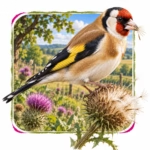
American Goldfinch Fact Highlight
From the full animal facts page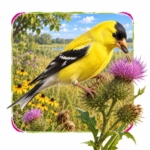
More Animal Comparisons
Pick another animal matchup and keep exploring. Compare appearances, habitats, diets, abilities, and surprising differences.





Make an Animal Story
Create a goldfinch story about two tiny seed acrobats wearing very different flashes of yellow!
Source notes: References used for this comparison. See more See less
Try Another Matchup
Explore this comparison →