
Frilled Lizard vs Bearded Dragon for Kids: Frill or Beard?
The Frilled Lizard and Central Bearded Dragon are Australian members of the dragon lizard family. Both bask, climb, lay eggs, and use body displays instead of loud calls. The frilled lizard spends much of its time on tree trunks and can unfold a huge neck ruff. The bearded dragon is a broad-bodied semi-arid omnivore with a spiky expandable throat.
About Frilled Lizard
- Type Arboreal agamid lizard
- Diet Mostly insectivore
- Group Dragon lizard family, Agamidae
- Known for A large neck frill and fast two-legged escape runs
- Special skill Opens its bright mouth and broad neck frill, then may sprint away on two legs
About Central Bearded Dragon
- Type Ground and shrub-dwelling agamid lizard
- Diet Omnivore
- Group Dragon lizard family, Agamidae
- Known for A spiky beard that expands and darkens during displays
- Special skill Puffs a dark beard and communicates with head bobs and slow arm waves
Quick Answer
Quick answer: A Frilled Lizard is the larger, more tree-living species, famous for opening a wide neck frill and sprinting on its hind legs when threatened. A Central Bearded Dragon is a stockier semi-arid lizard that puffs and darkens its spiky beard, head-bobs, and arm-waves. Both are diurnal, egg-laying agamids, but their habitats, diets, body shapes, and signature displays are different.
Frilled Lizard vs Central Bearded Dragon: Quick Comparison
| Feature | Frilled Lizard | Central Bearded Dragon |
|---|---|---|
| Scientific name | Chlamydosaurus kingii | Pogona vitticeps |
| Lizard family | Agamidae, the dragon lizards | Agamidae, the dragon lizards |
| Adult length | Often about 85 cm total; large males may approach 1 m | Up to about 55 cm total |
| Signature display | Unfolds a large circular neck frill and gapes | Expands and darkens a spiky throat beard |
| Main habitat | Tropical savanna woodland and dry forest with trees | Semi-arid woodland, scrub, rocky ground, and dry interior |
| Daily life | Diurnal and strongly arboreal, often resting on trunks | Diurnal and semi-arboreal, basking on rocks, logs, or shrubs |
| Main food | Insects and spiders, plus occasional small vertebrates | Leaves, fruit, flowers, invertebrates, and small vertebrates |
| Fast escape | May rise onto its hind legs and sprint to a tree | Runs on four legs and climbs to a basking or hiding place |
| Communication | Frill, open mouth, body posture, and color | Head bobs, arm waves, beard color, posture, and color |
| Young | Multiple eggs buried in warm soil; hatchlings are independent | Often 11 to 30 eggs in a burrow; hatchlings are independent |
How Frilled Lizards and Bearded Dragons Are Alike
- Both belong to Agamidae, the Old World dragon lizard family.
- Both are active by day and warm themselves by basking in sunlight.
- Both climb above the ground, although the frilled lizard spends more time in trees.
- Both lay eggs in soil and provide no long period of parental care after hatching.
- Both use expandable throat skin, body posture, and color in visual communication.
How Frilled Lizards and Bearded Dragons Are Different
- The Frilled Lizard has a broad skin frill supported by long cartilage rods, while the bearded dragon has a smaller spiky throat beard.
- An adult Frilled Lizard is usually longer and much more slender than a Central Bearded Dragon.
- The frilled lizard is mainly an insect hunter, while the bearded dragon is an omnivore that also eats plant food.
- Frilled Lizards favor tropical northern woodland, while Central Bearded Dragons occupy drier inland country.
- A frightened Frilled Lizard may sprint upright on two legs, while a bearded dragon normally escapes on all four.
Frilled Lizard vs Bearded Dragon Adaptation Showdown
Adaptation showdown: Frilled Lizard wins size because adults often reach about 85 cm total length, compared with about 55 cm for a Central Bearded Dragon. Frilled Lizard wins speed for its explosive bipedal dash to a tree. Strength is a Tie because matched force measurements are unavailable and each uses strong claws and jaws at its own scale. Frilled Lizard wins stealth because its bark-colored body can rest almost flat against a trunk. Social behavior is a Tie because both are mainly solitary but send detailed visual signals. Swimming is a Tie because neither species is aquatic and fair matched speeds are unavailable. Frilled Lizard wins weirdest for turning a folded neck membrane into a dramatic disk, then racing away on two legs.
Fun Frilled Lizard vs Central Bearded Dragon Facts
A Frill Built Like an Umbrella
Long cartilage rods support the Frilled Lizard’s folded neck skin. When muscles pull the rods forward, the membrane spreads into a broad disk around the head.
A Two-Legged Dash
When escape is the best option, a Frilled Lizard can lift its front body and run on its hind legs toward the nearest tree.
A Beard That Changes
A Central Bearded Dragon can enlarge its throat pouch and make it look darker. The display helps communicate challenge, courtship, stress, or temperature state.
Waves and Head Bobs
Bearded Dragons use quick head bobs, slow arm waves, body flattening, and beard displays. Different combinations can signal dominance or submission.
One Family, Two Menus
Both lizards catch invertebrates, but adult Central Bearded Dragons also eat substantial plant food. Frilled Lizards remain more focused on animal prey.
Frilled Lizard vs Bearded Dragon Quiz
- Which animal unfolds a wide circular neck display? Answer: The Frilled Lizard.
- Which animal commonly eats both plants and animals? Answer: The Central Bearded Dragon.
- What family includes both lizards? Answer: Agamidae, the dragon lizard family.
- How may a Frilled Lizard reach a tree quickly? Answer: It may sprint on its hind legs.
- Name two Bearded Dragon visual signals. Answer: Examples include a head bob, arm wave, dark beard, or flattened posture.
Frilled Lizard vs Central Bearded Dragon FAQ
Is a Frilled Lizard a type of Bearded Dragon?
No. They are separate genera and species, although both belong to the agamid dragon lizard family.
Does a Frilled Lizard keep its frill open all day?
No. The frill usually lies folded against the body and opens during a threat, territorial, or courtship display.
Does a Bearded Dragon’s beard have hair?
No. It is expandable throat skin covered with pointed scales.
Which animal is bigger?
The Frilled Lizard is generally longer, with a long neck, legs, and tail.
Should wild lizards be made to display?
No. A defensive frill or beard can mean the animal feels threatened. Observe wildlife quietly without touching or cornering it.
Animal Words to Know
- Agamid: A member of Agamidae, a family of mostly Old World lizards often called dragon lizards.
- Arboreal: Living or spending much of the time in trees.
- Diurnal: Active mainly during daylight.
- Omnivore: An animal that eats both plant and animal food.
- Bipedal: Moving on two legs.
Design Two Lizard Signal Cards
Design Two Lizard Signal Cards
Draw exactly one adult Frilled Lizard and exactly one adult Central Bearded Dragon at honest relative scale. Label the frill, long hind legs, tree-climbing claws, beard, side spines, and broad body. Add arrows showing a frill opening, a head bob, and an arm wave without showing a chase or fight. Write what each signal might communicate. Observe wild lizards from a safe distance and never touch, chase, feed, or force one to display.
Meet Each Animal
Want the full fact file? Here are quick highlights from each animal’s own facts page.
Frilled Lizard Fact Highlight
From the full animal facts page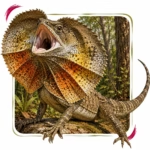
Central Bearded Dragon Fact Highlight
From the full animal facts page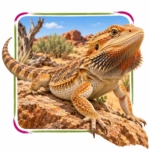
More Animal Comparisons
Pick another animal matchup and keep exploring. Compare appearances, habitats, diets, abilities, and surprising differences.
Make an Animal Story
Send a frill-flashing lizard and an arm-waving dragon into an Australian woodland mystery with our free Animal Story Generator.