
Frilled Lizard vs Chameleon for Kids: Frill, Casque, and Color
The Frilled Lizard and Veiled Chameleon are tree-climbing lizards with dramatic head shapes, changing colors, long tails, and insect-based diets. Yet they are not close look-alikes in motion. The frilled lizard is a fast agamid that dashes between trunks and opens a neck fan. The chameleon is a slow, precise branch gripper with independent eyes and a projectile tongue.
About Frilled Lizard
- Type Arboreal agamid lizard
- Diet Mostly insectivore
- Group Dragon lizard family, Agamidae
- Known for A large neck frill and fast two-legged escape runs
- Special skill Opens its bright mouth and broad neck frill, then may sprint away on two legs
About Veiled Chameleon
- Type Arboreal chameleon
- Diet Mostly insectivore with some plant food
- Group Chameleon family, Chamaeleonidae
- Known for Independent turret eyes, a tall casque, grasping feet, and a projectile tongue
- Special skill Aims two eyes separately, then launches a sticky tongue at insect prey
Quick Answer
Quick answer: A Frilled Lizard is a long Australian and New Guinean agamid that opens a broad neck frill and may sprint upright to escape. A Veiled Chameleon is a smaller Arabian chameleon with a tall head casque, independently moving eyes, grasping feet, a prehensile tail, and a sticky projectile tongue. Both climb and lay eggs, but their feet, vision, movement, signaling, and hunting tools are strikingly different.
Frilled Lizard vs Veiled Chameleon: Quick Comparison
| Feature | Frilled Lizard | Veiled Chameleon |
|---|---|---|
| Scientific name | Chlamydosaurus kingii | Chamaeleo calyptratus |
| Lizard family | Agamidae, the dragon lizards | Chamaeleonidae, the chameleons |
| Adult length | Often about 85 cm total; large males may approach 1 m | Males about 43 to 61 cm; females about 25 to 35 cm total |
| Head feature | Wide foldable neck frill supported by cartilage rods | Tall helmet-like casque on top of the skull |
| Native home | Northern Australia and southern New Guinea | Yemen and southwestern Saudi Arabia |
| Feet | Five separate clawed toes suited to trunks and running | Opposing toe bundles that grip a branch like tongs |
| Eyes | Paired eyes usually aim together | Turret eyes can scan in different directions |
| Feeding | Runs or climbs after insects and other small prey | Projects a sticky tongue toward prey from a perch |
| Defense | Displays frill and mouth, hisses, and may sprint away | Changes display colors, flattens, gapes, hisses, and grips branches |
| Young | Eggs are buried in soil; hatchlings are independent | Many eggs are buried in soil; hatchlings are independent |
How Frilled Lizards and Veiled Chameleons Are Alike
- Both are mostly tree-living lizards that use claws and a long tail among branches.
- Both are active by day and depend on outside heat to warm their bodies.
- Both eat many insects and capture prey without chewing plant matter like a mammal.
- Both communicate visually with body posture and changes in skin color.
- Both lay shelled eggs in soil, and the hatchlings begin life independently.
How Frilled Lizards and Veiled Chameleons Are Different
- The Frilled Lizard has a foldable neck frill, while the Veiled Chameleon has a rigid casque on its head.
- The frilled lizard has ordinary lizard toes, while the chameleon has opposing toe bundles for gripping twigs.
- A frilled lizard may sprint on two legs, while a chameleon usually walks slowly with a rocking, careful gait.
- The chameleon’s eyes can aim separately, while the frilled lizard normally looks with both eyes directed more conventionally.
- The chameleon shoots out a sticky tongue, while the frilled lizard moves its whole body toward prey.
Frilled Lizard vs Chameleon Adaptation Showdown
Adaptation showdown: Frilled Lizard wins size because adults are often about 85 cm long, exceeding even a large male Veiled Chameleon. Frilled Lizard wins speed because it can dash rapidly and even run on two legs, while the chameleon specializes in slow branch movement. Strength is a Tie because matched force data are unavailable and each is strong for its own climbing style. Veiled Chameleon wins stealth because its slow rocking gait, narrow body, and changing display colors can make it difficult to notice among leaves. Social behavior is a Tie because both are mainly solitary and territorial. Swimming is a Tie because neither species is an aquatic specialist. Veiled Chameleon wins weirdest for combining separately moving turret eyes, tong-like feet, a prehensile tail, a tall casque, and a projectile tongue.
Fun Frilled Lizard vs Veiled Chameleon Facts
A Frill, Not a Hood
The Frilled Lizard’s neck membrane folds flat most of the time. Long cartilage supports swing it open during territorial, courtship, and defensive displays.
Two Eyes, Two Views
A Veiled Chameleon can scan with one turret eye while the other looks elsewhere. When it targets prey, both eyes line up for a more precise distance estimate.
A Living Pair of Tongs
Each chameleon foot has toes fused into two opposing bundles. The bundles close around a branch, and the prehensile tail adds another gripping point.
Color Is Communication
Chameleons change color with mood, temperature, light, and social signals. They do not simply copy every background like paint.
Two Very Different Hunters
A Frilled Lizard actively searches trunks and ground for prey. A Veiled Chameleon waits, aims, and accelerates its sticky tongue outward.
Frilled Lizard vs Chameleon Quiz
- Which lizard has a foldable neck frill? Answer: The Frilled Lizard.
- Which lizard can aim its eyes in different directions? Answer: The Veiled Chameleon.
- What is the chameleon’s tall head structure called? Answer: A casque.
- Which animal may run on two legs? Answer: The Frilled Lizard.
- How does a Veiled Chameleon catch an insect at a distance? Answer: It projects a sticky tongue.
Frilled Lizard vs Veiled Chameleon FAQ
Is a Frilled Lizard a chameleon?
No. It is an agamid dragon lizard, while the Veiled Chameleon belongs to the chameleon family.
Do chameleons change color only for camouflage?
No. Color also changes with temperature, light, stress, courtship, and social communication.
Can a Frilled Lizard shoot out its tongue like a chameleon?
No. It uses a normal lizard tongue and moves its body close enough to seize prey.
Which animal is longer?
The Frilled Lizard is generally longer, especially because of its long body and tail.
Can either animal be safely handled in the wild?
No. Handling can stress or injure wildlife. Watch quietly and leave the animal an escape route.
Animal Words to Know
- Casque: A raised helmet-like structure on a chameleon’s head.
- Prehensile: Able to curl around and grip something, as a chameleon’s tail can.
- Turret eye: A raised swiveling eye that can scan a wide area.
- Projectile tongue: A tongue rapidly launched beyond the mouth to capture food.
- Territorial: Defending an area or perch from other members of the same species.
Build a Branch-Climber Blueprint
Build a Branch-Climber Blueprint
Draw exactly one adult Frilled Lizard and exactly one adult male Veiled Chameleon at honest relative scale. Label the frill, long running legs, ordinary clawed toes, casque, turret eyes, opposing toe bundles, prehensile tail, and projectile tongue. Use arrows to compare a fast dash with a slow grip-and-step walk. Do not draw the chameleon copying a checkerboard or rainbow background. Never touch, chase, feed, or force a wild lizard to display.
Meet Each Animal
Want the full fact file? Here are quick highlights from each animal’s own facts page.
Frilled Lizard Fact Highlight
From the full animal facts page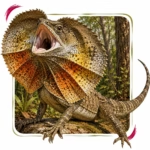
Veiled Chameleon Fact Highlight
From the full animal facts page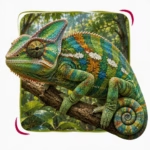
More Animal Comparisons
Pick another animal matchup and keep exploring. Compare appearances, habitats, diets, abilities, and surprising differences.





Make an Animal Story
Send a frill-flashing sprinter and a turret-eyed tongue launcher through a treetop puzzle with our free Animal Story Generator.