
Gaur vs Banteng: Asian Wild Cattle Comparison
Gaur and banteng are two rare kinds of Asian wild cattle. Both have horns and pale lower legs, so a quick glimpse can be confusing. Look higher and farther back: a gaur has a massive front end and tall shoulder ridge, while a banteng usually has a clearer white rump patch and stronger colour differences between adult bulls and cows.
About Gaur
- Type Living
- Diet Herbivore
- Group Wild cattle species (Bos gaurus)
- Known for Enormous body, high shoulder ridge and white lower legs
- Special skill Carries great body mass across hilly forest terrain
About Banteng
- Type Living
- Diet Herbivore
- Group Wild cattle species (Bos javanicus)
- Known for White rump patch, white stockings and different bull and cow colours
- Special skill Moves quietly between dense cover and open feeding areas
Gaur vs Banteng: Quick Answer
The gaur, Bos gaurus, is generally the larger and taller wild cattle species, with a huge shoulder ridge and deep body. The banteng, Bos javanicus, is usually smaller and more lightly built, with white stockings and a pale rump patch. Gaur favour forested hills and moist forest mosaics; banteng often use drier open forest and grass clearings. Both need strong conservation protection.
Where Do They Fit?
Follow the branches to see how Gaur and Banteng are classified and related.
Gaur vs Banteng: Quick Comparison
| Feature | Gaur | Banteng |
|---|---|---|
| Scientific name | Bos gaurus | Bos javanicus |
| Relationship | Wild cattle in genus Bos | Wild cattle in genus Bos |
| Main range | South and Southeast Asia | Southeast Asia |
| Adult size | Usually taller and heavier; bulls often 700-1,000 kg | Usually smaller; wild adults vary widely by sex and subspecies |
| Back shape | Very high shoulder ridge and muscular front end | Gentler shoulder rise with a less towering front end |
| Coat clue | Dark brown to nearly black bulls; pale lower legs | Dark bulls, reddish-brown cows, pale lower legs and a white rump patch |
| Horns | Thick horns curve outward and upward | Bulls have long horns curving up; cows have shorter inward-curving horns |
| Habitat | Forested hills, moist forest and grassy openings | Dry open forest, scrub, grassland and clearings |
| Social life | Female-led herds; older bulls may be solitary | Herds often include one mature bull, cows and young |
| Conservation | Vulnerable | Critically Endangered |
How Are Gaur and Banteng Alike?
- Both are living wild cattle species in genus Bos.
- Both are Asian herbivores that graze and browse.
- Both males and females grow permanent horns.
- Both have pale lower legs that can look like white stockings.
- Both form herds of cows and calves while some adult bulls spend time apart.
How Are Gaur and Banteng Different?
- Gaur are generally taller, heavier and more massive through the shoulders.
- Banteng usually show a bold pale rump patch that a gaur lacks.
- Banteng bulls and cows often differ sharply in colour; gaur sex colours overlap more.
- Gaur are strongly linked with forested hills; banteng often use drier open forest and grass clearings.
- Banteng are currently Critically Endangered, while gaur are Vulnerable.
Gaur vs Banteng Adaptation Showdown
- Size – Gaur: Across broad adult ranges, gaur are usually taller and heavier, especially in the massive bulls.
- Speed – Tie: There is no fair same-course top-speed test, and both species move through mixed forest rather than a race track.
- Strength – Gaur: Its generally greater body mass and heavily muscled shoulder region give the gaur the edge for whole-body power, not a fight prediction.
- Stealth – Banteng: Banteng are notably shy, use dense shelter and may shift activity toward night where people disturb them.
- Social – Tie: Both use cow-and-calf herds with changing roles for adult bulls, so neither has a clearly more complex social system.
- Swimming – Tie: Neither has enough directly comparable swimming evidence to name a reliable winner.
- Weirdest – Banteng: A mature bull may be almost black while a cow is reddish brown, yet both keep bright white stockings and a pale rump patch.
Fun Gaur vs Banteng Facts
They Are Close Wild-Cattle Cousins
Gaur and banteng both belong to genus Bos, the same genus that includes domestic cattle. They are separate species, not male and female forms of one animal.
A Gaur’s Front End Rises High
The gaur’s shoulder ridge is supported by long vertebral spines and heavy muscles. This gives it a powerful uphill-looking outline even when all four hooves are level.
Banteng Wear a Bright Rear Signal
Most banteng have a pale rump patch and white lower legs. The rump marking may help herd members keep track of one another in dim vegetation, although its exact function is not proven.
Adult Banteng Change Their Colour Story
Female and young banteng are usually reddish or chestnut brown. Many adult bulls darken to deep brown or nearly black, though colour varies among subspecies and individuals.
Both Species Are in Trouble
Habitat loss, hunting and small separated populations threaten both wild cattle. The gaur is listed as Vulnerable, while the banteng was uplisted to Critically Endangered after a severe decline.
Gaur vs Banteng Quiz
Which species is generally larger? A) Gaur B) Banteng C) They are insects Answer: A) Gaur
Which animal usually has a bold pale rump patch? A) Gaur B) Banteng C) Neither has fur Answer: B) Banteng
What genus includes both animals? A) Bos B) Panthera C) Corvus Answer: A) Bos
Which species is currently Critically Endangered? A) Gaur B) Banteng C) Both are domestic Answer: B) Banteng
Why is swimming a tie? A) They have flippers B) Directly comparable evidence is lacking C) Both live in the ocean Answer: B) Directly comparable evidence is lacking
Gaur vs Banteng FAQ
Are gaur and banteng the same species?
No. Gaur are Bos gaurus and banteng are Bos javanicus.
Which is larger, a gaur or a banteng?
The gaur is generally taller and heavier, although measurements vary with sex, age, population and subspecies.
How can I tell a banteng from a gaur?
Look for the banteng’s pale rump patch and stronger bull-cow colour difference. A gaur has a more towering shoulder ridge.
Do gaur and banteng live in the same places?
Their ranges overlap in parts of Southeast Asia, but they can use habitat differently. Gaur often favour forested hills, while banteng commonly use drier open forest and grass clearings.
Are gaur and banteng domestic cattle?
No. Both animals compared here are wild species, although people domesticated a banteng form known as Bali cattle.
Animal Words to Know
- Wild cattle: Undomesticated bovines such as gaur and banteng.
- Shoulder ridge: A raised line over the front of the back supported by bone and muscle.
- Sexual dimorphism: A visible difference between adult males and females of one species.
- Subspecies: A named population within a species with consistent differences.
- Critically Endangered: The IUCN category for a species facing an extremely high risk of extinction in the wild.
Gaur and Banteng Field Guide Drawing Activity
Gaur and Banteng Field Guide Drawing Activity
Divide a page into two forest clearings. Draw a taller gaur with a high shoulder ridge on one side. Draw a slightly smaller banteng with a pale rump patch on the other. Give both white lower legs, then label five field marks: shoulder ridge, rump patch, horn curve, bull colour and cow colour.
Meet Each Animal
Want the full fact file? Here are quick highlights from each animal’s own facts page.
Gaur Fact Highlight
From the full animal facts page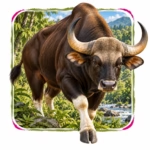
Banteng Fact Highlight
From the full animal facts page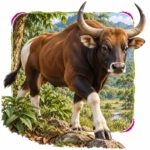
More Animal Comparisons
Pick another animal matchup and keep exploring. Compare appearances, habitats, diets, abilities, and surprising differences.



Make an Animal Story
Create a wild-cattle forest story featuring a mighty gaur and a shy white-stocking banteng!
Source notes: References used for this comparison. See more See less
Try Another Matchup
Explore this comparison →