
Gelada vs Olive Baboon: Primate Species Comparison
Geladas were once commonly called gelada baboons, but they are not true baboons in genus Papio. The Gelada, Theropithecus gelada, is the only living member of its genus. It grazes in the Ethiopian and Eritrean highlands and has a bright red chest patch. This page compares it with the Olive Baboon, Papio anubis, a long-muzzled omnivore found across a much wider part of Africa.
About Gelada
- Type Living
- Diet Herbivore and mainly a grazer; eats grass blades and seeds plus roots, flowers, stems and some fruit
- Group Grass-eating monkey and the only living species in genus Theropithecus (Theropithecus gelada)
- Known for Short muzzle, pale eyelids, red chest patch, long male shoulder cape and highly specialized grass eating
- Special skill Shuffles across the ground while seated, plucking grass quickly with very nimble fingers
About Olive Baboon
- Type Living
- Diet Omnivore; eats grass, roots, fruit, leaves, seeds and bark plus insects, eggs and small animals
- Group Large true baboon in genus Papio (Papio anubis)
- Known for Olive-gray speckled coat, long dog-like muzzle, powerful male mane, cheek pouches and a bent-looking tail
- Special skill Uses cheek pouches to gather food quickly and can switch among foods on the ground, in trees and underground
Gelada vs Olive Baboon: Quick Answer
A Gelada has a short face, pale eyelids and a bare red patch on its chest. It spends much of the day sitting and plucking grass in cool highland meadows. An Olive Baboon has a long dog-like muzzle, an olive-gray coat and cheek pouches for carrying food. It lives in many warmer habitats and eats both plants and small animals.
Where Do They Fit?
Follow the branches to see how Gelada and Olive Baboon are classified and related.
Gelada vs Olive Baboon: Quick Comparison
| Feature | Gelada | Olive Baboon |
|---|---|---|
| Scientific name | Theropithecus gelada | Papio anubis |
| Adult mass | Females about 15 kg; males about 20 kg | Females about 14-15 kg; males often about 24-25 kg |
| Face | Short muzzle, pale eyelids and wide nostrils | Long dog-like muzzle and heavy brow |
| Special marking | Bare red hourglass-shaped chest patch | Olive-gray speckled coat; no red chest patch |
| Male coat | Long golden-brown cape over shoulders and back | Thicker mane around the head and shoulders |
| Range | Highlands of Ethiopia and Eritrea only | A broad belt across central and equatorial Africa |
| Habitat | Cool high grassland beside rocky cliffs | Savanna, woodland, forest edge and dry country |
| Food | Mostly grass blades and seeds | Plants plus insects, eggs and small animals |
| Social life | Small units combine into bands and large grazing gatherings | Mixed troops often containing dozens of members |
| Foraging tool | Nimble fingers pluck grass while the animal sits and shuffles | Cheek pouches store food collected during flexible searches |
How Are Geladas and Olive Baboons Alike?
- Both are African Old World monkeys that spend much of their time on the ground.
- Both have strong limbs, forward-facing eyes and hands that handle food carefully.
- Both live in complex societies and use calls, faces, grooming and body movements to communicate.
- Both eat grass and other plant foods, although the amount differs greatly.
- Both have larger adult males with longer hair around the shoulders.
How Are Geladas and Olive Baboons Different?
- Geladas belong to genus Theropithecus, while Olive Baboons are true baboons in genus Papio.
- A Gelada has a short face and red chest patch; an Olive Baboon has a long muzzle and no chest patch.
- Geladas live only in high Ethiopian and Eritrean grasslands; Olive Baboons range across many African habitats.
- Geladas mainly graze grass, while Olive Baboons are flexible omnivores.
- Gelada units join into bands and huge grazing gatherings, while Olive Baboons usually organize as mixed troops.
Gelada vs Olive Baboon Adaptation Showdown
- Size – Olive Baboon: Adult males average around 24-25 kg, heavier than an average adult male Gelada near 20 kg.
- Speed – Tie: Both travel well on the ground, but the sources do not provide a fair matched speed test.
- Strength – Olive Baboon: Its larger average male mass and robust build give it the cautious strength edge.
- Stealth – Tie: Geladas use cliff country and baboons use varied cover, but neither is a specialized stealth hunter.
- Social – Gelada: Its nested society can link family units into bands and bring several bands together in very large grazing gatherings.
- Swimming – Tie: Neither species is a swimming specialist, and matched swimming evidence is lacking.
- Weirdest – Gelada: It wears a red chest signal, sits to shuffle-feed and survives mainly on grass, unlike almost every other primate.
Fun Gelada vs Olive Baboon Facts
A Heart-Shaped Signal
Both male and female Geladas have a bare red chest patch. On some animals it resembles an hourglass or heart.
The Grass-Eating Primate
Geladas are the only living primates whose diet is based mainly on grass blades and seeds.
Shuffle Feeding
A Gelada can sit, pluck grass with one hand after the other and scoot forward without standing up.
Built-In Food Pockets
An Olive Baboon can stuff food into expandable cheek pouches and chew it later in a safer place.
One Society Inside Another
Gelada families join bands, and bands may meet in feeding gatherings containing hundreds of animals.
Gelada vs Olive Baboon Quiz
Which animal has a red chest patch? A) Gelada B) Olive Baboon C) Both Answer: A) Gelada
Which animal has a long dog-like muzzle? A) Gelada B) Olive Baboon C) Neither Answer: B) Olive Baboon
What does a Gelada mainly eat? A) Grass B) Fish C) Meat Answer: A) Grass
Where do wild Geladas live? A) Ethiopian and Eritrean highlands B) South America C) Arctic ice Answer: A) Ethiopian and Eritrean highlands
Is a Gelada a true baboon in genus Papio? A) Yes B) No C) Only as a baby Answer: B) No
Gelada vs Olive Baboon FAQ
Is a Gelada a Baboon?
People once called it the gelada baboon, but it is not a true baboon in genus Papio. It is the only living Theropithecus species.
Which Baboon does this page compare?
It uses the Olive Baboon. Other baboon species have different ranges, sizes and coat colors.
Why is a Gelada’s chest red?
The bare patch is a visible social signal. Its color can change with blood flow and social condition.
Do Geladas eat only grass?
Grass blades and seeds dominate, but they also eat roots, flowers, stems, herbs and occasional fruit or tiny animals.
Which animal lives in more places?
The Olive Baboon. It occupies many habitats across a broad African range, while Geladas are highland specialists.
Animal Words to Know
- Genus: A scientific group containing one or more closely related species.
- Grazer: An animal that feeds mainly on grass.
- Omnivore: An animal that eats both plant and animal foods.
- Primate: The mammal group containing monkeys, apes, lemurs and humans.
- Troop: A social group of monkeys such as Olive Baboons.
Design a Primate Field-ID Card
Design a Primate Field-ID Card
Fold a card in half. Draw a short-faced Gelada with pale eyelids, a red chest patch and a long male cape on a grassy cliff side. Draw a long-muzzled Olive Baboon with olive-gray fur and cheek pouches on the savanna side. Add three identification clues and one favorite food for each.
Meet Each Animal
Want the full fact file? Here are quick highlights from each animal’s own facts page.
Gelada Fact Highlight
From the full animal facts page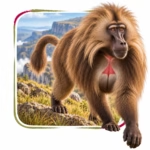
Olive Baboon Fact Highlight
From the full animal facts page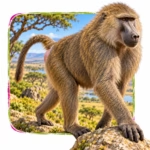
More Animal Comparisons
Pick another animal matchup and keep exploring. Compare appearances, habitats, diets, abilities, and surprising differences.


Make an Animal Story
Create a highland story about a grass-plucking Gelada meeting a clever Olive Baboon!
Source notes: References used for this comparison. See more See less
Try Another Matchup
Explore this comparison →