
Goat vs Antelope: Domestic-Goat-to-Wild-Antelope Bovid Comparison
A goat is one domesticated bovid species; an antelope is a loose common-name basket holding many different wild bovid lineages. They share family Bovidae, four-compartment stomachs, cloven hooves, horns rather than deer antlers, and plant-eating ancestry. Yet there is no single antelope size, speed, habitat, horn shape, or social system to compare with a goat. This page uses an impala as the recognizable picture example while keeping the facts broad: royal antelopes, duikers, gazelles, springboks, wildebeest, oryxes, kudus, saigas, lechwes, and elands can differ more from one another than a quick cartoon suggests.
About Goat
- Type Mammal
- Diet Herbivorous browser and grazer that often selects leaves, shoots, vines, twigs, weeds, and shrubs as well as grass and hay; goats do not safely eat every plant or object and require a balanced species-appropriate diet
- Group Domestic goat, Capra hircus in family Bovidae and subfamily Caprinae; one domesticated species with hundreds of breeds, descended mainly from the wild bezoar goat Capra aegagrus of western and central Asia
- Known for A compact to medium-sized climber and browser with a mobile split upper lip, horizontal pupils, cloven hooves, short often upright-curving tail, hair or undercoat, and breed-variable ears, horns, beard, color, and body shape. Broad references place adult breeds from about 9 to 113 kilograms and 26 to 107 centimeters tall, with an approximate 45-kilogram average in one global account
- Special skill Sure-footed cloven hooves, flexible joints, balance, a mobile upper lip, browsing reach, four-compartment ruminant digestion, panoramic pupils, horns in many breeds, and social learning help goats use steep ground and scattered woody food
About Antelope
- Type Mammal
- Diet Herbivorous grazer, browser, or mixed feeder depending on species, eating combinations of grasses, sedges, herbs, leaves, buds, shoots, fruit, seeds, bark, and aquatic plants; water needs and digestive strategies vary with habitat
- Group Antelope as a broad everyday label for many mainly wild Old World members of family Bovidae, spread across several subfamilies and evolutionary branches rather than forming one species, genus, or clean monophyletic group; the North American pronghorn is excluded because it belongs to Antilocapridae
- Known for Extraordinarily variable bovid body plans ranging from the tiny royal antelope at only a few kilograms to giant eland males approaching 1,000 kilograms. Depending on species, an antelope may be delicate or cattle-sized, long-legged or compact, striped or plain, and carry straight, curved, spiraled, ridged, or very short permanent horns in males, both sexes, or occasionally neither visible sex class in a population
- Special skill Permanent keratin-sheathed horns, cloven hooves specialized for sand, rock, mud, or speed, long-distance running, bounding leaps, camouflage, large eyes and ears, scent marking, water conservation, seasonal migration, and species-specific herd defenses help antelopes survive predators and highly varied Old World habitats
Goat vs Antelope: Quick Answer
A goat is the domesticated species Capra hircus, usually kept by people and famous for browsing and climbing. “Antelope” is not one species; it is an informal name for many mainly wild bovids such as gazelles, impalas, duikers, oryxes, wildebeest, and elands. Goats and antelopes share cloven hooves, four-compartment stomachs, and permanent horns in many forms, but antelopes range from a few kilograms to nearly a metric ton and live in very different wild habitats.
Where Do They Fit?
Follow the branches to see how Goat and Antelope are classified and related.
Goat vs Antelope: Quick Comparison
| Feature | Domestic Goat | Antelope Group |
|---|---|---|
| Scientific scope | One species, Capra hircus | Many bovid species across several branches; no single scientific name |
| Wild or domestic? | Domesticated, although feral populations exist | Mainly wild; a few species have been managed or partly domesticated in limited settings |
| Native history | Western Asian domestication followed by worldwide human transport | Mainly native to Africa and Asia; pronghorn is not included |
| Adult size | Breed range roughly 9–113 kg | From royal antelope of only a few kilograms to giant eland males approaching 1,000 kg |
| Body plan | Compact climber-browser, often with upright tail and possible beard | Anything from tiny forest duiker to long-legged gazelle or cattle-sized eland |
| Horns | Permanent horns in many males and females, but some breeds are naturally hornless | Permanent horns; sex, size, shape, and presence vary strongly by species |
| Feet | Sure-footed cloven hooves suited to varied and often rocky managed ground | Cloven hooves specialized for plains, sand, rock, swamp, forest, or mountains depending on species |
| Food | Flexible browser and grazer, often selecting leaves and shrubs | Grazer, browser, or mixed feeder depending on species |
| Social life | Social herd animal with breed and management variation | Solitary, paired, territorial, herding, or massively migratory depending on species |
| Young | Kid | Usually calf; fawn is also used for some species |
How Are Goats and Antelopes Alike?
- Both belong to family Bovidae, the even-toed hoofed mammal family that also includes sheep, cattle, bison, buffalo, muskoxen, and many other horned herbivores.
- Both are true ruminants with one stomach divided into rumen, reticulum, omasum, and abomasum, allowing microbes to ferment plant fiber before food is rechewed as cud.
- Both have two main weight-bearing toes enclosed in cloven keratin hooves, no upper front incisors, a tough dental pad, and sideways-set eyes with broad horizontal pupils.
- Both grow true horns with a bony core and permanent keratin sheath in the horned forms; those horns are not branched deer antlers and are not normally shed each year.
- Both may browse leaves or graze grasses, live in social groups, use scent and body posture, defend themselves with horns or kicks, and depend on alert senses to notice danger.
How Are Goats and Antelopes Different?
- Domestic goat is one species shaped by thousands of years of breeding beside people. Antelope is an informal common-name group scattered across many wild bovid branches, so no single antelope description fits every member.
- Goats now live worldwide mainly in farms, herds, and managed rangelands. Native antelope diversity is concentrated in Africa and Asia across habitats from rainforest to desert and swamp to alpine slope.
- Goat breeds vary widely but remain within a much narrower overall size band. Antelopes stretch from tiny royal antelopes to giant elands hundreds of times heavier.
- A goat often has a compact climbing body, mobile browsing lip, short upright tail, possible beard, and backward-sweeping horns. An antelope may instead have gazelle-like running legs, a duiker’s rounded forest body, an oryx’s long horns, a wildebeest’s heavy shoulders, or many other forms.
- Goat social behavior is consistently herd-oriented despite breed and management variation. Antelope social systems include solitary, pair-living, territorial, harem, bachelor, nursery, herd, and migration patterns.
- A baby goat is a kid. A baby antelope is generally called a calf, although fawn appears in the common language for the young of some smaller species.
Goat vs Antelope Adaptation Showdown
Domestic browser versus many-shaped wild-bovid showdown: Antelope wins maximum size because a giant eland can approach 1,000 kilograms, far beyond even a large goat, while admitting that tiny royal antelopes weigh much less than most goats. Antelope wins speed because numerous open-country species are specialized runners and leapers, not because every forest duiker outruns every goat. Strength is a tie because the word antelope includes delicate and massive species and no honest group-wide test exists. Antelope wins stealth for the camouflage, freezing, hiding, scent control, and predator-avoidance behavior found across wild species. Social behavior is a tie: goats form close herds, while antelopes range from solitary animals to enormous gatherings. Swimming is a tie because goats and many antelopes can cross water, but only some antelopes such as lechwes are wetland specialists. Antelope wins strangest adaptation for its extraordinary range of saiga noses, klipspringer hoof tips, lechwe swamp feet, springbok leaps, spiral horns, and desert water-saving systems. The broad antelope label makes these category results illustrative rather than universal.
Fun Goat vs Antelope Facts
Antelope Is a Label, Not One Species
Gazelles, impalas, springboks, duikers, wildebeest, kudus, oryxes, saigas, lechwes, and elands may all be called antelopes, yet they occupy different bovid branches. Some antelope are evolutionarily closer to goats, cattle, or sheep than to other animals carrying the antelope name. That is why the antelope column must describe a range rather than one standard creature.
Goats and Antelopes Share the Bovid Family
Domestic goats belong to Caprinae inside Bovidae. Commonly named antelopes appear in Antilopinae, Bovinae, Cephalophinae, Hippotraginae, Reduncinae, and other bovid branches. Their shared family explains the four-compartment stomach, permanent horn design, cloven hooves, dental pad, and many similarities in plant eating.
Horns Stay While Antlers Fall
A typical goat horn or antelope horn has a living bony core covered by a hard keratin sheath that remains and grows. Deer antlers are exposed bone that is shed and regrown. Horn rules still vary: polled goat breeds lack horns, some antelope females are hornless, both sexes carry horns in other species, and horn shape cannot identify every animal safely from a distance.
Their Hooves Match Very Different Landscapes
Goat hooves spread, grip, and balance on uneven ground, supporting climbing and browsing. Antelope feet are far more diverse: lechwes use long spreading toes in wetlands, sand gazelles carry broad feet on dunes, and klipspringers balance on small rubbery-centered hoof tips over rock. The same basic two-toed plan has been remodeled for many habitats.
Antelopes Range From Tiny to Giant
A royal antelope can weigh only a few kilograms and stand around the height of a small house cat at the shoulder. At the opposite extreme, an adult male giant eland can weigh hundreds of kilograms and approach 1,000 kilograms. Domestic goat breeds vary dramatically too, but their full range fits inside only a small portion of the antelope spectrum.
Goat vs Antelope Quiz
- Is antelope the name of one species? Answer: No. It is a broad common-name group covering many bovid species.
- What family includes both goats and true antelopes? Answer: Bovidae.
- What is a baby goat called? Answer: A kid; a baby antelope is generally a calf.
- Which animal is not a true bovid antelope: impala or pronghorn? Answer: Pronghorn, which belongs to family Antilocapridae.
- Do horns fall off each year like deer antlers? Answer: No. True horns normally keep their keratin sheath and bony core, although horn presence varies by sex, species, and domestic breed.
Goat vs Antelope FAQ
Is a goat an antelope?
Not in normal modern usage. A domestic goat is Capra hircus in subfamily Caprinae. It shares family Bovidae with antelopes, and some close caprine relatives are called goat-antelopes, but that does not turn every goat into an antelope.
Which is bigger, a goat or an antelope?
There is no one antelope size. A royal antelope weighs only a few kilograms and is much smaller than most goats, while a giant eland can approach 1,000 kilograms and dwarf every goat breed. The individual species or breed must be named before a fair comparison.
Are all antelopes fast?
No. Gazelles, impalas, springboks, and several open-country antelopes are powerful runners or leapers, but forest duikers may rely more on freezing, hiding, and short dashes, while wetland antelopes may escape through water. The group contains many survival plans.
Do female goats and female antelopes have horns?
Many female goats have horns unless the breed is naturally polled or the animal has been managed otherwise. In antelopes, both sexes carry horns in some species, only males do in others, and size or shape may differ. A hornless female cannot safely identify the whole group.
Is a pronghorn a true antelope?
No. The North American pronghorn is often nicknamed pronghorn antelope, but it belongs to family Antilocapridae, not Bovidae. This page uses antelope for the mainly African and Asian bovid group and excludes pronghorn speed or horn facts.
Animal Words to Know
- Bovid: A member of family Bovidae, including goats, sheep, cattle, bison, buffalo, muskoxen, and true antelopes.
- Antelope: An informal common name for many mainly wild Old World bovids, not one scientific group with a single ancestor exclusive to all members.
- Cloven hoof: A hard hoof divided into two main weight-bearing toes.
- Horn: A permanent keratin sheath over a bony core, unlike a seasonally shed deer antler.
- Browser: An herbivore that selects leaves, buds, shoots, vines, and other woody or higher-growing plant parts.
Goat and Antelope Family Activity
Goat and Antelope Family Activity
Draw a domestic goat beside an impala as one representative antelope. Give the goat a sturdy climbing body, beard, horns, and gripping hooves on rocky ground. Give the impala a slender body, long legs, ringed horns on the male, and running hooves on open grassland. Add a bracket showing that both are bovids, then note that “antelope” is a broad common name rather than one species. Label goat, antelope, horn, hoof, kid, and calf.
Meet Each Animal
Want the full fact file? Here are quick highlights from each animal’s own facts page.
Goat Fact Highlight
From the full animal facts page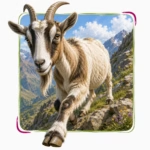
Antelope Fact Highlight
From the full animal facts page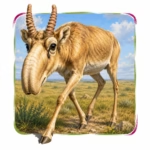
More Animal Comparisons
Pick another animal matchup and keep exploring. Compare appearances, habitats, diets, abilities, and surprising differences.





Make an Animal Story
Turn this goat vs antelope comparison into a rocky-farm and wild-savanna journey with our free Animal Story Generator.
Source notes: References used for this comparison. See more See less
Try Another Matchup
Explore this comparison →