
Gorilla vs Monkey: Great-Ape Genus-to-Diverse Monkey Umbrella Comparison
A gorilla is not a giant monkey. It is a great ape in genus Gorilla, with no tail, an extremely large ground-adapted body, long arms, knuckle-walking hands, and fresh sleeping nests. “Monkey” is an everyday umbrella name for hundreds of New World and Old World primates, so there is no single monkey size, tail, habitat, diet, speed, or social plan. This page compares gorillas with the broad monkey category and uses named examples—such as mandrills, marmosets, macaques, and prehensile-tailed New World monkeys—whenever a special trait does not belong to all monkeys.
About Gorilla
- Type Mammal
- Diet Primarily herbivorous, eating leaves, stems, shoots, pith, bark, roots, herbs, and seasonal fruit; western gorillas generally eat more fruit than mountain gorillas, and small amounts of ants, termites, or other invertebrates add animal protein, but gorillas are not routine hunters of monkeys
- Group Gorilla means the great-ape genus Gorilla in family Hominidae, containing the western gorilla Gorilla gorilla and eastern gorilla Gorilla beringei, each with two recognized subspecies; gorillas are apes and simian primates, not monkeys in the traditional everyday classification
- Known for The largest living nonhuman primate, with a broad chest, massive shoulders, long muscular arms, short powerful legs, large hands and feet, dark hair, no tail, and mature males called silverbacks; western lowland males average about 136 kilograms and can reach roughly 227 kilograms, while species, subspecies, sex, age, and condition change the measurement
- Special skill Very long arms, mobile shoulders, grasping hands and feet, opposable thumbs, nails, fingerprints, unique nose prints, powerful chewing muscles, and weight-bearing knuckles support ground travel and plant processing; gorillas use many calls and gestures, build fresh day or night nests, learn socially, solve problems, and have been observed using branches as walking sticks and supports in wild swamp habitat
About Monkey
- Type Mammal
- Diet Species-dependent omnivore or herbivore eating combinations of fruit, leaves, flowers, nectar, gum, seeds, roots, grasses, fungi, insects, spiders, shellfish, eggs, and occasional small vertebrates; colobines specialize in leafy food with complex stomachs, marmosets gouge gum, and many cercopithecines carry food in cheek pouches
- Group Monkey is a broad traditional common name rather than one species or a complete modern clade; it usually covers New World monkeys in parvorder Platyrrhini and Old World monkeys in superfamily Cercopithecoidea while excluding apes, lemurs, and tarsiers, even though all monkeys and apes belong to the simian branch
- Known for Extraordinary variety across hundreds of species, from tiny marmosets weighing little more than 100 grams to adult male mandrills around 32–54 kilograms; monkeys can have long, short, grasping, balancing, or externally absent tails, and their faces, coats, hands, locomotion, colors, teeth, calls, and social systems differ far too much for one generic body description
- Special skill Primate hands, forward-facing eyes, flexible shoulders, nails, sensitive fingertips, and learning support climbing and object handling; different lineages add prehensile tails only in certain New World species, food-carrying cheek pouches in many Old World species, leaf-digesting chambered stomachs in colobines, gum-gouging teeth in marmosets, strong swimming in some macaques and proboscis monkeys, and highly specific alarm calls
Gorilla vs Monkey: Quick Answer
A gorilla is a great ape, not a monkey. Gorillas are the largest living primates, have no tails, spend much of their time on the ground, knuckle-walk on curled fingers, and build nests for resting. “Monkey” is a broad name for many smaller primates from Africa, Asia, and the Americas. Most monkeys have tails, but not all; only some New World monkeys have truly prehensile tails. Monkeys may climb, leap, run, swim, or live mainly on the ground depending on the species.
Where Do They Fit?
Follow the branches to see how Gorilla and Monkey are classified and related.
Gorilla vs Monkey: Quick Comparison
| Feature | Gorilla | Monkey |
|---|---|---|
| Scientific identity | Genus Gorilla: western and eastern gorillas, both great apes | Broad traditional category containing many New World and Old World species |
| Tail | No tail | Most have a tail, but length and function vary and a few have almost none externally |
| Body size | Largest living primates; adult silverbacks commonly exceed 130 kg | Tiny marmosets to male mandrills around 32–54 kg |
| Typical movement | Mostly terrestrial knuckle-walking, climbing more when young or where useful | Species may run, walk, leap, climb, suspend, or swim |
| Native range | Equatorial forests of central and eastern Africa | Africa and Asia for Old World forms; Central and South America for New World forms |
| Food | Mostly leaves, stems, shoots, pith, and fruit, plus small invertebrates | Fruit, leaves, seeds, gum, insects, grass, and other foods depending on species |
| Social life | Usually a stable troop organized around a silverback and several females with young | Pairs, families, harems, huge troops, or fission–fusion communities depending on species |
| Sleeping clue | Builds a fresh day or night nest from vegetation | Uses branches, tree holes, cliffs, caves, or other sleeping sites; not one universal nest plan |
| Hands and posture | Long-armed ape with weight-bearing knuckles and no tail balance | Usually palm- or sole-supported quadruped with tail balance in many species |
| Memory clue | Every gorilla is an ape | “Monkey” names many species, not one standard animal |
How Are Gorillas and Monkeys Alike?
- Both are primate mammals in the simian branch, with forward-facing eyes, overlapping visual fields, grasping hands, flat nails rather than claws on most digits, sensitive fingertips, relatively large brains, and young that depend on long parental care.
- Both can learn from experience, remember social relationships and food locations, solve problems, communicate through calls, facial expressions, posture, gaze, and touch, and use grooming or gentle contact to maintain bonds.
- Both include mainly daytime forest animals, although monkey exceptions exist, and both use flexible shoulders and mobile hands to climb, gather food, inspect objects, and care for infants.
- Both may eat leaves, fruit, shoots, seeds, and invertebrates, disperse plant seeds, influence forest growth, and depend on connected habitat even though the balance of foods differs greatly among species.
- Both face habitat loss, hunting, wildlife trade, road development, disease, and conflict with people, and both should be observed from a safe respectful distance without feeding or touching.
How Are Gorillas and Monkeys Different?
- Gorillas are great apes in one genus containing two species. “Monkey” is a traditional umbrella term covering hundreds of New World and Old World species rather than one scientific species or complete clade.
- Gorillas never have tails. Most monkeys do, but a tail is not a perfect test: Barbary macaques and a few other monkeys have extremely short or externally absent tails, while no ape has a tail.
- Gorillas are dramatically larger and heavier than any living monkey. Even an adult male mandrill—the largest monkey reference—is only a fraction of a silverback gorilla’s mass.
- Gorillas usually knuckle-walk and spend much of the day on the forest floor. Monkey locomotion is far more diverse and includes palm-walking, running, vertical clinging and leaping, branch running, suspension, prehensile-tail support, and capable swimming in certain species.
- Every gorilla builds a vegetation nest for resting or sleeping. Monkey sleeping behavior varies by species, and most do not make the full fresh ape-style nest associated with gorillas.
- Gorilla troops commonly center on a protective silverback with several females and young. Monkey groups may instead be monogamous pairs, cooperative families, one-male units, multi-male troops, or communities that split and reunite.
Gorilla vs Monkey Adaptation Showdown
Great ape versus many-species umbrella showdown: Gorilla wins size by a huge margin because it is the largest living primate; even the biggest monkey examples are far lighter. Speed is a tie because “monkey” includes fast ground runners, canopy leapers, and slow specialists, while no standardized race compares this whole category with gorillas. Gorilla receives a cautious strength win from its much greater body and muscle mass, not from invented “times stronger than a human” figures or combat tests. Stealth is a tie because forest gorillas can move quietly and monkey camouflage varies by species. Social behavior is a tie: gorilla troops show stable family bonds, while monkey systems range from devoted pairs to vast complex societies. Monkey wins swimming only at category level because several named monkeys are skilled swimmers, whereas gorillas are mainly waders; this does not mean every monkey swims well. Monkey wins strangest adaptation for the category’s remarkable range of prehensile tails, cheek pouches, gum-gouging teeth, chambered leaf-digesting stomachs, and specialized calls—but no single monkey has all of them. These fields compare adaptations, not combat.
Fun Gorilla vs Monkey Facts
A Gorilla Is an Ape, Not a Monkey
Gorillas belong to the great-ape family Hominidae with humans, chimpanzees, bonobos, and orangutans. Monkeys and apes share older simian ancestors, but “monkey” traditionally excludes apes. That makes “gorilla monkey” incorrect in ordinary zoological usage even though both animals are primates.
A Tail Is a Clue, but Not a Perfect Rule
No living ape has a tail, so a tail immediately tells you an animal is not a gorilla. Most monkeys have one, but some macaques have tiny tails and the Barbary macaque has no visible external tail. Scientists also check teeth, nostrils, skeleton, DNA, and ancestry instead of relying on one body part.
Only Some New World Monkeys Have a Fifth-Hand Tail
A truly prehensile tail can curl around a branch and support or steady the body. It evolved in certain New World monkey families, including spider, woolly, howler, and some capuchin monkeys. No Old World monkey has a prehensile tail, and even many New World monkeys use the tail only for balance.
Gorillas Make a Fresh Bed From Plants
A gorilla bends, layers, and tucks vegetation into a day-resting or night-sleeping nest. Adults usually build their own, while infants share with mothers. Nests may be on the ground or in trees depending on age, body size, vegetation, and gorilla population, and researchers can count old nests to study unhabituated groups.
Wild Gorillas Have Used Walking Sticks
Researchers observed one wild western gorilla use a branch to test water depth and support herself while crossing a swamp. Another used a detached trunk as a stabilizer and bridge. These rare observations show flexible problem-solving, not that every gorilla carries tools or that monkeys lack tool skills.
Gorilla vs Monkey Quiz
- Is a gorilla an ape or a monkey? Answer: A great ape.
- Do gorillas have tails? Answer: No.
- Does every monkey have a long tail? Answer: No. Tail length and function vary, and a few monkeys have almost no visible tail.
- Where do gorillas live naturally? Answer: In equatorial forests of central and eastern Africa.
- Can every monkey use its tail like a hand? Answer: No. A truly prehensile tail occurs only in certain New World monkey species.
Gorilla vs Monkey FAQ
What is the main difference between a gorilla and a monkey?
A gorilla is a great ape in genus Gorilla. “Monkey” is a broad common name for many New World and Old World primates that traditionally excludes apes. Gorillas have no tail, grow much larger than any monkey, knuckle-walk, spend much time on the ground, and build vegetation nests.
Which is bigger, a gorilla or a monkey?
The gorilla is much bigger. Adult male gorillas commonly weigh well above 130 kilograms, while even male mandrills—the largest monkey reference—are generally around 32–54 kilograms. Comparing one gorilla number with “a monkey” still requires a named monkey species, sex, and age.
Are gorillas stronger than monkeys?
A gorilla’s much greater body size and muscular upper body make it the sensible category-level strength winner. There is no ethical standardized strength contest, and popular claims that a gorilla is a precise number of times stronger than a human or monkey are not reliable measurements.
Do all monkeys have tails?
No. Most monkeys have tails, but tail length ranges from very long to tiny, and the Barbary macaque lacks an obvious external tail. Only certain New World monkeys have prehensile tails able to grasp branches; Old World monkey tails are never truly prehensile.
Can gorillas and monkeys live in the same forest?
Yes. African gorillas share parts of their forest range with several Old World monkeys, but they use food and forest layers differently. They are wild animals, not pets. People should never feed, touch, chase, imitate, or approach them, and visitors near great apes must follow disease-prevention rules.
Animal Words to Know
- Ape: A tailless simian primate in superfamily Hominoidea, including gorillas, chimpanzees, bonobos, orangutans, gibbons, and humans.
- Monkey: A traditional common name for New World and Old World simians that usually excludes apes; it is not one species.
- Prehensile: Able to grasp or hold, as in the specialized tails of certain New World monkeys.
- Knuckle-walking: Four-limbed travel in which body weight passes through the knuckles of curled hands.
- Silverback: A physically mature adult male gorilla with a silver-gray saddle of hair across the back.
Gorilla and Monkey Family Activity
Gorilla and Monkey Family Activity
Draw a western lowland gorilla beside a mandrill as one representative monkey. Make the gorilla much larger, with no tail, a broad chest, and very long arms. Give the mandrill a smaller body, a visible tail, and a narrower chest. Add a small family-tree branch showing gorillas under apes and mandrills under Old World monkeys. Write one note: a gorilla is an ape, while “monkey” covers many different species. Label primate, ape, monkey, tail, infant, and habitat.
Meet Each Animal
Want the full fact file? Here are quick highlights from each animal’s own facts page.
Gorilla Fact Highlight
From the full animal facts page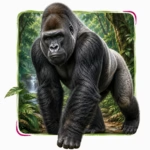
Monkey Fact Highlight
From the full animal facts page
More Animal Comparisons
Pick another animal matchup and keep exploring. Compare appearances, habitats, diets, abilities, and surprising differences.


Make an Animal Story
Turn this gorilla vs monkey comparison into a silverback-troop and many-monkey forest mystery with our free Animal Story Generator.
Source notes: References used for this comparison. See more See less
Try Another Matchup
Explore this comparison →