
Grasshopper vs Cricket: Orthopteran Insect Comparison
Grasshoppers and crickets are jumping insects in the order Orthoptera, but their antennae, sounds, activity times, and body shapes offer useful clues. Grasshoppers usually have short antennae and are active in daylight. Crickets usually have very long antennae and are famous for chirping after dark.
About Grasshopper
- Type Insect
- Diet Herbivore or omnivore depending on species
- Group Short-Horned Orthopteran
- Known for Powerful jumping legs, short antennae, daytime activity, chewing plants, and buzzing flights
- Special skill Launching into long jumps with enlarged hind legs and producing sounds by rubbing legs against wings
About Cricket
- Type Insect
- Diet Omnivore, herbivore, scavenger, or predator depending on species
- Group Long-Horned Orthopteran
- Known for Long antennae, nighttime chirping, jumping legs, sensitive hearing, and wing songs
- Special skill Producing species-specific songs by rubbing specialized parts of the front wings together
Grasshopper vs Cricket: Quick Answer
Grasshoppers usually have short antennae, are active during the day, and make sounds by rubbing a hind leg against a wing. Crickets usually have antennae longer than their bodies, are more active at night, and chirp by rubbing their front wings together. Both are powerful jumpers with babies called nymphs.
Where Do They Fit?
Follow the branches to see how Grasshopper and Cricket are classified and related.
Grasshopper vs Cricket: Quick Comparison
| Feature | Grasshopper | Cricket |
|---|---|---|
| Animal type | Insect | Insect |
| Animal group | Short-horned orthopteran | Long-horned orthopteran |
| Known for | Daytime jumping, short antennae, plant eating, and buzzing flight | Nighttime chirping, long antennae, sensitive hearing, and jumping |
| Main habitat | Grasslands, meadows, farms, gardens, and shrublands | Grasslands, forests, gardens, caves, burrows, and buildings |
| Antennae | Usually shorter than the body | Usually longer than the body |
| Activity | Often active during the day | Often active at dusk or night |
| Diet | Mainly plants, though some are omnivorous | Plants, fungi, insects, and decaying material depending on species |
| Baby name | Nymph | Nymph |
| Sound method | Usually rubs hind leg against wing | Usually rubs front wings together |
| Special skill | Long leaps and strong daytime vision | Chirping and detecting vibrations in darkness |
How Are Grasshoppers and Crickets Alike?
- Both grasshoppers and crickets are insects in the order Orthoptera.
- Both have six legs, two antennae, chewing mouthparts, and powerful enlarged hind legs.
- Both develop through incomplete metamorphosis from egg to nymph to adult.
- Both can produce sounds and detect vibrations.
- Both are important food for birds, reptiles, amphibians, spiders, and other animals.
How Are Grasshoppers and Crickets Different?
- Grasshoppers usually have short antennae, while crickets have very long antennae.
- Grasshoppers are commonly active during the day, while many crickets are active at night.
- Grasshoppers usually sing by rubbing a hind leg against a wing, while crickets rub their front wings together.
- Grasshopper ears are commonly on the abdomen, while cricket ears are often on the front legs.
- Grasshoppers are mainly plant eaters, while cricket diets are often more varied.
Grasshopper vs Cricket Showdown
Jumping-insect showdown: The grasshopper wins for typical size and open-ground speed because many species are larger and combine powerful leaps with buzzing flights. Strength is a tie because both have muscular jumping legs. The cricket takes stealth through nighttime activity, dark hiding places, and vibration sensing. Social life and swimming are ties because both vary widely and neither is aquatic. The cricket wins our weirdest-fact prize because its ears are located on its front legs.
Fun Grasshopper vs Cricket Facts
Short Antennae vs Long Antennae
Grasshopper antennae are usually shorter than the body and contain relatively few segments. Cricket antennae are threadlike, contain many segments, and may extend far beyond the insect’s abdomen.
Leg Song vs Wing Song
Many male grasshoppers make sounds by scraping a row of tiny pegs on a hind leg against a wing. Male crickets usually chirp by rubbing a scraper on one front wing across a file on the other.
Day Jumper vs Night Singer
Grasshoppers often rely on daylight, warmth, and visual signals while feeding in open vegetation. Many crickets emerge at dusk or night and use songs, touch, smell, and vibration to navigate and communicate.
Abdominal Ears vs Leg Ears
Many short-horned grasshoppers have tympanal hearing organs on the first abdominal segment. Crickets have small oval eardrums, called tympana, on their front legs near the knees.
Cricket Chirps Change With Temperature
Crickets are ectotherms, so their muscle activity and chirping rate usually increase as temperatures rise within a suitable range. Different species have different songs, making any temperature estimate approximate.
Grasshopper vs Cricket Quiz
- Which insect usually has shorter antennae? Answer: Grasshopper.
- Which insect usually chirps by rubbing its front wings together? Answer: Cricket.
- What are young grasshoppers and crickets called? Answer: Nymphs.
- Where are a cricket’s hearing organs usually located? Answer: On its front legs.
- Which insect is more commonly active during daylight? Answer: Grasshopper.
Grasshopper vs Cricket FAQ
What is the main difference between a grasshopper and a cricket?
Grasshoppers usually have short antennae and are active during the day. Crickets usually have very long antennae and are more active at night.
Do grasshoppers and crickets make sounds in the same way?
Usually not. Many grasshoppers rub a hind leg against a wing, while male crickets commonly rub their front wings together.
Which jumps farther, a grasshopper or a cricket?
Both are excellent jumpers. Grasshoppers are generally larger and often make longer open-ground leaps, but performance varies greatly among species.
Can grasshoppers turn into locusts?
Only certain grasshopper species can enter a swarming phase and become locusts when crowding and environmental conditions trigger changes in behavior and appearance.
Do crickets really tell the temperature?
Cricket chirping often speeds up as temperatures rise, but the relationship differs among species and conditions, so it provides only a rough estimate.
Animal Words to Know
- Orthoptera: The insect order containing grasshoppers, crickets, katydids, and locusts.
- Nymph: A young insect that resembles a small wingless adult and grows through molts.
- Stridulation: Making sound by rubbing body parts together.
- Tympanum: A thin hearing membrane that functions like an eardrum.
- Ectotherm: An animal whose body temperature and activity depend strongly on external heat.
Grasshopper and Cricket Sound Detective Activity
Grasshopper and Cricket Sound Detective Activity
Draw a grasshopper and cricket at the same enlarged scale. Give the grasshopper short antennae and powerful jumping legs; give the cricket very long antennae and a rounder body. Add sound lines and close-ups showing how each example rubs body parts together to make sound. Label antennae, hind leg, front wing, tympanum, and stridulation.
Meet Each Animal
Want the full fact file? Here are quick highlights from each animal’s own facts page.
Grasshopper Fact Highlight
From the full animal facts page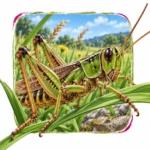
Cricket Fact Highlight
From the full animal facts page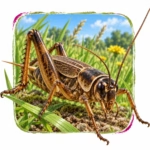
More Animal Comparisons
Pick another animal matchup and keep exploring. Compare appearances, habitats, diets, abilities, and surprising differences.






Make an Animal Story
Turn this grasshopper vs cricket comparison into a chirping meadow adventure with our free Animal Story Generator.
Source notes: References used for this comparison. See more See less
Try Another Matchup
Explore this comparison →