
Great White Shark vs Tiger Shark: Shark Comparison
Great white sharks and tiger sharks are two of the ocean’s best-known predators, but they are built for different hunting styles. Great whites are streamlined ambush hunters that often attack with explosive speed. Tiger sharks have broader heads, striped young, unusual cutting teeth, and one of the widest diets among large sharks.
About Great White Shark
- Type Fish
- Diet Carnivore
- Group Mackerel Shark
- Known for Large serrated teeth, countershading, powerful swimming, regional warm-bodiedness, and ambush hunting
- Special skill Keeping parts of its body warmer than the surrounding water and accelerating rapidly during ambush attacks
About Tiger Shark
- Type Fish
- Diet Carnivore
- Group Requiem Shark
- Known for Dark vertical stripes, a blunt head, deeply notched teeth, a broad diet, and adaptable hunting
- Special skill Using strongly curved, serrated teeth and an adaptable hunting style to eat many kinds of marine prey
Great White Shark vs Tiger Shark: Quick Answer
Great white sharks are usually larger, faster in short bursts, and more specialized for ambushing fish and marine mammals. Tiger sharks are usually stockier, live mainly in warmer seas, have dark stripes when young, and eat a wider variety of prey. Both are large cartilaginous fish with gills, replaceable teeth, and live-born pups.
Where Do They Fit?
Follow the branches to see how Great White Shark and Tiger Shark are classified and related.
Great White Shark vs Tiger Shark: Quick Comparison
| Feature | Great White Shark | Tiger Shark |
|---|---|---|
| Animal type | Fish | Fish |
| Animal group | Mackerel shark | Requiem shark |
| Known for | Powerful ambushes, serrated teeth, countershading, and speed | Stripes, broad diet, notched teeth, and adaptable hunting |
| Main habitat | Mainly temperate and subtropical coastal and offshore waters | Mainly tropical and subtropical coastal and offshore waters |
| Body shape | Robust, torpedo-shaped, and pointed-snouted | Stockier, blunt-headed, and broad across the front |
| Teeth | Broad triangular teeth with serrated edges | Curved teeth with deep notches and serrated edges |
| Typical diet | Fish, rays, seals, sea lions, carrion, and other marine prey | Fish, rays, turtles, seabirds, crustaceans, marine mammals, and carrion |
| Baby name | Pup | Pup |
| Color pattern | Dark above and pale below | Dark bars or spots, especially in younger sharks |
| Special skill | Explosive ambush attacks and regional warm-bodiedness | Eating many prey types with versatile cutting teeth |
How Are Great White Sharks and Tiger Sharks Alike?
- Both great white sharks and tiger sharks are large predatory fish.
- Both have cartilage skeletons, gills, replaceable teeth, and powerful tails.
- Both use smell, vision, vibration detection, and electroreception to locate prey.
- Both give birth to live pups rather than laying eggs outside the body.
- Both can travel long distances and sometimes scavenge dead animals.
How Are Great White Sharks and Tiger Sharks Different?
- Great whites usually have more pointed snouts, while tiger sharks have broad, blunt heads.
- Great white teeth are broad and triangular, while tiger shark teeth are strongly curved and deeply notched.
- Great whites are common in cooler temperate waters, while tiger sharks favor warmer tropical and subtropical seas.
- Great whites often specialize more on fish and marine mammals as they mature, while tiger sharks eat an exceptionally wide variety of prey.
- Young tiger sharks have obvious dark stripes, while great whites use simpler dark-above and pale-below countershading.
Great White Shark vs Tiger Shark Showdown
Shark showdown: The great white wins for typical maximum size, burst speed, strength, and stealth because its streamlined body, countershading, and ambush strategy are built for powerful surprise attacks. Social life and swimming are ties because both are mainly solitary and superbly adapted to long-distance movement. The tiger shark wins our weirdest-fact prize for teeth shaped like curved, serrated can openers that can slice through tough prey such as sea turtle shells.
Fun Great White Shark vs Tiger Shark Facts
Pointed Torpedo vs Blunt-Nosed Cruiser
Great white sharks have robust, torpedo-shaped bodies and pointed conical snouts that reduce drag during rapid attacks. Tiger sharks are also strong swimmers, but their heads are broader and blunter, giving them a heavy, unmistakable profile.
Triangle Teeth vs Notched Teeth
Great white teeth are broad, triangular, and serrated for cutting large pieces from prey. Tiger shark teeth curve backward and contain a deep notch, creating a saw-like shape that can grip, slice, and crush tough food.
Warm-Bodied Hunter vs Warm-Sea Traveler
Great whites can keep parts of their swimming muscles, stomach, eyes, and brain warmer than the surrounding water through regional endothermy. Tiger sharks are ectothermic and are most strongly associated with tropical and subtropical waters.
Focused Hunter vs Giant Menu
Young great whites eat many fish and rays, while larger individuals often add seals and other marine mammals. Tiger sharks consume an especially broad range of prey, including fish, turtles, seabirds, rays, crustaceans, and carrion.
Tiger Shark Stripes Fade With Age
Young tiger sharks display bold vertical bars and spots along their sides, inspiring their name. These markings usually become less distinct as the sharks grow older, although traces may remain on adults.
Great White Shark vs Tiger Shark Quiz
- Which shark usually has the more pointed snout? Answer: Great white shark.
- Which shark has dark stripes when young? Answer: Tiger shark.
- What are baby great whites and tiger sharks called? Answer: Pups.
- Which shark can keep parts of its body warmer than the surrounding water? Answer: Great white shark.
- Which shark is famous for an especially broad diet? Answer: Tiger shark.
Great White Shark vs Tiger Shark FAQ
What is the main difference between a great white shark and a tiger shark?
A great white usually has a pointed snout, broad triangular teeth, strong countershading, and a powerful ambush style. A tiger shark has a blunt head, curved notched teeth, youthful stripes, and a much broader diet.
Which is bigger, a great white shark or a tiger shark?
Great white sharks generally reach greater maximum lengths and masses, although both species can grow very large and measurements vary.
Which shark is faster?
Great whites are generally credited with faster short bursts, especially during ambushes. Reliable wild speed measurements are difficult, so exact maximum values vary among studies.
Do tiger sharks really eat anything?
No. Tiger sharks have a very broad diet, but they do not literally eat everything. They choose available animal prey and carrion, and unusual objects found in stomachs are exceptions rather than normal food.
Are great white sharks and tiger sharks dangerous to people?
Both are large wild predators, and bites can be serious, but attacks are rare compared with the number of people entering the ocean. Swimmers should follow local beach and wildlife guidance.
Animal Words to Know
- Cartilage: Flexible supporting tissue that forms a shark’s skeleton.
- Countershading: Dark coloring above and pale coloring below that helps an animal blend into the water.
- Regional endothermy: The ability to keep certain body regions warmer than the surrounding water.
- Electroreception: The ability to detect weak electrical fields made by living organisms.
- Scavenger: An animal that sometimes feeds on creatures that are already dead.
Great White and Tiger Shark Detective Activity
Great White and Tiger Shark Detective Activity
Draw a great white shark and tiger shark at the same scale. Give the great white a pointed snout, torpedo-shaped body, broad triangular teeth, and strong countershading. Give the tiger shark a blunter head, dark side bars, and curved notched teeth. Label snout, body shape, markings, and teeth, noting that both sharks hunt and may scavenge.
Meet Each Animal
Want the full fact file? Here are quick highlights from each animal’s own facts page.
Great White Shark Fact Highlight
From the full animal facts page
Tiger Shark Fact Highlight
From the full animal facts page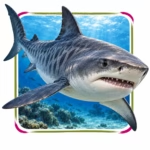
More Animal Comparisons
Pick another animal matchup and keep exploring. Compare appearances, habitats, diets, abilities, and surprising differences.






Make an Animal Story
Turn this great white shark vs tiger shark comparison into a thrilling ocean adventure with our free Animal Story Generator.
Source notes: References used for this comparison. See more See less
Try Another Matchup
Explore this comparison →