
Greater Glider vs Sugar Glider for Kids: Giant and Tiny Gliders
The Southern Greater Glider and Sugar Glider are nocturnal Australian marsupials that sail between trees without powered flight. The Greater Glider is a large, fluffy, solitary leaf specialist with a membrane from elbow to knee. The tiny Sugar Glider is an omnivore that glides from wrist to ankle and shares nests with a social colony.
About Southern Greater Glider
- Type Large gliding possum
- Diet Specialist herbivore
- Group Ringtail possum family, Pseudocheiridae
- Known for Being Australia’s largest gliding possum and eating eucalyptus leaves
- Special skill Glides on a membrane stretching between each elbow and knee
About Sugar Glider
- Type Small gliding possum
- Diet Omnivore
- Group Wrist-winged glider family, Petauridae
- Known for Gliding between trees and living in social family colonies
- Special skill Glides on a membrane stretching from each wrist to ankle
Quick Answer
Quick answer: The Southern Greater Glider is Australia’s largest gliding possum, commonly around 1 to 1.5 kg, and eats mainly eucalyptus leaves. The Sugar Glider is roughly one-tenth that mass, eats sap, nectar, pollen, and small animals, and lives in social colonies. Both use skin membranes, long steering tails, tree hollows, pouches, and night vision.
Southern Greater Glider vs Sugar Glider: Quick Comparison
| Feature | Southern Greater Glider | Sugar Glider |
|---|---|---|
| Scientific name | Petauroides volans | Petaurus breviceps |
| Marsupial family | Pseudocheiridae, the ringtail possum family | Petauridae, the wrist-winged glider family |
| Body size | Body about 30 to 48 cm; usually about 1 to 1.5 kg | Body about 16 to 21 cm; usually about 95 to 160 g |
| Gliding membrane | Stretches mainly from elbow to knee | Stretches from wrist to ankle |
| Main food | Almost entirely eucalyptus leaves and buds | Sap, gum, nectar, pollen, insects, and other small prey |
| Main habitat | Tall mature eucalypt forest with old hollow trees | Eucalypt forest and woodland with food trees and hollows |
| Social life | Usually solitary and territorial | Lives in scent-marked family colonies |
| Young | Usually one joey, first in the pouch and later riding on the mother’s back | Usually one or two joeys that develop in the pouch |
| Tail | Very long, furry, and used as a rudder but not for gripping | Long and furry, helping balance and steer during a glide |
| Best field clue | Large fluffy body, round furry ears, and variable dark or pale coat | Small grey body, dark head-to-back stripe, large eyes, and pointed ears |
How Greater Gliders and Sugar Gliders Are Alike
- Both are Australian marsupials that glide on a skin membrane called a patagium.
- Both are nocturnal tree-dwellers with large eyes for gathering light.
- Both steer in the air with body movements and a long furry tail.
- Both shelter and raise young in tree hollows, making old trees important habitat.
- Both have pouches where tiny newborn joeys attach to teats and continue developing.
How Greater Gliders and Sugar Gliders Are Different
- The Southern Greater Glider is about eight to twelve times as heavy as a Sugar Glider.
- The Greater Glider’s membrane runs from elbow to knee, while the Sugar Glider’s runs from wrist to ankle.
- The Greater Glider is a eucalyptus-leaf specialist, while the Sugar Glider is an omnivore.
- Greater Gliders are usually solitary, while Sugar Gliders live in social family colonies.
- The two gliders belong to different marsupial families and evolved different styles of gliding.
Greater Glider vs Sugar Glider Adaptation Showdown
Adaptation showdown: Southern Greater Glider wins size because it commonly weighs around 1 to 1.5 kg, about eight to twelve times a Sugar Glider’s mass. Speed is a Tie because both glide rather than power their flight and fair matched airspeed data are unavailable. Southern Greater Glider wins strength because its much larger body and strong climbing limbs handle thick branches and bulky leaf meals. Stealth is a Tie because both move quietly at night and use camouflage in the canopy. Sugar Glider wins social behavior because it sleeps and communicates in family colonies, while the Greater Glider is usually solitary. Swimming is a Tie because neither is a water specialist. Southern Greater Glider wins weirdest for being a giant gliding possum whose elbow-to-knee membrane opens into a triangular airfoil.
Fun Southern Greater Glider vs Sugar Glider Facts
Australia’s Largest Gliding Possum
The Southern Greater Glider is far heavier than a Sugar Glider. Its thick fur can be black, brown, grey, white, or a mixture, so individuals may look surprisingly different.
Elbows Make the Wing
A Greater Glider’s patagium stretches mainly between its elbows and knees. When spread, the body forms a broad triangular gliding shape.
Leaves Need a Fermentation Tank
Eucalyptus leaves are fibrous and chemically challenging. A Greater Glider uses an enlarged cecum and helpful microbes to ferment and digest this difficult food.
A Colony in a Hollow
Sugar Gliders share tree hollows in family groups that can include several adults and their young. They huddle for warmth and recognize their group by scent.
A Sweet and Buggy Menu
Sugar Gliders lick sap and gum, visit flowers for nectar and pollen, and catch insects or other small prey. Their flexible menu changes with the seasons.
Greater Glider vs Sugar Glider Quiz
- Which animal is much larger? Answer: The Southern Greater Glider.
- Where does a Greater Glider’s membrane attach? Answer: Mainly from elbow to knee.
- Which glider lives in social family colonies? Answer: The Sugar Glider.
- What is the Greater Glider’s main food? Answer: Eucalyptus leaves and buds.
- Do these animals truly fly? Answer: No. They glide by losing height as their membrane carries them forward.
Southern Greater Glider vs Sugar Glider FAQ
Is a Greater Glider a giant Sugar Glider?
No. They are different species in different marsupial families, with different membranes, diets, and social lives.
Which animal glides farther?
Both can cross gaps between trees, but distance depends on launch height, landing height, trees, wind, and the individual glide.
Why do gliders need old trees?
Large old trees are more likely to contain hollows where gliders can sleep, hide, and raise young.
Can a Greater Glider grip with its tail?
No. Its very long tail steers and balances, but it is not prehensile.
Where does the Sugar Glider species live?
After recent scientific splits, Petaurus breviceps refers to Sugar Gliders native to eastern Australia on the coastal side of the Great Dividing Range.
Animal Words to Know
- Patagium: A sheet of skin that stretches between limbs and supports a gliding animal in the air.
- Airfoil: A shape that changes airflow to create lift.
- Arboreal: Adapted for living or moving in trees.
- Cecum: A pouch in the digestive tract where microbes can help ferment plant food.
- Territorial: Defending a home area from others of the same species.
Compare Two Gliding Blueprints
Compare Two Gliding Blueprints
Draw exactly one adult Southern Greater Glider and exactly one adult Sugar Glider at honest relative scale, making the Greater Glider dramatically larger. Trace the Greater Glider’s elbow-to-knee membrane and the Sugar Glider’s wrist-to-ankle membrane in different colors. Label eyes, ears, tail, tree hollow, diet, joeys, and social style. Watch wild gliders only from a respectful distance and never handle or feed them.
Meet Each Animal
Want the full fact file? Here are quick highlights from each animal’s own facts page.
Southern Greater Glider Fact Highlight
From the full animal facts page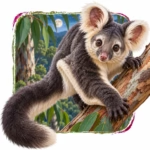
Sugar Glider Fact Highlight
From the full animal facts page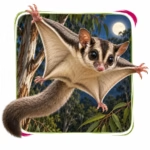
More Animal Comparisons
Pick another animal matchup and keep exploring. Compare appearances, habitats, diets, abilities, and surprising differences.
Make an Animal Story
Send a giant leaf-eating Glider and a tiny social Sugar Glider on a moonlit canopy quest with our free Animal Story Generator.