
Green vs Hawksbill Sea Turtle for Kids: Grazer or Sponge Hunter?
Green Sea Turtles and Hawksbill Sea Turtles are warm-ocean reptiles with paddle-like flippers, lungs, and long migrations between feeding areas and nesting beaches. The Green Turtle is the world’s largest hard-shelled sea turtle and develops a mostly plant-based adult diet. The smaller Hawksbill has a sharp bird-like beak and overlapping patterned shell plates suited to life around coral reefs.
About Green Sea Turtle
- Type Large hard-shelled sea turtle
- Diet Adults mainly herbivorous
- Group Sea turtle family, Cheloniidae
- Known for Being the largest hard-shelled sea turtle and grazing mainly on seagrass and algae as an adult
- Special skill Migrates hundreds or thousands of kilometers between feeding grounds and nesting beaches
About Hawksbill Sea Turtle
- Type Medium reef-dwelling sea turtle
- Diet Omnivore, often a sponge specialist
- Group Sea turtle family, Cheloniidae
- Known for A narrow hawk-like beak, overlapping amber shell scutes, and a sponge-rich diet
- Special skill Uses its pointed beak to reach sponges and other prey in narrow reef cracks
Quick Answer
Quick answer: A Green Sea Turtle is larger, with a broad smooth shell, comparatively small rounded head, and an adult diet dominated by seagrass and algae. A Hawksbill Sea Turtle is smaller, with a narrow pointed beak, overlapping amber-and-brown shell scutes, and a jagged rear shell edge. It searches coral reefs for sponges and other animals. Both must surface to breathe, travel long distances, and nest on sandy beaches.
Green Sea Turtle vs Hawksbill Sea Turtle: Quick Comparison
| Feature | Green Sea Turtle | Hawksbill Sea Turtle |
|---|---|---|
| Scientific name | Chelonia mydas | Eretmochelys imbricata |
| Adult shell length | Usually about 90 to 120 cm | Usually about 60 to 90 cm |
| Adult mass | Commonly about 113 to 181 kg | Commonly about 45 to 68 kg |
| Head and beak | Small rounded head with a short serrated beak | Narrow head with a long sharp hawk-like beak |
| Shell clues | Smooth oval shell; scutes meet edge to edge | Amber-patterned shell; scutes overlap and rear edge is serrated |
| Main adult food | Mostly seagrass and algae | Mostly sponges in many reef areas, plus other invertebrates and algae |
| Main feeding habitat | Shallow seagrass beds, algae-rich coasts, reefs, and lagoons | Coral reefs, rocky ledges, lagoons, and mangroves |
| Ocean range | Tropical and subtropical seas around the world | Tropical seas around the world, especially reef regions |
| Nesting | Females crawl onto sandy beaches, usually at night, and lay about 110 eggs per nest | Females nest on sandy beaches, often under vegetation, and may lay around 140 eggs per nest |
| Conservation | Different populations are protected as threatened or endangered in the United States | Critically Endangered globally and protected from international shell trade |
How Green and Hawksbill Sea Turtles Are Alike
- Both are marine reptiles that breathe air and must surface regularly.
- Both have streamlined shells and powerful front flippers for long-distance swimming.
- Both live in warm Atlantic, Pacific, and Indian Ocean regions.
- Both females leave the water to bury many eggs on sandy nesting beaches.
- Both face danger from fishing gear, marine debris, habitat loss, boat strikes, harvest, and changing climate.
How Green and Hawksbill Sea Turtles Are Different
- The Green Sea Turtle is much larger and heavier than the Hawksbill.
- A Green Turtle has a small rounded head, while a Hawksbill has a narrow head and long hooked beak.
- Green Turtle shell scutes meet edge to edge, while Hawksbill scutes overlap like roof tiles.
- Adult Green Turtles mostly graze seagrass and algae, while Hawksbills commonly specialize in reef sponges.
- Green Turtles often forage in seagrass beds, while Hawksbills are especially closely tied to coral reefs and rocky crevices.
Green vs Hawksbill Sea Turtle Adaptation Showdown
Adaptation showdown: Green Sea Turtle wins size because adults commonly weigh 113 to 181 kg, far more than the typical Hawksbill. Speed is a Tie because comparable maximum-speed studies are limited and both are strong sea swimmers. Green Sea Turtle wins strength because its greater mass powers long migrations and heavy surf landings. Hawksbill Sea Turtle wins stealth because its mottled amber-and-brown shell blends with sun-dappled reef surfaces. Social behavior is a Tie because both are mostly solitary outside shared feeding, resting, mating, or nesting areas. Swimming is a Tie because each has long front flippers and crosses large stretches of ocean. Hawksbill Sea Turtle wins weirdest for eating chemically defended sponges and reaching them with a beak shaped like a hawk’s bill.
Fun Green Sea Turtle vs Hawksbill Sea Turtle Facts
Green Refers to Body Fat
The Green Sea Turtle is not named for a bright green shell. Its common name came from the greenish color once noticed in the fat beneath its shell.
A Sea Turtle Lawn Mower
Adult Green Turtles crop seagrass and algae. Repeated grazing can help keep seagrass blades productive and shape healthy feeding meadows.
Scutes Like Roof Tiles
A Hawksbill’s upper shell is covered by overlapping scutes with amber, brown, yellow, and black patterns, plus a saw-like rear edge.
A Beak for Reef Cracks
The Hawksbill’s narrow head and pointed beak fit into crevices where it pulls out sponges and other small reef animals.
Born With a Magnetic Map
Sea turtles can detect Earth’s magnetic field. Females later return toward the broad region where they hatched when it is time to nest.
Green vs Hawksbill Sea Turtle Quiz
- Which turtle is larger? Answer: The Green Sea Turtle.
- Which turtle has overlapping shell scutes? Answer: The Hawksbill Sea Turtle.
- What do adult Green Sea Turtles mainly eat? Answer: Seagrass and algae.
- How does a Hawksbill reach food in reef cracks? Answer: It uses a narrow head and long pointed beak.
- Why must both turtles visit the ocean surface? Answer: They have lungs and breathe air.
Green Sea Turtle vs Hawksbill Sea Turtle FAQ
Is a Green Sea Turtle’s shell always green?
No. The shell is often brown, olive, gray, or patterned. The common name refers to greenish body fat.
Do Hawksbill Sea Turtles eat only sponges?
No. Sponges dominate many populations’ diets, but Hawksbills also eat algae, jelly animals, mollusks, crustaceans, and other reef life.
Can sea turtles breathe underwater?
No. They have lungs and must surface, although a resting turtle can remain underwater for a long time.
Do male sea turtles come ashore to nest?
No. After entering the sea as hatchlings, males normally remain at sea, while adult females return to beaches to lay eggs.
How can families help sea turtles?
Reduce plastic, keep nesting beaches dark and clear, avoid touching turtles, choose responsible seafood, and report entangled or stranded turtles to trained rescuers.
Animal Words to Know
- Scute: A hard plate of keratin covering part of a turtle’s shell.
- Carapace: The upper part of a turtle’s shell.
- Herbivore: An animal that eats mainly plants or algae.
- Migration: A regular long-distance movement between important habitats.
- Bycatch: An animal caught accidentally in fishing gear meant for something else.
Create a Sea Turtle Identification Board
Create a Sea Turtle Identification Board
Draw exactly one adult Green Sea Turtle and exactly one adult Hawksbill Sea Turtle from above at honest relative scale, making the Green Turtle clearly larger. Label the Green Turtle’s broad oval shell, smooth meeting scutes, small rounded head, seagrass food, and one claw on each front flipper. Label the Hawksbill’s overlapping patterned scutes, serrated rear edge, narrow pointed beak, reef sponge food, and two claws on each front flipper. Add a surface-breathing arrow and a clean-beach protection message without touching real turtles.
Meet Each Animal
Want the full fact file? Here are quick highlights from each animal’s own facts page.
Green Sea Turtle Fact Highlight
From the full animal facts page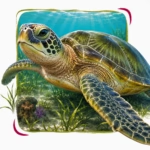
Hawksbill Sea Turtle Fact Highlight
From the full animal facts page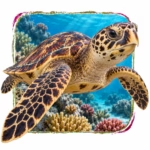
More Animal Comparisons
Pick another animal matchup and keep exploring. Compare appearances, habitats, diets, abilities, and surprising differences.

Make an Animal Story
Send a seagrass grazer and a reef sponge hunter across a tropical ocean with our free Animal Story Generator.