
Hammerhead Shark vs Tiger Shark: Wide-Sensor Hammerhead-to-Striped Generalist Shark Comparison
This comparison uses the great hammerhead as the measurable hammerhead representative because “hammerhead shark” names a whole family, while tiger shark names one species. The great hammerhead may grow slightly longer, has a sensor-packed wing-like cephalofoil, specializes strongly on rays, and sometimes swims rolled on its side. The tiger shark is usually heavier-bodied, carries fading stripes and shell-cutting notched teeth, and eats a wider range of prey and carrion. Both are migratory warm-water ground sharks with live-born pups, but their embryo nutrition differs.
About Hammerhead Shark
- Type Fish
- Diet A great hammerhead actively eats stingrays and other rays, bony fishes, smaller sharks, squid, octopus, crabs, and lobsters; it sweeps a wide sensory field, detects buried prey electrically, turns sharply, and can use the cephalofoil to help pin or control a ray near the seafloor
- Group Hammerhead shark can mean any member of family Sphyrnidae, a group of differently sized sharks with flattened side-expanded heads called cephalofoils; for clean species-level measurements and showdown fields, this row uses the great hammerhead Sphyrna mokarran, the largest hammerhead, as its reference while marking family-wide claims separately
- Known for The great-hammerhead reference averages roughly 3 meters and about 230 kilograms in cited samples, with a reported maximum near 6.1 meters and 450 kilograms; other hammerhead species range from the small bonnethead to large scalloped and smooth hammerheads, so “a hammerhead’s size” has no single number
- Special skill A wide cephalofoil spreads the eyes, nostrils, and electroreceptors across a broad search area and supports sharp maneuvering and prey handling; the great hammerhead adds a nearly straight front edge, very tall curved first dorsal fin, serrated teeth, long-distance migration, and frequent rolled side-swimming that can reduce transport drag
About Tiger Shark
- Type Fish
- Diet An extremely broad carnivorous and scavenging diet including bony fish, rays, other sharks, sea turtles, seabirds, squid, octopus, crustaceans, marine mammals, and carrion; curved serrated teeth with deep notches and a side-to-side head motion can slice tough prey such as turtle shell, but swallowed rubbish is harmful debris rather than a natural food
- Group Tiger shark, Galeocerdo cuvier, the only living species in genus Galeocerdo and one of the largest requiem sharks in family Carcharhinidae; its name comes from the dark bars and blotches most obvious on young animals, not from any relationship to the mammal tiger
- Known for A broad-headed heavy shark commonly about 3.25–4.25 meters and 385–635 kilograms in one widely cited range; exceptional individuals exceed 5.5 meters and may exceed 900 kilograms, so a typical tiger is often heavier than the more slender great-hammerhead reference even though maximum reported lengths overlap
- Special skill A blunt broad snout, robust body, large eyes, a protective nictitating membrane, acute smell, lateral-line and electroreceptive senses, countershading, juvenile stripes, curved serrated teeth shaped similarly in both jaws, short ambush bursts, long-distance navigation, and an unusually flexible diet support hunting and scavenging across varied warm-water habitats
Hammerhead Shark vs Tiger Shark: Quick Answer
A hammerhead has a flattened side-expanded cephalofoil with an eye near each tip, spreading vision, smell, and electroreception across a wide search area. A tiger shark has a conventional blunt snout, heavier body, dark juvenile bars that fade with age, and deeply notched serrated teeth suited to cutting varied prey. For fair measurements, this page uses the great hammerhead—the largest hammerhead—as its reference rather than pretending every hammerhead species is the same size or behavior.
Where Do They Fit?
Follow the branches to see how Hammerhead Shark and Tiger Shark are classified and related.
Hammerhead Shark vs Tiger Shark: Quick Comparison
| Feature | Hammerhead Shark | Tiger Shark |
|---|---|---|
| Comparison identity | Hammerhead family traits with great hammerhead Sphyrna mokarran as size reference | One species, Galeocerdo cuvier |
| Typical large-adult clue | Great-hammerhead reference roughly 3 m and about 230 kg on average, with broad variation | Often about 3.25–4.25 m and 385–635 kg |
| Maximum reported clue | Great hammerhead near 6.1 m and 450 kg | Over 5.5 m and estimated above 900 kg |
| Head | Wide flattened cephalofoil with eyes and nostrils spread apart | Broad conventional head with a short blunt snout |
| Body marking | Gray, brown, or olive above and pale below; adult great hammerhead lacks bold stripes | Dark juvenile bars and spots that fade as the shark ages |
| Teeth | Triangular and serrated in the great hammerhead | Curved, deeply notched, heavily serrated, and similar in both jaws |
| Diet emphasis | Rays, fish, smaller sharks, cephalopods, and crustaceans; great hammerheads favor rays | Fish, rays, sharks, turtles, birds, cephalopods, mammals, crustaceans, and carrion |
| Swimming clue | Great hammerheads often roll sideways so the tall dorsal fin helps generate lift | Steady cruising plus short ambush bursts and long migrations |
| Social clue | Varies by species; scalloped schools, but adult great hammerheads are mainly solitary | Mainly solitary, with food-linked or seasonal gatherings |
| Embryo nutrition | Great-hammerhead embryos develop a yolk-sac placenta | Embryos rely first on yolk and later drink nutrient-rich uterine fluid, without a placenta |
How Are Hammerhead Sharks and Tiger Sharks Alike?
- Both belong to the ground-shark order Carcharhiniformes, with five gill slits, a nictitating eye membrane, two dorsal fins, an asymmetrical tail, cartilage skeleton, replaceable teeth, and dermal denticles.
- Both detect odors, sound, water vibration, light, and weak electric fields; both spread ampullae of Lorenzini across the underside of the head, though a hammerhead’s cephalofoil widens the search pattern.
- Both are live-bearing sharks whose pups develop inside the mother, use warm coastal habitat as nursery space, grow slowly, mature late, migrate long distances, and reproduce much less rapidly than most bony fishes.
- Both eat rays, bony fishes, smaller sharks, squid, octopus, and crustaceans and can use serrated teeth, head movement, and strong bodies to handle substantial prey.
- Both inhabit tropical and warm-temperate coastal and offshore waters and face bycatch, targeted fishing, fin trade, habitat damage, and the danger of being misidentified or grouped broadly in fishery records.
How Are Hammerhead Sharks and Tiger Sharks Different?
- “Hammerhead shark” describes a family containing multiple species; “tiger shark” identifies one species. This row uses the great hammerhead only as the large measurable representative.
- A hammerhead spreads its eyes, nostrils, and electroreceptors across a wide cephalofoil; a tiger shark has a blunt conventional snout and sensory organs arranged across a much narrower head.
- The great hammerhead may reach a slightly longer reported maximum, but the tiger shark is usually much heavier-bodied and published maximum mass estimates are about twice the great hammerhead record.
- Great hammerheads strongly favor rays and may press one down with the cephalofoil; tiger sharks take a broader menu and use deeply notched teeth to saw through fish, carrion, and tough turtle tissues.
- Some hammerhead species form large daytime schools, but the great-hammerhead reference is mostly solitary; tiger sharks are also mainly solitary and gather loosely where food or seasonal habitat concentrates them.
- Great-hammerhead embryos receive nutrition through a yolk-sac placenta; tiger-shark embryos have no placenta and later drink nutrient-rich uterine fluid after their yolk is depleted.
Hammerhead Shark vs Tiger Shark Adaptation Showdown
Wide-sensor specialist versus striped generalist showdown: Size is a tie because the great hammerhead reference has a slightly longer reported maximum while the tiger shark is normally much heavier; combining length and mass into one champion would mislead. Speed is a tie because neither species has a standardized same-condition top-speed trial; great hammerheads maneuver sharply and reduce transport cost by rolled swimming, while tiger sharks cruise slowly and burst quickly during ambush. Tiger shark wins strength narrowly for its much heavier body and deeply notched cutting dentition, not a staged bite contest. Tiger shark wins stealth for murky-water ambush, countershading, and especially the bold camouflage of juveniles, although adult stripes fade. Social behavior is a tie for the two represented species because adult great hammerheads and tiger sharks are mainly solitary; schooling by scalloped hammerheads cannot be awarded to the great hammerhead. Swimming is a tie between hammerhead maneuverability and efficient side-swimming and tiger-shark endurance across varied habitats. Hammerhead wins strangest adaptation for a cephalofoil that expands sensory search and can help turn and handle rays. These fields compare ecology, not combat.
Fun Hammerhead Shark vs Tiger Shark Facts
“Hammerhead Shark” Names a Whole Family
Hammerheads are not one interchangeable species. The family Sphyrnidae includes compact bonnetheads and several larger Sphyrna species with different head outlines, sizes, ranges, conservation histories, and social behavior. This comparison uses Sphyrna mokarran whenever it gives a number or awards a showdown field, while broader sensory traits are identified as family traits.
A Great Hammerhead Often Swims Sideways
Tagged great hammerheads spent much of their travel rolled roughly 50–75 degrees instead of perfectly upright. Their extremely tall first dorsal fin then acts more like a lift-producing wing. Hydrodynamic modelling estimated that this posture can reduce drag and transport cost by around ten percent, turning a shark that looks tilted into an efficient traveler.
Tiger Stripes Are Brightest on Young Sharks
A young tiger shark carries dark spots and vertical bars over a gray upper body, breaking up its outline in shifting coastal light. The markings gradually fade as the animal grows, so a huge mature tiger can look mostly gray. “Tiger shark” remains the species name even when an old adult no longer wears crisp tiger stripes.
The Cephalofoil Widens Search Without Becoming a Magic Detector
All sharks and rays use electroreceptors, so a hammerhead does not own a unique “sixth sense.” Its advantage is geometry: pores spread across a wider head can sweep a broader strip of seafloor, while widely placed eyes increase binocular overlap and the flattened shape supports sharp turns. Experiments do not justify claiming infinitely stronger electrical sensitivity.
The Two Mothers Nourish Embryos Differently
Great-hammerhead embryos begin with yolk and then connect to the mother through a yolk-sac placenta. Tiger-shark embryos also begin with yolk, but no placenta forms; after yolk is used, they swallow nutrient-rich uterine fluid in a process called embryotrophy. Both mothers later give birth to live pups, showing that “live birth” can hide different internal routes.
Hammerhead Shark vs Tiger Shark Quiz
- Which hammerhead species supplies the measurements in this comparison? Answer: The great hammerhead, Sphyrna mokarran.
- What is the hammer-shaped head properly called? Answer: A cephalofoil.
- Do adult tiger sharks always have bold stripes? Answer: No. The markings are strongest on juveniles and usually fade with age.
- Why does a great hammerhead sometimes swim rolled on its side? Answer: Its tall dorsal fin can generate lift more efficiently and reduce transport cost.
- Which shark’s embryos develop a yolk-sac placenta? Answer: The great hammerhead’s.
Hammerhead Shark vs Tiger Shark FAQ
Which is bigger, a hammerhead shark or a tiger shark?
It depends on what “bigger” measures and which hammerhead species is meant. The great hammerhead has a reported maximum length near 6.1 meters, slightly longer than common tiger-shark maxima, but tiger sharks are much heavier-bodied and exceptional estimates exceed 900 kilograms. Most other hammerhead species are smaller than either.
Are all hammerhead sharks great hammerheads?
No. Hammerheads form a family of multiple species. Great, scalloped, smooth, and bonnethead hammerheads differ in size, head outline, schooling, and range. This row uses the great hammerhead for numerical comparison because it is the largest, but the related fact page can introduce the wider family.
Which shark is faster?
This row gives a tie. Widely repeated top speeds do not come from a controlled head-to-head trial. Great hammerheads turn sharply and can travel efficiently while rolled sideways; tiger sharks usually cruise slowly but use short ambush bursts and undertake long migrations.
Do hammerheads use their heads as hammers?
Not like a person swings a tool. The cephalofoil spreads sensory organs and affects maneuvering and lift. Great hammerheads have been observed using the broad head to press or control rays, but it should not be illustrated smashing another shark like a metal hammer.
Is it safe to swim near either shark?
Both are large wild predators deserving distance and respect. Never bait, feed, touch, chase, corner, hook, or deliberately approach one. Follow beach warnings, trained local authorities, and reputable wildlife rules; leave the water calmly if instructed rather than trying to test a comparison page in real life.
Animal Words to Know
- Cephalofoil: The flattened, side-expanded head structure of a hammerhead shark.
- Ampullae of Lorenzini: Jelly-filled electroreceptor organs that detect weak electric fields in the water.
- Nictitating membrane: A protective eyelid-like membrane that can cover a ground shark’s eye.
- Embryotrophy: Embryo nutrition supplied by the mother; in tiger sharks this includes drinking nutrient-rich uterine fluid.
- Circumtropical: Distributed through warm tropical waters around much of the world.
Hammerhead and Tiger Shark Drawing Activity
Hammerhead and Tiger Shark Drawing Activity
Draw a great hammerhead and tiger shark at the same scale. Give the hammerhead a wide hammer-shaped head with eyes near the ends and a tall curved dorsal fin. Give the tiger shark a blunt snout, broad body, notched teeth, and dark side bars that are strongest in younger sharks. Add small dots on both snouts to represent electroreceptors. Label head shape, eyes, stripes, teeth, electroreception, and pup.
Meet Each Animal
Want the full fact file? Here are quick highlights from each animal’s own facts page.
Hammerhead Shark Fact Highlight
From the full animal facts page
Tiger Shark Fact Highlight
From the full animal facts page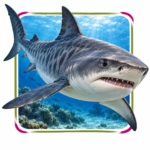
More Animal Comparisons
Pick another animal matchup and keep exploring. Compare appearances, habitats, diets, abilities, and surprising differences.






Make an Animal Story
Turn this hammerhead shark vs tiger shark comparison into a wide-sensor and fading-stripe ocean mystery with our free Animal Story Generator.
Source notes: References used for this comparison. See more See less
Try Another Matchup
Explore this comparison →