
Hawk vs Owl: Living Raptor Group-to-Representative Comparison
Hawks and owls are raptors with hooked bills, strong feet, sharp talons, and superb senses, but the labels cover many species rather than two single body types. Hawks in family Accipitridae are generally daytime hunters that rely heavily on long-distance vision, soaring, perching, and fast aerial approaches. Owls form the separate order Strigiformes and are generally built around forward-facing eyes, sound-catching facial discs, soft flight feathers, and night or twilight hunting. This page uses the familiar Red-tailed Hawk and Great Horned Owl for exact measurements while explaining the broader groups and their exceptions.
About Hawk
- Type Bird
- Diet Carnivore using hooked bill and talons; Red-tailed Hawks eat mainly mammals such as voles, mice, squirrels, rabbits, and hares, plus birds, snakes, carrion, and other available prey
- Group Hawk group in family Accipitridae, represented here by the Red-tailed Hawk (Buteo jamaicensis)
- Known for Hawks vary from small woodland hunters to large broad-winged buteos; the representative Red-tailed Hawk is about 45–65 centimeters long, weighs roughly 0.69–1.46 kilograms, and spans about 114–133 centimeters, with females usually larger than males
- Special skill Exceptional distance vision, broad soaring wings in buteo hawks, sharp grasping talons, hooked tearing bill, a protective third eyelid, light but strong skeleton, and efficient use of thermals to search wide areas
About Owl
- Type Bird
- Diet Carnivore taking prey with talons and hooked bill; Great Horned Owls eat an exceptionally broad menu including rodents, rabbits, hares, birds, reptiles, amphibians, insects, fish, carrion, and occasionally other raptors
- Group Owl group in order Strigiformes, represented here by the Great Horned Owl (Bubo virginianus)
- Known for Owls range from tiny elf owls to enormous eagle-owls; the representative Great Horned Owl is about 46–63 centimeters long, weighs roughly 0.91–2.5 kilograms, and spans about 101–145 centimeters, with females usually larger than males
- Special skill Forward-facing eyes, facial disc that directs sound, hidden ear openings, flexible neck, reversible outer toe, powerful talons, soft combed and fringed flight feathers, low-light vision, keen hearing, and camouflage for daytime roosting
Hawk vs Owl: Quick Answer
A hawk usually has a slimmer forward-pointing face, eyes placed more toward the sides, firmer flight feathers, and a daytime hunting style based strongly on distant vision. An owl usually has a broad facial disc, large forward-facing eyes, hidden ears, softer fringed feathers, and quieter flight suited to hunting at night or twilight. Both are raptors, but they belong to different branches of the bird family tree.
Where Do They Fit?
Follow the branches to see how Hawk and Owl are classified and related.
Hawk vs Owl: Quick Comparison
| Feature | Hawk | Owl |
|---|---|---|
| Representative | Red-tailed Hawk, Buteo jamaicensis | Great Horned Owl, Bubo virginianus |
| Main taxonomic group | Family Accipitridae within order Accipitriformes | Order Strigiformes, including typical owls and barn owls |
| Typical activity | Mostly daytime, although timing varies among hawk species | Mostly night or twilight, with important daytime-hunting exceptions |
| Head and eyes | Narrower face, strongly hooked bill, eyes angled more sideways | Broad facial disc, short-looking hooked bill, large forward-facing eyes |
| Hearing equipment | Good hearing but no large owl-style facial disc | Facial disc directs sound; some species have asymmetrical ear openings |
| Flight sound | Normal firm flight feathers; many soar efficiently on thermals | Soft surfaces plus combed and fringed edges reduce flight noise in many species |
| Representative size | 45–65 cm long; 0.69–1.46 kg; 114–133 cm wingspan | 46–63 cm long; 0.91–2.5 kg; 101–145 cm wingspan |
| Nest pattern | Red-tailed pair builds or repairs a large stick nest | Great Horned pair often adopts an old hawk, crow, raven, heron, or squirrel nest |
| Young | Chick | Owlet |
| Representative conservation | Red-tailed Hawk: Least Concern globally | Great Horned Owl: Least Concern globally |
How Are Hawks and Owls Alike?
- Hawks and owls are birds of prey, or raptors, with hooked bills, muscular legs, sharp talons, excellent vision, and meat-based diets.
- Both swallow some small prey whole and later cast pellets containing indigestible fur, feathers, teeth, bones, scales, or insect parts, although owl pellets are usually easier to find beneath roosts.
- Both use calls, postures, flight displays, and territory defense, and many species form breeding pairs while raising helpless chicks that need weeks of care.
- Both can hunt rodents and other animals that people may consider pests, making healthy raptor populations valuable parts of food webs.
- Both face risks from habitat loss, vehicle collisions, window or wire strikes, illegal shooting, lead, pesticides, and secondary poisoning from eating contaminated prey.
How Are Hawks and Owls Different?
- Hawks and owls are not close versions of one raptor: hawks belong to Accipitriformes and owls to Strigiformes.
- Most familiar hawks hunt during daylight, while most owls hunt at night or twilight; however, Northern Hawk Owls, Burrowing Owls, Snowy Owls, and other species can be active in daylight.
- Hawks usually emphasize long-distance visual scanning and efficient soaring or fast woodland pursuit; many owls combine forward-facing vision with precise sound localization and quiet flight.
- An owl’s broad facial disc helps channel sound toward hidden ear openings, while a hawk’s face lacks that large dish-like sound collector.
- Many hawks build or repair stick nests; many owls use cavities, ledges, burrows, ground scrapes, or old nests made by hawks, crows, ravens, and other animals.
- Hawks generally have three toes forward and one back, while many owls can rotate the outer toe backward, producing a two-forward and two-back grip.
Hawk vs Owl Adaptation Showdown
Raptor adaptation showdown: Owl wins size and gripping power only in this representative matchup because a Great Horned Owl can be heavier than a Red-tailed Hawk; across all hawks and owls, species sizes overlap widely. Hawk wins speed for efficient daytime soaring, travel, and visible aerial pursuit, not for one universal maximum-speed record. Owl wins stealth through low-noise feather structure, camouflage, and low-light approach. Social life is a tie because both representatives form territorial pairs while hunting mostly alone. Swimming is a tie because neither is an aquatic specialist, although either may cross water and individuals can survive an accidental landing. Owl wins weirdest adaptation for a facial disc, partly offset ears in some species, and a neck that can turn about 270 degrees. These categories compare adaptations, not combat.
Fun Hawk vs Owl Facts
Hollywood Often Gives Every Raptor a Red-Tail’s Voice
The Red-tailed Hawk makes a long, rough, descending scream. Film and television editors use that dramatic call for eagles and many other birds, even when the animal on screen would make a very different sound. A Great Horned Owl instead gives deep, rhythmic hoots along with hisses, barks, screams, and bill claps.
An Owl’s Horns Are Feathers, Not Ears
The Great Horned Owl’s pointed head tufts are bundles of feathers called plumicorns. They may help with camouflage, recognition, or signaling, but the real ear openings are hidden beneath feathers on the sides of the head. An owl can raise or flatten the tufts without moving its ears.
A Hawk May Build the Nursery an Owl Uses Later
Red-tailed Hawks invest in a large stick platform and may repair an old nest. Great Horned Owls usually do not construct such a platform; they often take over a nest previously built by a hawk, crow, raven, heron, or squirrel. Because Great Horned Owls can nest early, they may occupy a platform before its former builder returns.
Owls Turn Their Necks Because Their Eyes Stay Put
An owl’s large tube-shaped eyes are held firmly in the skull and do not swivel like human eyes. Extra neck vertebrae, flexible joints, and specialized blood vessels let the bird turn its head roughly 270 degrees without twisting it all the way around. Hawks can move their eyes more, but also turn their heads to scan.
Both Raptors Make Pellets
After a raptor digests the useful parts of a meal, its stomach can pack indigestible fur, feathers, bones, teeth, or insect shells into a pellet and send it back through the bill. Owls often swallow prey more completely, so their pellets can hold recognizable bones; hawks also cast pellets, though they may tear food into smaller pieces first.
Hawk vs Owl Quiz
- Which representative is mainly active by day? Answer: The Red-tailed Hawk.
- What does an owl’s facial disc help collect? Answer: Sound.
- Are the Great Horned Owl’s feather tufts its ears? Answer: No. Its ear openings are hidden beneath feathers.
- Which representative commonly adopts an old nest made by another animal? Answer: The Great Horned Owl.
- Are all owls nocturnal and all hawks identical? Answer: No. Both groups contain many species and important exceptions.
Hawk vs Owl FAQ
What is the easiest way to tell a hawk from an owl?
An owl usually has a broad, flat-looking facial disc, very large forward-facing eyes, a short-looking hooked bill, and a big rounded head. A hawk usually has a narrower face, a more exposed bill, and eyes angled farther toward the sides. Shape, behavior, habitat, and local field marks should all be checked.
Which is bigger, a hawk or owl?
There is no group-wide winner because both labels cover tiny and very large species. In the representative pair used here, a Great Horned Owl overlaps the Red-tailed Hawk in length and wingspan but can be considerably heavier.
Are all owls awake at night?
No. Most are nocturnal or crepuscular, but several species routinely hunt in daylight, including Burrowing Owls, Northern Hawk Owls, and Snowy Owls under some conditions.
Can hawks and owls live in the same place?
Yes. Their territories and prey can overlap. They may avoid one another, mob an intruder, compete for nest sites, or occasionally prey on one another, but a child should observe only from a respectful distance and never play calls near a nest.
Can an owl turn its head all the way around?
No. Many owls can turn about 270 degrees, which is three-quarters of a circle, but not a full 360 degrees.
Animal Words to Know
- Raptor: A bird of prey with strong feet, sharp talons, a hooked bill, and a meat-based diet.
- Facial disc: The broad arrangement of feathers around an owl’s face that helps direct sound toward its ears.
- Thermal: A column of rising warm air that a soaring bird can ride with little flapping.
- Pellet: A compact mass of indigestible food parts cast through a bird’s bill.
- Nocturnal: Mainly active at night; this describes many but not all owl species.
Hawk and Owl Raptor Activity
Hawk and Owl Raptor Activity
Draw a red-tailed hawk in daylight and a great horned owl at dusk. Give the hawk broad soaring wings, an exposed hooked bill, and a reddish adult tail above a thermal. Give the owl a round head, facial disc, feather tufts, large forward-facing eyes, and broad soft-edged wings. Label raptor, talons, thermal, facial disc, eyesight, hearing, and hunting time.
Meet Each Animal
Want the full fact file? Here are quick highlights from each animal’s own facts page.
Hawk Fact Highlight
From the full animal facts page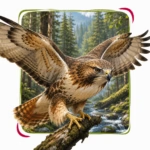
Owl Fact Highlight
From the full animal facts page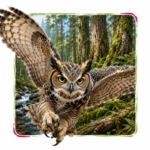
More Animal Comparisons
Pick another animal matchup and keep exploring. Compare appearances, habitats, diets, abilities, and surprising differences.


Make an Animal Story
Turn this hawk vs owl comparison into a sunny-sky and moonlit-forest mystery with our free Animal Story Generator.
Source notes: References used for this comparison. See more See less
Try Another Matchup
Explore this comparison →