
Hawksbill Sea Turtle vs Loggerhead Sea Turtle: Sea Turtle Comparison
Hawksbill and Loggerhead Sea Turtles are hard-shelled ocean reptiles, but their faces reveal different feeding jobs. The Hawksbill has a narrow head and hooked beak for pulling sponges and other food from coral crevices. The Loggerhead is much larger and has a huge blocky head with powerful jaws for crushing crabs, whelks, clams, and other hard prey.
About Hawksbill Sea Turtle
- Type Medium reef-dwelling sea turtle
- Diet Omnivore, often a sponge specialist
- Group Sea turtle family, Cheloniidae
- Known for A hawk-like beak, overlapping patterned scutes, and a sponge-rich reef diet
- Special skill Reaches food in tight coral cracks with a narrow head and pointed beak
About Loggerhead Sea Turtle
- Type Large hard-shelled sea turtle
- Diet Carnivorous omnivore
- Group Sea turtle family, Cheloniidae
- Known for An enormous head and powerful jaws that crush crabs, whelks, clams, and other hard prey
- Special skill Crushes hard-shelled prey with massive jaw muscles in a broad head
Hawksbill Sea Turtle vs Loggerhead Sea Turtle: Quick Answer
A Hawksbill Sea Turtle is the smaller reef specialist, usually with overlapping amber-patterned scutes, a serrated rear shell edge, and a long pointed beak. A Loggerhead Sea Turtle is larger and heavier, with a reddish-brown heart-shaped shell, a very broad head, heavy jaws, and non-overlapping scutes. Both breathe air, migrate through large ocean regions, and bury eggs on sandy beaches.
Where Do They Fit?
Follow the branches to see how Hawksbill Sea Turtle and Loggerhead Sea Turtle are classified and related.
Hawksbill Sea Turtle vs Loggerhead Sea Turtle: Quick Comparison
| Feature | Hawksbill Sea Turtle | Loggerhead Sea Turtle |
|---|---|---|
| Scientific name | Eretmochelys imbricata | Caretta caretta |
| Adult shell length | Usually about 60 to 90 cm | Usually about 80 to 110 cm |
| Adult mass | Commonly about 45 to 68 kg | Commonly about 90 to 160 kg |
| Head | Narrow and tapered with a hooked hawk-like beak | Very large, broad, and blocky with powerful jaw muscles |
| Shell clues | Overlapping amber-patterned scutes and a serrated rear edge | Reddish-brown heart-shaped shell with five pairs of side scutes |
| Main adult food | Sponges, plus other reef invertebrates and algae | Crabs, whelks, clams, conchs, and many other animals |
| Main feeding habitat | Coral reefs, rocky ledges, lagoons, and mangroves | Coastal bays, continental shelves, estuaries, and open ocean |
| Ocean range | Tropical Atlantic, Pacific, and Indian Oceans | Temperate and subtropical oceans plus the Mediterranean Sea |
| Nesting | Often nests under beach vegetation and may lay around 140 eggs per clutch | Nests on warm sandy beaches and lays roughly 100 to 126 eggs per clutch |
| Conservation | Critically Endangered globally | Protected populations face continuing threats across the world |
How Hawksbill and Loggerhead Sea Turtles Are Alike
- Both are hard-shelled sea turtles with lungs, paddle-like flippers, and streamlined bodies.
- Both travel long distances between feeding habitats and nesting regions.
- Both females bury large clutches of eggs on warm sandy beaches.
- Both eat animal prey and help shape marine food webs.
- Both are protected animals threatened by fishing gear, marine debris, beach development, boat strikes, harvest, and climate change.
How Hawksbill and Loggerhead Sea Turtles Are Different
- A Loggerhead is usually much larger and heavier than a Hawksbill.
- The Hawksbill has a narrow pointed beak, while the Loggerhead has an exceptionally broad head and crushing jaws.
- Hawksbill shell scutes overlap, while Loggerhead scutes meet without overlapping.
- Hawksbills specialize on reef sponges, while Loggerheads commonly crush crabs, whelks, clams, and conchs.
- Hawksbills are most closely tied to tropical reefs, while Loggerheads also use broad continental shelves, bays, estuaries, and temperate seas.
Hawksbill vs Loggerhead Sea Turtle Adaptation Showdown
Adaptation showdown: Loggerhead Sea Turtle wins size because adults commonly weigh about 90 to 160 kg, well above the typical Hawksbill. Speed is a Tie because reliable matched speed trials are not available. Loggerhead Sea Turtle wins strength because its giant head carries jaw muscles powerful enough to crack hard mollusk and crab shells. Hawksbill Sea Turtle wins stealth because its amber-and-brown pattern blends with mottled reef light. Social behavior is a Tie because both spend most of life alone outside shared feeding, mating, or nesting areas. Swimming is a Tie because each uses long flippers for major migrations and underwater feeding. Hawksbill Sea Turtle wins weirdest for eating sponges that contain tough fibers and defensive chemicals many animals avoid.
Fun Hawksbill Sea Turtle vs Loggerhead Sea Turtle Facts
A Bird-Shaped Feeding Tool
The Hawksbill’s common name comes from its narrow hooked beak, which resembles the bill of a hawk and fits into reef crevices.
A Shell Once Called Tortoiseshell
Hawksbill scutes have striking amber and dark patterns. People once killed huge numbers for combs, jewelry, and ornaments sold as tortoiseshell.
The Head That Named a Turtle
A Loggerhead’s head is so large that it inspired the animal’s common name. Powerful muscles close the jaws around hard prey.
A Living Shell Crusher
Loggerheads often eat whelks, clams, conchs, crabs, and horseshoe crabs, crushing or tearing shells before swallowing the softer parts.
Years on an Ocean Journey
Young Loggerheads may spend years circling huge current systems in the open ocean before settling into coastal feeding areas.
Hawksbill vs Loggerhead Sea Turtle Quiz
- Which turtle has the larger head? Answer: The Loggerhead Sea Turtle.
- Which turtle has overlapping shell scutes? Answer: The Hawksbill Sea Turtle.
- What prey can a Loggerhead’s jaws crush? Answer: Hard-shelled animals such as crabs, whelks, clams, and conchs.
- Why is a Hawksbill’s narrow beak useful? Answer: It can reach sponges and other food in reef cracks.
- What do female sea turtles do on sandy beaches? Answer: They dig nests, lay eggs, cover them, and return to the sea.
Hawksbill Sea Turtle vs Loggerhead Sea Turtle FAQ
Is a Loggerhead a land tortoise?
No. It is an ocean-going sea turtle with powerful flippers and a streamlined shell.
Which turtle is bigger?
The Loggerhead is usually longer and much heavier than the Hawksbill.
Are Hawksbill shells still used for jewelry?
International commercial trade is banned, but illegal tortoiseshell products still exist and should never be bought.
Do Loggerheads eat only shellfish?
No. They eat many animals, including crabs, mollusks, jelly animals, fish, and other available prey, plus occasional plant material.
What should someone do if a sea turtle is tangled?
Do not handle it alone. Keep a safe distance and contact the local trained marine-wildlife rescue or stranding network immediately.
Animal Words to Know
- Mollusk: An animal group that includes clams, snails, squid, and octopuses.
- Scute: A hard keratin plate covering part of a turtle’s shell.
- Crevice: A narrow crack or opening in rock or coral.
- Current: A large, continuing movement of ocean water.
- Wildlife trade: The buying and selling of wild animals, plants, or products made from them.
Match Each Turtle to Its Ocean Toolkit
Match Each Turtle to Its Ocean Toolkit
Draw exactly one adult Hawksbill Sea Turtle and exactly one adult Loggerhead Sea Turtle from above at honest relative scale, making the Loggerhead clearly larger. Label the Hawksbill’s narrow hooked beak, overlapping amber scutes, serrated rear edge, reef crevice, and sponge food. Label the Loggerhead’s broad head, powerful jaws, reddish heart-shaped shell, five pairs of side scutes, and crab or whelk food. Draw arrows matching each head shape to its feeding job, then add a promise never to buy tortoiseshell products.
Meet Each Animal
Want the full fact file? Here are quick highlights from each animal’s own facts page.
Hawksbill Sea Turtle Fact Highlight
From the full animal facts page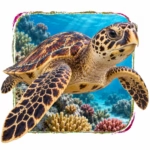
Loggerhead Sea Turtle Fact Highlight
From the full animal facts page
More Animal Comparisons
Pick another animal matchup and keep exploring. Compare appearances, habitats, diets, abilities, and surprising differences.



Make an Animal Story
Send a reef crevice explorer and a mighty shell crusher across the ocean with our free Animal Story Generator.
Source notes: References used for this comparison. See more See less
Try Another Matchup
Explore this comparison →