
Western Jackdaw vs Common Raven: Corvid Comparison
Western Jackdaws and Common Ravens are both clever corvids, yet their silhouettes sit at opposite ends of the family. The jackdaw is a compact crow with a short bill, gray nape, and striking pale eyes. The raven is enormous, with a thick bill, shaggy throat feathers, long wings, and a diamond or wedge-shaped tail. Their calls also differ: chack versus deep kronk.
About Western Jackdaw
- Type Bird
- Diet Omnivore; invertebrates, seeds, fruit, carrion, eggs, scraps, and other foods
- Group Corvid; family Corvidae
- Known for A gray nape, pale eyes, short bill, chack call, cavity nests, devoted pairs, and busy flocks
- Special skill Reads companions’ calls and movements inside an organized flock while using many human-made cavities
About Common Raven
- Type Bird
- Diet Omnivore and scavenger; carrion, insects, small animals, eggs, grains, acorns, fruit, and buds
- Group Corvid; family Corvidae
- Known for Enormous size, a heavy bill, shaggy throat, wedge tail, deep croak, soaring, tumbling, and intelligence
- Special skill Solves new problems, stores many kinds of food, performs aerial acrobatics, and plays with a huge sound repertoire
Western Jackdaw vs Common Raven: Quick Answer
The Common Raven is the clear giant, averaging about 1.2 kilograms in BTO records compared with about 231.8 grams for the Western Jackdaw. Jackdaws are pale-eyed, gray-naped, highly social cavity nesters that often live near villages and chimneys. Ravens have dark eyes, heavy bills, throat hackles, wedge tails, soaring flight, aerial tumbles, and wide-ranging wild habitats.
Western Jackdaw vs Common Raven: Quick Comparison
| Feature | Western Jackdaw | Common Raven |
|---|---|---|
| Scientific identity | Coloeus monedula | Corvus corax |
| Bird family | Corvidae | Corvidae |
| Average adult weight | About 231.8 g in BTO records | About 1.2 kg in BTO records |
| Overall size | Small, compact crow | Largest member of the crow family and one of the largest songbirds |
| Head clue | Gray nape, black cap, pale blue-gray or silver eye, short bill | Black shaggy throat hackles, dark eye, and massive curved bill |
| Tail in flight | Short and fairly square or rounded | Long and diamond or wedge-shaped |
| Voice | Sharp chack or tchack | Deep resonant kronk and many other calls |
| Favorite setting | Villages, old suburbs, chimneys, farmland, parks, woods, and sea cliffs | Rugged uplands, mountains, cliffs, coasts, tundra, deserts, forests, and open country |
| Nest | Cavity in a tree, cliff, building, chimney, or ruin | Large stick nest on a cliff ledge, tree, tower, or other high structure |
| Social pattern | Colonies, pairs, large flocks, and winter roosts | Territorial pairs and families; nonbreeders gather at food and communal roosts |
How Are Jackdaws and Ravens Alike?
- Both are corvids, members of the intelligent crow and jay family.
- Both have mostly dark feathers, sturdy feet, strong bills, and varied vocal communication.
- Both are omnivores and scavengers that eat animal foods as well as seeds or fruit.
- Both form lasting pair bonds and work together to raise helpless chicks.
- Both learn quickly, remember useful places, and adapt some behavior around people.
How Are Jackdaws and Ravens Different?
- The Common Raven averages more than five times the jackdaw’s weight in BTO records.
- The jackdaw has a gray nape and pale eyes; the raven is fully black with dark eyes and shaggy throat hackles.
- The jackdaw has a short bill and short tail; the raven has a massive bill and long wedge-shaped tail.
- Jackdaws commonly nest in cavities and form colonies; ravens build large open stick nests and defend broad territories.
- Jackdaws give sharp chack calls, while ravens give deep croaks and perform more soaring and tumbling flight.
Jackdaw vs Raven Showdown
Adaptation showdown: Common Raven wins size because its average BTO weight is more than five times greater. Speed is a Tie because the sources give no fair matched flight-speed test. Common Raven wins strength because its much larger body and massive bill can handle substantial food and carry varied objects. Stealth is a Tie because the smaller jackdaw blends around roofs and cliffs while the raven’s dark plumage and soaring search suit open wild country. Western Jackdaw wins social behavior because pairs live inside organized colonies, flocks, and large winter roosts. Swimming is a Tie because neither is a water specialist. Common Raven wins weirdest for aerial tumbling, vocal play that may last for hours, and caching both edible and non-edible objects while young.
Fun Western Jackdaw vs Common Raven Facts
More Than Five Jackdaws on the Scale
BTO averages place the Western Jackdaw at about 231.8 grams and the Common Raven at about 1.2 kilograms. A raven therefore weighs a little more than five average jackdaws.
Eyes Like Frosted Glass
Adult Western Jackdaws have unusually pale blue-gray or silver-yellow eyes that stand out against a black cap and gray nape. Young birds begin with bluer or darker-looking eyes.
The Tail Makes a Flying Diamond
A Common Raven’s long central tail feathers create a wedge or diamond shape in flight. Together with long wings, a heavy bill, and soaring, the tail separates a raven from smaller crows at a distance.
A Crow That Loves Cavities
Jackdaws tuck nests into chimneys, tree holes, church towers, ruins, quarries, and rock crevices. Many pairs can nest near one another wherever safe cavities are plentiful.
Ravens Play With Sound
Young ravens experiment with pitches, volumes, calls, wing whistles, and bill snaps. Animal Diversity Web describes vocal play that can run through a huge repertoire for minutes or even hours.
Jackdaw vs Raven Quiz
- Which bird is much larger? Answer: The Common Raven.
- Which bird has a gray nape and pale eyes? Answer: The Western Jackdaw.
- What shape is a raven’s tail in flight? Answer: A diamond or wedge.
- Where do jackdaws often build nests? Answer: In cavities such as tree holes, chimneys, buildings, ruins, or rock crevices.
- Which bird gives the deeper kronk call? Answer: The Common Raven.
Western Jackdaw vs Common Raven FAQ
Is a jackdaw a raven?
No. They are different species in the same corvid family.
Which is bigger, a jackdaw or a raven?
The Common Raven is far larger and averages more than five times the jackdaw’s weight in BTO records.
How can you tell them apart in flight?
The raven has much longer wings and a wedge-shaped tail; the jackdaw is compact with a shorter tail.
Why are jackdaw eyes so easy to notice?
Adult eyes are very pale blue-gray or silver-yellow, creating a strong contrast with dark head feathers.
Are both birds intelligent?
Yes. Both are corvids with complex social learning, memory, communication, and flexible feeding behavior.
Animal Words to Know
- Corvid: A member of the crow family, which includes ravens, jackdaws, rooks, magpies, and jays.
- Hackles: Long or shaggy feathers on a bird’s throat or neck.
- Cavity nester: A bird that places its nest inside a hole or enclosed space.
- Soar: To stay aloft on rising air with little wing flapping.
- Vocal repertoire: The collection of different calls and sounds an animal can produce.
Scale the Smallest and Largest Crows
Scale the Smallest and Largest Crows
Draw exactly one adult Western Jackdaw near a stone chimney and exactly one adult Common Raven above a nearby sea cliff at honest relative scale, with the raven much larger. Add clue cards for pale eye, dark eye, gray nape, throat hackles, short tail, wedge tail, chack, and kronk. Sort and explain each clue. Watch birds quietly without people handling them.
Meet Each Animal
Want the full fact file? Here are quick highlights from each animal’s own facts page.
Western Jackdaw Fact Highlight
From the full animal facts page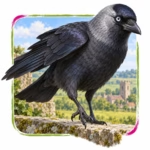
Common Raven Fact Highlight
From the full animal facts page
More Animal Comparisons
Pick another animal matchup and keep exploring. Compare appearances, habitats, diets, abilities, and surprising differences.






Make an Animal Story
Send a pale-eyed Jackdaw and a tumbling giant Raven across a cliffside mystery with our free Animal Story Generator.
Source notes: References used for this comparison. See more See less
Try Another Matchup
Explore this comparison →