
Kangaroo vs Wombat: Open-Country-Kangaroo-to-Burrowing-Wombat Marsupial Comparison
Kangaroos and wombats are Australian plant-eating marsupials in the same order, Diprotodontia, but they solve life on land in almost opposite ways. A kangaroo is a long-legged open-country traveler that saves energy by hopping and often feeds in a flexible mob. A wombat is a compact nocturnal excavator that shelters in a cool burrow, grazes close to the ground, and usually protects its own feeding area. Both raise tiny newborn joeys in pouches, yet the wombat pouch opens toward the rear to stay cleaner while digging. “Kangaroo” and “wombat” each cover several species, so red kangaroo and bare-nosed wombat measurements are examples rather than universal labels.
About Kangaroo
- Type Mammal
- Diet Herbivore feeding mainly on grasses, forbs, leaves, shoots, and shrubs; red and grey kangaroos are especially important grazers, but plant choice shifts with species, season, rainfall, fire, habitat, and the freshness of available growth
- Group Kangaroo in the narrow everyday sense: the four large living macropods commonly called kangaroos—the red kangaroo Osphranter rufus, antilopine kangaroo Osphranter antilopinus, eastern grey kangaroo Macropus giganteus, and western grey kangaroo Macropus fuliginosus; this page does not treat every wallaby, wallaroo, tree-kangaroo, or other macropod as a kangaroo
- Known for A tall or long-bodied marsupial with a small head, large mobile ears, short grasping forelimbs, an enormous muscular tail, very long hind feet, and powerful hind legs; size and coat vary greatly, with adult male red kangaroos the largest and some grey-kangaroo females far smaller
- Special skill Huge elastic hind limbs recycle energy during hopping, a muscular tail balances fast bounds and powers a five-point slow gait, large ears track sound, specialized teeth and a chambered foregut process fibrous plants, and heat-management behaviors such as shade-seeking, panting, and forearm licking help some species cope with hot open country
About Wombat
- Type Mammal
- Diet Herbivore grazing native grasses and sedges and also eating roots, herbs, rushes, bark, and other tough low-growing plant material; slow hindgut fermentation and long food passage help extract water and nutrients from a fibrous diet
- Group Wombats, family Vombatidae in order Diprotodontia, represented by three living Australian species: the bare-nosed or common wombat Vombatus ursinus, southern hairy-nosed wombat Lasiorhinus latifrons, and northern hairy-nosed wombat Lasiorhinus krefftii
- Known for A low, barrel-bodied marsupial with a broad blunt head, tiny tail, small eyes, short powerful neck, stout legs, wide feet, flattened digging claws, thick hide, and chisel-like continuously growing incisors; adults are commonly around 20–35 kilograms, with body size and nose hair differing by species
- Special skill Powerful shoulders, broad feet, and flattened claws excavate deep tunnels; the rear-facing pouch helps exclude digging soil, ever-growing incisors crop abrasive grasses, a thick reinforced rump can block a tunnel entrance, and long efficient digestion conserves moisture while uneven intestinal mechanics shape distinctive cubic droppings
Kangaroo vs Wombat: Quick Answer
A kangaroo is usually taller, faster, longer-tailed, and built to hop across open country. A wombat is shorter, stockier, and built to dig and live underground. Kangaroos often feed in mobs and carry joeys in a forward-and-upward-opening pouch; wombats usually forage alone and have a rear-facing pouch that helps keep soil away from the joey. Both are herbivorous Australian marsupials, but a wombat is more closely related to a koala than to a kangaroo.
Where Do They Fit?
Follow the branches to see how Kangaroo and Wombat are classified and related.
Kangaroo vs Wombat: Quick Comparison
| Feature | Kangaroo | Wombat |
|---|---|---|
| Scientific scope | Four large species commonly called kangaroos in genera Osphranter and Macropus | Three living species in family Vombatidae |
| Body plan | Tall rear-powered body, very long hind feet, short forelimbs, and huge tail | Low barrel body, stout legs, broad feet, tiny tail, and blunt head |
| Representative size | Male red kangaroos can approach about 90 kg; species and sexes vary widely | Most adults are roughly 20–35 kg and about one metre long |
| Main movement | Two-legged hopping at speed and five-point tail-assisted walking while feeding | Four-legged walking, short rapid sprints, and powerful digging |
| Home | Shade, vegetation, and open seasonal ranges rather than a permanent nest | Underground burrow or connected warren used for shelter |
| Pouch opening | Opens toward the front and upward on the abdomen | Opens toward the rear, away from the digging direction |
| Social pattern | Often gathers in flexible mobs whose membership changes | Usually feeds alone, though burrows or warrens may be shared |
| Food | Mostly grasses and other green plants, with species-specific grazing and browsing | Grasses, sedges, roots, and other coarse low-growing plants |
| Famous adaptation | Elastic hopping plus a muscular tail that works like a fifth leg at slow speed | Rear-facing pouch, excavator body, and cube-shaped droppings formed in the intestine |
| Young | Joey develops in the pouch and later travels at the mother’s feet | Usually one joey develops for months in the rear-facing pouch |
How Are Kangaroos and Wombats Alike?
- Both are warm-blooded, fur-covered Australian marsupials in order Diprotodontia, with two enlarged lower front teeth and highly undeveloped newborn young.
- Both normally carry a joey in a pouch, nurse it with milk, protect it for months, and continue mother-young contact after the juvenile first leaves the pouch.
- Both are herbivores with specialized microbial digestion that helps unlock energy from fibrous Australian plants.
- Both have strong claws, excellent smell and hearing, activity patterns that avoid the hottest part of many days, and the ability to move surprisingly quickly when necessary.
- Both can swim if they must, face dangers from vehicles, fences, habitat change, dogs, and disease, and should be watched quietly from a generous distance without feeding or touching.
How Are Kangaroos and Wombats Different?
- A kangaroo is a macropod in family Macropodidae, while a wombat belongs to family Vombatidae and shares a more recent ancestor with koalas than with kangaroos.
- Kangaroos have towering hindquarters, long feet, small forelimbs, and an enormous tail; wombats have a low quadrupedal body, short legs, broad paws, a blunt head, and almost no visible tail.
- Kangaroos cross open ground by elastic hopping and use the tail as a propulsive fifth limb while moving slowly. Wombats walk on four feet and use their strength mainly to excavate and maintain burrows.
- A kangaroo pouch opens toward the front and upward. A wombat pouch opens toward the rear, reducing the amount of soil and plant debris pushed inside while the mother digs.
- Kangaroos often gather in flexible mobs around forage and water. Wombats usually graze alone and mark feeding areas, although several animals may use the same burrow system at different times.
- Kangaroo droppings are commonly pellet-like or oval. Bare-nosed wombats are famous for forming dry cube-like pieces inside the final part of a long intestine.
Kangaroo vs Wombat Adaptation Showdown
Open-country hopper versus underground digger showdown: Kangaroo wins size because the largest adult male red kangaroos greatly outweigh any living wombat, although females and smaller kangaroo species narrow the gap. Kangaroo wins speed because documented red-kangaroo bounds exceed the short sprint speed reported for wombats. Strength is a tie: kangaroos direct powerful hind limbs into hopping and defense, while wombats move soil and roots with a compact excavator body, so no honest single test represents both. Wombat wins stealth for disappearing underground, traveling low through cover, and feeding mostly from dusk to dawn. Kangaroo wins social behavior for flexible mobs, while this does not mean every individual stays in a group. Swimming is a tie because both can cross water but neither group is aquatic. Wombat wins strangest adaptation for forming cubic droppings through uneven intestinal stiffness and muscular contractions. These categories compare survival designs, not combat.
Fun Kangaroo vs Wombat Facts
They Share an Order but Not the Same Close Branch
Kangaroos and wombats both belong to Diprotodontia, an Australian marsupial order whose members share features including two enlarged lower incisors. Inside that order, kangaroos sit with wallabies and other macropods, while wombats form the wombat-and-koala branch called Vombatiformes. Similar pouches do not make every marsupial equally close.
A Kangaroo Tail Becomes a Fifth Leg at Slow Speed
A fast kangaroo holds its tail behind as a counterbalance while elastic hind legs hop together. When grazing slowly, it plants both forefeet, then the muscular tail, swings the paired hind feet forward, and advances in a five-point gait. Force-platform research on red kangaroos found that the tail supplies major support, propulsion, and positive mechanical work rather than acting as a simple kickstand.
Their Pouches Point Through Different Work Zones
A kangaroo mother carries a joey high on the front of her body while she hops, so the pouch opening faces forward and upward. A wombat drives its head and forequarters into soil and throws loosened dirt backward; its pouch opens toward the rear, helping keep the nursery away from the main stream of excavated soil. The pouch is not dirt-proof, but its direction is a useful digging adaptation.
Wombat Cubes Are Molded Before They Leave the Body
A wombat does not have a square opening and does not sculpt droppings afterward. Research on bare-nosed wombats found that feces dry and take shape in the final part of the long intestine, where regions with different stiffness stretch and contract unevenly. The resulting flat-sided pieces can be placed at scent-marking sites; the popular idea that cubes evolved specifically to avoid rolling is plausible but not proven as the only reason.
A Red Kangaroo Can Pause One Embryo
Female red kangaroos can nurse a joey outside the pouch, support a younger joey inside it, and hold a newly conceived embryo in embryonic diapause. Development resumes when pouch space and conditions allow. Wombats generally raise one joey at a time and do not use that famous red-kangaroo assembly line. Diapause should not be pasted onto every kangaroo species without checking the species.
Kangaroo vs Wombat Quiz
- Which animal usually travels quickly by hopping? Answer: The kangaroo.
- Which animal lives in an underground burrow? Answer: The wombat.
- Why does a wombat pouch open toward the rear? Answer: It helps keep excavated soil and debris away while the mother digs.
- What job can a kangaroo tail perform during slow movement? Answer: It works as a powered fifth limb for support and propulsion.
- Where are wombat cubes shaped? Answer: Inside the final part of the intestine, through drying, uneven stiffness, and contractions.
Kangaroo vs Wombat FAQ
Is a wombat a type of kangaroo?
No. Both are diprotodont marsupials, but kangaroos belong to family Macropodidae and wombats to family Vombatidae. A wombat is more closely related to a koala than to a kangaroo.
Which is bigger, a kangaroo or wombat?
The largest kangaroos are much bigger. A large male red kangaroo can approach about 90 kilograms, while living wombats are commonly around 20–35 kilograms. “Kangaroo” covers four species and both groups show sex and population differences, so one number never describes every adult.
Which is faster, a kangaroo or wombat?
A red kangaroo can bound at roughly 60 kilometres per hour in a short burst, while government wildlife material reports wombats at up to about 40 kilometres per hour for a short sprint. Those are not standardized races across every species, but the kangaroo is the stronger high-speed traveler.
Do wombats really make cube-shaped poop?
Yes, especially bare-nosed wombats. The pieces are molded inside the intestine as material dries and passes through regions that deform differently. Their flat surfaces may help at raised scent-marking sites, but scientists should test evolutionary explanations rather than treating one popular story as settled fact.
Can kangaroos and wombats be approached or fed?
No. Both are powerful wild animals, human food can harm them, and close contact can cause stress or defensive injuries. Slow down on wildlife roads, keep dogs controlled, stay well back, and contact a licensed wildlife rescuer or veterinarian if an animal is injured.
Animal Words to Know
- Marsupial: A mammal whose very undeveloped newborn usually continues growing while attached to a teat, often inside a pouch.
- Macropod: A member of the big-footed marsupial family that includes kangaroos, wallabies, wallaroos, and related animals.
- Warren: A connected burrow system that may contain several entrances and be used by more than one wombat.
- Pentapedal: Moving with five contact points; a slowly feeding kangaroo uses two forelimbs, two hind limbs, and its tail in sequence.
- Embryonic diapause: A temporary pause in the development of an early embryo, used by red kangaroos and some other mammals.
Kangaroo and Wombat Marsupial Activity
Kangaroo and Wombat Marsupial Activity
Draw a red kangaroo and bare-nosed wombat on the same ground line. Make the kangaroo tall, with huge hind feet, short forearms, a long balancing tail, and a forward-opening pouch. Make the wombat low and barrel-shaped, with short powerful legs, digging claws, a tiny tail, and a rear-opening pouch beside a burrow. Add a joey to each scene. Label marsupial, pouch, joey, hopping, digging, and burrow.
Meet Each Animal
Want the full fact file? Here are quick highlights from each animal’s own facts page.
Kangaroo Fact Highlight
From the full animal facts page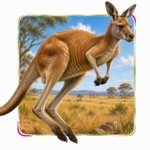
Wombat Fact Highlight
From the full animal facts page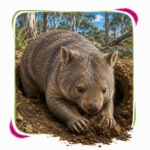
More Animal Comparisons
Pick another animal matchup and keep exploring. Compare appearances, habitats, diets, abilities, and surprising differences.





Make an Animal Story
Turn this kangaroo vs wombat comparison into an open-grassland hopping trail and underground burrow mystery with our free Animal Story Generator.
Source notes: References used for this comparison. See more See less
Try Another Matchup
Explore this comparison →