
King Cobra vs Monocled Cobra: Elapid Snake Species Comparison
King Cobras and Monocled Cobras are both venomous Asian snakes that spread hoods, but they are not the same kind of cobra. The King Cobra belongs to genus Ophiophagus and is the world’s longest venomous snake. It mainly hunts other snakes and makes a mound-like leaf nest. The Monocled Cobra is a true cobra in genus Naja. It is much shorter, often hunts rodents around wetlands and fields, and usually carries one round monocle marking on the back of its hood.
About King Cobra
- Type Living
- Diet Carnivore and snake specialist; mainly eats other snakes, with occasional lizards or small mammals
- Group World’s longest venomous snake; an elapid in genus Ophiophagus rather than a true Naja cobra (Ophiophagus hannah in the traditional broad treatment)
- Known for Exceptional length, narrow hood, olive or dark banded body, deep growling hiss, snake-eating diet and leaf nest
- Special skill Raises a long section of its body, spreads a narrow hood and builds the only known snake nest made by actively gathering vegetation
About Monocled Cobra
- Type Living
- Diet Carnivore; eats rodents, frogs, fish, lizards, birds, eggs and other snakes
- Group True cobra in genus Naja and the venomous snake family Elapidae (Naja kaouthia)
- Known for Single O-shaped hood mark, broad hood, brown or olive body, nighttime hunting and powerful defensive display
- Special skill Spreads a broad hood that often shows one pale O-shaped eye spot, creating a larger warning display
King Cobra vs Monocled Cobra: Quick Answer
A King Cobra is much longer, has a narrower hood and mainly eats other snakes. A female gathers leaves into a nest mound for her eggs. A Monocled Cobra is shorter and heavier-looking, has a broader hood with one O-shaped mark, and eats many rodents, frogs and other small animals. Both are venomous wild snakes that should only be watched from a safe distance.
Where Do They Fit?
Follow the branches to see how King Cobra and Monocled Cobra are classified and related.
King Cobra vs Monocled Cobra: Quick Comparison
| Feature | King Cobra | Monocled Cobra |
|---|---|---|
| Scientific name | Ophiophagus hannah in the traditional broad treatment | Naja kaouthia |
| Cobra type | King cobra genus Ophiophagus; not a true Naja cobra | True cobra in genus Naja |
| Adult length | Usually about 3-4 m; exceptional animals reach about 5.5 m | Usually about 1.2-1.5 m; rare animals reach about 2.3 m |
| Build | Extremely long and relatively slender | Shorter and more compact |
| Hood | Long, narrow hood without one round monocle | Broad hood, often with one O-shaped mark on the back |
| Main food | Mostly other snakes | Mostly rodents, frogs and other small vertebrates |
| Daily activity | Often active by day, but timing can vary | Often active at dusk and night |
| Habitat | Forest, bamboo, mangrove, wetland and farmland edges | Forest, grassland, swamp, rice field and settlements |
| Egg care | Female builds a vegetation nest and stays nearby for much of incubation | Female lays eggs in a sheltered place; no piled leaf nest |
| Conservation | Vulnerable under the familiar broad species assessment | Least Concern, though local snakes still face capture and habitat change |
How Are King Cobras and Monocled Cobras Alike?
- Both are venomous Asian snakes in the elapid family.
- Both spread neck ribs into a hood when they feel seriously threatened.
- Both lay eggs and begin life as fully independent hatchlings.
- Both use a forked tongue to carry scent particles to a special organ in the mouth.
- Both can swim and often live in landscapes containing streams, marshes or rice fields.
How Are King Cobras and Monocled Cobras Different?
- The King Cobra belongs to genus Ophiophagus, while the Monocled Cobra is a true Naja cobra.
- A King Cobra can grow more than twice as long as a large Monocled Cobra.
- The King Cobra has a long narrow hood; the Monocled Cobra has a broader hood often marked with one circle.
- King Cobras mainly hunt snakes, while Monocled Cobras often hunt rodents, frogs and other small prey.
- A female King Cobra builds a vegetation nest mound, while a Monocled Cobra does not make that kind of nest.
King Cobra vs Monocled Cobra Adaptation Showdown
- Size – King Cobra: It is the world’s longest venomous snake and can exceed 5 m, far beyond the Monocled Cobra’s rare maximum near 2.3 m.
- Speed – Tie: Both can move quickly over short distances, but the selected sources provide no fair matched race.
- Strength – King Cobra: Its much greater body length and mass give it more total muscular power.
- Stealth – Monocled Cobra: Its compact brown or olive body hides well in leaf litter, fields and rodent burrows, especially after dark.
- Social – Tie: Both normally live alone and meet other adults mainly during breeding.
- Swimming – Tie: Both can cross water capably, but neither has a proven advantage in a matched swimming test.
- Weirdest – King Cobra: It eats snakes, makes a deep growling hiss and is the only known snake to gather plants into a nest mound.
Fun King Cobra vs Monocled Cobra Facts
The Longest Venomous Snake
A King Cobra can reach about 5.5 m, making it the longest venomous snake species known.
A Name That Means Snake Eater
Ophiophagus comes from Greek words meaning snake eater, matching the King Cobra’s favorite prey.
The Nest-Building Snake
A female King Cobra gathers leaves and other vegetation into a mound around her eggs.
One Eye on the Hood
The Monocled Cobra is named for the single O-shaped marking often displayed on the back of its hood.
A Hood Is a Warning
Cobras spread their hoods to look larger when alarmed; they would usually rather escape than waste energy in danger.
King Cobra vs Monocled Cobra Quiz
Which is the world’s longest venomous snake? A) King Cobra B) Monocled Cobra C) Both Answer: A) King Cobra
Which cobra often has one O-shaped hood mark? A) King Cobra B) Monocled Cobra C) Neither Answer: B) Monocled Cobra
What does a King Cobra mainly eat? A) Other snakes B) Grass C) Fruit Answer: A) Other snakes
Which snake builds a mound-like leaf nest? A) King Cobra B) Monocled Cobra C) Both Answer: A) King Cobra
What should you do if you see a wild cobra? A) Keep far away and alert an adult B) Touch its hood C) Try to feed it Answer: A) Keep far away and alert an adult
King Cobra vs Monocled Cobra FAQ
Is a King Cobra a True Cobra?
It is a close relative in the elapid family, but it belongs to genus Ophiophagus rather than the true cobra genus Naja.
Why is it called a Monocled Cobra?
Many individuals have one O-shaped mark on the back of the hood, resembling a single eyeglass lens called a monocle.
Which Cobra is longer?
The King Cobra by a large margin. Adults are often 3-4 m long, while Monocled Cobras are usually about 1.2-1.5 m.
Do all Monocled Cobras have a perfect circle?
No. The hood marking varies and can be faint, broken or absent in some individuals.
Are Cobra Hoods Always Open?
No. A cobra normally keeps its neck narrow and spreads the hood only during a serious warning or defensive display.
Animal Words to Know
- Elapid: A member of the venomous snake family containing cobras, mambas, kraits and coral snakes.
- Genus: A scientific group containing one or more closely related species.
- Hood: The widened neck a cobra creates by spreading long movable ribs.
- Monocle: A single round eyeglass lens; the cobra’s hood mark resembles one.
- Venomous: Able to deliver toxins through a bite or sting.
Design Two Cobra Warning Cards
Design Two Cobra Warning Cards
Fold a page in half. Draw a much longer King Cobra with a narrow hood and a small leaf-nest symbol. Draw a shorter Monocled Cobra with a broad hood and one round mark. Add three safe identification clues to each side, then write one shared safety rule: observe wild snakes only from far away.
Meet Each Animal
Want the full fact file? Here are quick highlights from each animal’s own facts page.
King Cobra Fact Highlight
From the full animal facts page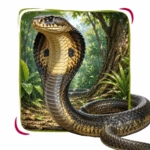
Monocled Cobra Fact Highlight
From the full animal facts page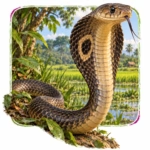
More Animal Comparisons
Pick another animal matchup and keep exploring. Compare appearances, habitats, diets, abilities, and surprising differences.


Make an Animal Story
Create a rainforest story about a giant snake-eating King Cobra and a circle-marked Monocled Cobra!
Source notes: References used for this comparison. See more See less
Try Another Matchup
Explore this comparison →