
Kiwi vs Emu: New-Zealand-Kiwi-to-Australian-Emu Flightless-Bird Comparison
Kiwi and emus are southern flightless birds in the ancient palaeognath branch, yet they look as if someone shrank one design and stretched the other. A kiwi is a small, mostly night-active New Zealand ground bird that probes soil with a sensory bill whose nostrils sit near the tip. An emu is Australia’s tallest native bird, a long-legged daytime runner that can cross wide dry landscapes, swim strongly, and follow rain toward food. Both have tiny useless-for-flight wings, shaggy-looking feathers, strong legs, and unusual father care. “Kiwi” means five living species, while “emu” means one living species, and DNA does not make them each other’s closest living pair: emus group most closely with cassowaries, while kiwi form a separate lineage whose closest known relatives include extinct elephant birds.
About Kiwi
- Type Bird
- Diet Omnivorous ground forager eating mainly earthworms, insect larvae, beetles, wētā, spiders, centipedes, snails, and other invertebrates, plus fallen fruit, seeds, leaves, fungi, and occasional small aquatic prey; menus differ by species, place, and season
- Group Kiwi, genus Apteryx in family Apterygidae and order Apterygiformes, represented by five living New Zealand species: North Island brown kiwi Apteryx mantelli, rowi Apteryx rowi, tokoeka Apteryx australis, great spotted kiwi Apteryx haastii, and little spotted kiwi Apteryx owenii
- Known for A chicken-sized or smaller flightless bird with a pear-shaped body, long narrow slightly curved bill, nostrils close to the bill tip, tiny eyes, no visible tail, one-inch-scale wings hidden under loose hair-like feathers, thick four-toed feet, and strong muscular legs; females are generally larger and longer-billed than males
- Special skill A flexible bill tip combines smell with touch- and vibration-sensitive pits to find hidden prey, powerful feet scratch and defend, dense marrow-filled bones support a ground life, loose hair-like feathers move quietly through vegetation, facial bristles feel nearby objects, and an unusually large yolky egg gives a chick a substantial food reserve
About Emu
- Type Bird
- Diet Mobile omnivore selecting seeds, fruits, flowers, young shoots, herbs, and other nutrient-rich plant parts plus caterpillars, grasshoppers, beetles, and occasional small vertebrates; swallowed stones help the muscular gizzard grind food
- Group Emu, Dromaius novaehollandiae, the only living species in genus Dromaius and a member of order Casuariiformes; the living mainland form is closely related to cassowaries, while historical Tasmanian and small island emu populations are extinct
- Known for A very large flightless bird standing about 1.6–1.9 metres tall with a small head, long blue-tinged neck, shaggy grey-brown double-shafted feathers, tiny wings, deep body, extremely long powerful legs, and three forward-pointing toes; adult females are generally somewhat larger and heavier than males
- Special skill Long three-toed legs deliver fast, economical travel and defensive kicks, strong swimming broadens movement options, shaggy double-shafted feathers shield the skin from heat, mobile feeding follows patchy rainfall, a booming inflatable neck structure helps females call, and dedicated males fast through incubation and raise the chicks
Kiwi vs Emu: Quick Answer
A kiwi is a small New Zealand forest-and-scrub bird with hair-like feathers, four-toed feet, a long sensory bill, and nostrils near the bill tip. An emu is a huge Australian open-country bird with shaggy double-shafted feathers, three-toed feet, long legs, and running speed near 50 kilometres per hour. Neither can fly. Kiwi often search at night and lay an enormous egg for their body size; emu travel by day, and the male incubates a clutch and leads the striped chicks.
Where Do They Fit?
Follow the branches to see how Kiwi and Emu are classified and related.
Kiwi vs Emu: Quick Comparison
| Feature | Kiwi | Emu |
|---|---|---|
| Scientific scope | Five living species in genus Apteryx | One living species, Dromaius novaehollandiae |
| Native home | New Zealand only | Mainland Australia only in the living native range |
| Typical scale | About 25–45 cm long and roughly 1–3.5 kg, depending on species and sex | About 1.6–1.9 m tall and commonly around 30–60 kg |
| Feet | Short powerful legs with four toes and strong claws | Very long running legs with three forward-pointing toes |
| Bill clue | Long probe with nostrils and many sensory pits near the tip | Shorter broad bill used to pick plant parts, insects, and other food |
| Feathers | Loose hair-like plumage, facial bristles, and no visible tail | Shaggy double-shafted plumage and a small drooping tail area |
| Activity | Mostly nocturnal or crepuscular, with important species and island exceptions | Mainly daytime traveler whose movement follows food, water, weather, and breeding |
| Egg care | Male-only incubation in some species and shared incubation in others | Male incubates the large dark-green clutch and raises the chicks |
| Food search | Probes soil and litter for invertebrates and also takes fruit and fungi | Walks widely for nutrient-rich plant parts, seeds, fruit, and insects |
| Signature sound | High male whistles and lower female calls that carry through habitat | Male grunts and female booms or drum-like calls from the neck |
How Are Kiwi and Emus Alike?
- Both are warm-blooded, feathered palaeognath birds with reduced wings, no flight ability, powerful legs, ground nests or burrows, and chicks that hatch covered in down.
- Both have loose shaggy-looking feathers rather than the tightly zipped flight surface of a strong flying bird.
- Both eat mixed diets containing plant material and invertebrates, swallow food rather than chewing it, and use muscular gizzards in digestion.
- Both show important male parental care: male emus incubate and rear chicks, and males perform all or much incubation in several kiwi species.
- Both can swim, communicate with low or far-carrying calls, require large safe habitats without harassment, and should never be approached, chased, fed, or blocked from a path or nest.
How Are Kiwi and Emus Different?
- Kiwi are five species endemic to New Zealand in order Apterygiformes; the emu is one living Australian species in order Casuariiformes and is the cassowary’s closest living partner.
- An emu can stand more than four times as tall and weigh many times more than a kiwi. Kiwi are compact ground probers; emus are among the world’s tallest birds.
- Kiwi have four-toed feet and a long flexible bill with nostrils and vibration-sensitive structures near the tip. Emus have three-toed running feet and a shorter bill used to select visible food.
- Kiwi are mostly active after dusk and shelter in burrows, hollow logs, or dense cover. Emus are conspicuous daytime travelers of open woodland, grassland, heath, and dry country.
- Kiwi lay one or sometimes two extremely large pale eggs relative to the female’s body, with incubation roles varying by species. Emu females lay several large dark-green eggs, then a male incubates and raises the brood.
- Kiwi feathers look hair-like and their tiny wings disappear beneath them. Emu feathers grow as paired shafts from a follicle and form a shaggy insulating body coat around equally tiny flightless wings.
Kiwi vs Emu Adaptation Showdown
Scent-led forest bird versus giant open-country runner showdown: Emu wins size by an enormous margin and speed because official wildlife profiles place its short sprint near 48–50 kilometres per hour, far beyond ordinary kiwi travel. Emu wins whole-body strength from its much greater mass and long running legs; this is not a fight prediction. Kiwi wins stealth for quiet hair-like plumage, night activity, low forest movement, and burrow shelter. Social behavior is a tie: kiwi may maintain long pair bonds and family territories, while emus form breeding pairs, mobile aggregations, and devoted father-led broods, with neither system universally “more social.” Emu wins swimming because it is specifically documented as a strong swimmer, although kiwi can cross water. Kiwi wins strangest adaptation for combining nostrils and a vibration-sensitive bill-tip organ with an egg that is enormous relative to the female. These fields compare survival designs, not combat.
Fun Kiwi vs Emu Facts
Flightless Does Not Mean Closest Cousins
Kiwi and emus both belong to Palaeognathae, the bird branch containing ostriches, rheas, cassowaries, tinamous, and several extinct flightless groups. Modern genome studies place emus with cassowaries, while kiwi form a separate branch closely linked to extinct Madagascan elephant birds. Ratite-like flightlessness evolved more than once from ancestors that could fly, so matching tiny wings do not prove a two-species partnership.
A Kiwi Searches With the Far End of Its Bill
Most birds place nostrils near the bill base, but a kiwi’s openings sit close to the tip. Inside and around that tip are sensory pits and touch receptors that help detect pressure and vibration from hidden prey as the bill probes soil and leaf litter. Smell, touch, hearing, and facial bristles work together; the kiwi is not simply “sniffing worms” with one superpower.
An Emu Runs on Three Toes and Swims Too
Each emu foot has three forward-pointing toes attached to a long, powerful leg. The stride can carry the bird across huge dry landscapes and reach roughly 48–50 kilometres per hour in a short sprint. Emus can also swim strongly across water. A kiwi has four toes, shorter legs, and a careful ground-searching gait built for cover rather than continental-distance running.
Both Have Tiny Wings but Different Feather Engineering
A kiwi’s wings are only a few centimetres long and vanish beneath long, loose, hair-like feathers; the bird also lacks a visible tail. An emu’s wings are reduced to small stubs beneath a massive shaggy coat. Many emu body feathers have two shafts growing from one follicle and loose barbs that do not zip into a stiff flight vane, helping create insulation rather than an airfoil.
The Fathers Sit, but the Egg Stories Are Not Identical
A kiwi female produces one of the largest eggs relative to adult body size among birds. Brown and little spotted kiwi males normally incubate, while pairs share incubation in rowi, great spotted kiwi, and some tokoeka. An emu male builds a ground nest, incubates a large clutch of dark-green eggs for about eight weeks while eating and drinking little or nothing, then guards the striped chicks for months.
Kiwi vs Emu Quiz
- Which bird is much larger? Answer: The emu.
- Where are a kiwi’s nostrils? Answer: Near the tip of its long bill.
- How many forward-pointing toes does an emu have on each foot? Answer: Three.
- Can either bird fly? Answer: No. Both living groups are flightless.
- Who incubates emu eggs? Answer: The male, who also leads and guards the chicks.
Kiwi vs Emu FAQ
Is a kiwi a small emu?
No. Kiwi are five New Zealand species in order Apterygiformes, while the emu is one Australian species in order Casuariiformes. Both are palaeognath birds, but emus are most closely related to cassowaries and kiwi belong to their own deeper branch.
Which is bigger and faster, a kiwi or emu?
The emu is both. It stands about 1.6–1.9 metres tall and can sprint near 48–50 kilometres per hour. Kiwi species are roughly chicken-sized or smaller, generally about 25–45 centimetres long and around 1–3.5 kilograms, and are adapted for careful probing rather than high-speed open travel.
Can kiwi or emus fly?
No. Both have tiny reduced wings and feathers adapted to ground life. Their ancestors belonged to flight-capable palaeognath lineages, and modern evidence indicates that major ratite groups lost flight independently rather than inheriting it once from one giant flightless ancestor.
Do male kiwi and male emus sit on eggs?
Male emus incubate and raise the brood. Brown and little spotted kiwi males normally incubate alone, but females share incubation in rowi, great spotted kiwi, and some tokoeka. “The father always sits” is therefore accurate for emus but too simple for all five kiwi species.
Do kiwi and emus live together?
No in their natural ranges. Kiwi are endemic to New Zealand, while wild emus are native to mainland Australia. Zoo or farm settings do not turn them into natural neighbors, and neither should be approached or fed in the wild.
Animal Words to Know
- Palaeognath: A member of an ancient living bird branch that includes tinamous and the groups commonly called ratites.
- Ratite: A traditional name for large or small flightless palaeognath birds with reduced breastbone keels; DNA shows their flightlessness evolved repeatedly.
- Bill-tip organ: Clusters of touch- and vibration-sensitive structures near a probing bird’s bill tip that help detect hidden food.
- Gizzard: A muscular part of a bird’s stomach that grinds food, sometimes with the help of swallowed grit or stones.
- Incubation: Keeping eggs at suitable temperature and humidity while embryos develop.
Kiwi and Emu Scale Activity
Kiwi and Emu Scale Activity
Draw a brown kiwi and emu on the same ground line and at the same scale. Make the kiwi very small, with hair-like feathers, a long bill with nostrils near the tip, four-toed feet, and a forest-floor setting. Make the emu much taller, with a long neck, shaggy feathers, three-toed feet, and open woodland or grassland. Add an egg near each bird and show the fathers caring for them. Label flightless, bill, toes, egg, father care, and habitat.
Meet Each Animal
Want the full fact file? Here are quick highlights from each animal’s own facts page.
Kiwi Fact Highlight
From the full animal facts page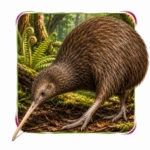
Emu Fact Highlight
From the full animal facts page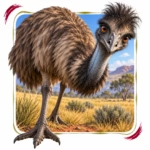
More Animal Comparisons
Pick another animal matchup and keep exploring. Compare appearances, habitats, diets, abilities, and surprising differences.



Make an Animal Story
Turn this kiwi vs emu comparison into a sensory-bill forest trail and rain-chasing outback journey with our free Animal Story Generator.
Source notes: References used for this comparison. See more See less
Try Another Matchup
Explore this comparison →