
Greater Kudu vs Common Eland: Antelope Species Comparison
Kudu and eland are names for more than one kind of antelope. This page compares the Greater Kudu, Tragelaphus strepsiceros, with the Common Eland, Taurotragus oryx. Both belong to the spiral-horned antelope group, but their shapes are very different. A Greater Kudu is tall, narrow and boldly striped, and adult males carry huge open corkscrew horns. A Common Eland is much bulkier and more ox-like, with a large throat dewlap and shorter, tighter horns in both sexes.
About Greater Kudu
- Type Living
- Diet Herbivore; browses leaves, shoots, herbs, vines, flowers and fruit, with some grass
- Group Spiral-horned antelope species in the cattle family Bovidae (Tragelaphus strepsiceros)
- Known for Slender gray-brown body, six to ten thin white stripes, huge ears and spectacular open spiral horns on males
- Special skill Makes powerful high leaps over obstacles, then vanishes into striped shade among bushes and trees
About Common Eland
- Type Living
- Diet Herbivore; grazes grass and browses leaves, herbs, fruit and other plant food
- Group One of the largest living antelope species in the cattle family Bovidae (Taurotragus oryx)
- Known for Enormous ox-like build, fawn-to-gray coat, hanging throat dewlap and tightly twisted horns in both sexes
- Special skill Combines a nearly one-tonne adult build with surprising agility and standing jumps over high fences
Greater Kudu vs Common Eland: Quick Answer
The Common Eland is the heavyweight: a large bull may approach 1,000 kilograms, several times a Greater Kudu’s mass. The Greater Kudu is slimmer, with six to ten crisp white stripes, enormous ears and widely spiraled horns on males. A Common Eland is fawn to gray, often has fainter stripes, carries a big hanging dewlap and usually has tightly twisted horns whether male or female.
Where Do They Fit?
Follow the branches to see how Greater Kudu and Common Eland are classified and related.
Greater Kudu vs Common Eland: Quick Comparison
| Feature | Greater Kudu | Common Eland |
|---|---|---|
| Scientific name | Tragelaphus strepsiceros | Taurotragus oryx |
| Body mass | About 120-315 kg across adults | About 300-1,000 kg across adults |
| Body shape | Tall, narrow and long-legged | Huge, deep-chested and ox-like |
| Coat pattern | Usually six to ten thin white vertical stripes | Fawn to gray, sometimes with faint white stripes |
| Horns | Long open spirals, normally on males | Shorter tight twists, normally on both sexes |
| Special feature | Very large round ears and male neck fringe | Large dewlap and short mane, especially obvious on males |
| Habitat | Wooded and bushy country with hiding cover | Open savanna, grassland, scrub and woodland |
| Food | Mostly browse such as leaves, shoots, vines and fruit | Mixed feeding on grass, leaves, herbs and fruit |
| Social life | Small female herds; mature males often alone | Herds often number dozens and sometimes many more |
| Escape style | High bounding jumps into thick cover | Steady endurance, herd defense and surprising jumps |
How Are Greater Kudus and Common Elands Alike?
- Both are African antelopes in the cattle family Bovidae.
- Both belong to a group known for permanent spiral horns rather than shed antlers.
- Both eat plants and can browse leaves, shoots, flowers or fruit above ground level.
- Both usually produce one calf, which the mother may hide in vegetation when it is very young.
- Both can jump much higher than their heavy-looking bodies might suggest.
How Are Greater Kudus and Common Elands Different?
- A Common Eland can weigh several times as much as a Greater Kudu.
- Greater Kudus are slender and sharply striped; Common Elands are deeper-bodied with plainer coats.
- Only male Greater Kudus normally grow horns, while male and female Common Elands usually have them.
- Kudu horns form huge open spirals; eland horns are shorter, thicker and more tightly twisted.
- Greater Kudus favor cover and small groups, while Common Elands often use more open land and larger herds.
Kudu vs Eland Adaptation Showdown
- Size – Common Eland: It is one of the world’s largest antelopes, and the biggest bulls may approach one metric tonne.
- Speed – Tie: The Kudu is a nimble bounder and the Eland has strong endurance, but matched top-speed evidence does not give a fair winner.
- Strength – Common Eland: Its immense chest, neck and shoulder mass provide far more total power; this is not a fight prediction.
- Stealth – Greater Kudu: Thin white stripes break up its outline among sunlit stems, while huge ears detect danger early.
- Social – Common Eland: Elands usually form larger herds, sometimes gathering far beyond the Kudu’s usual small female group.
- Swimming – Tie: Both can cross water when needed, but neither is a specialized swimmer.
- Weirdest – Common Eland: An antelope almost as heavy as a small car can still jump a 1.5-meter fence from a standstill.
Fun Greater Kudu vs Common Eland Facts
Horns Like Giant Corkscrews
A mature male Greater Kudu may carry horns with two and a half turns. Measured along the curve, exceptional horns can be about 1.8 meters long.
An Antelope Heavyweight
Common Elands are among the largest living antelopes. A very large bull can approach 1,000 kilograms, while females are smaller.
Stripes in Broken Light
A Kudu’s white lines echo narrow shafts of sunlight and pale branches. Standing still among scrub can make the tall animal surprisingly hard to see.
Horns for Everyone
Male and female Common Elands normally carry twisted horns. Male horns tend to be thicker, while female horns are often slimmer.
A Dewlap That Keeps Growing
A dewlap is the loose fold of skin under the neck. It becomes especially large and noticeable on an older male Common Eland.
Kudu vs Eland Quiz
Which animal is much heavier? A) Greater Kudu B) Common Eland C) They always weigh the same Answer: B) Common Eland
Which animal usually has six to ten clear white stripes? A) Greater Kudu B) Common Eland C) Neither Answer: A) Greater Kudu
Which species normally has horns in both sexes? A) Greater Kudu B) Common Eland C) Neither Answer: B) Common Eland
What is a dewlap? A) Loose neck skin B) A shed antler C) A hoof print Answer: A) Loose neck skin
What do both animals eat? A) Plants B) Fish C) Other antelopes Answer: A) Plants
Greater Kudu vs Common Eland FAQ
Is every kudu a Greater Kudu?
No. Greater Kudu and Lesser Kudu are different species. This comparison uses the larger Greater Kudu.
Is every eland a Common Eland?
No. There are Common and Giant Elands. This page compares the Common Eland.
Which is bigger, a Kudu or an Eland?
The Common Eland is much heavier. A large bull can weigh several times as much as an adult Greater Kudu.
Do female Kudus and Elands have horns?
Female Greater Kudus are normally hornless. Female Common Elands usually carry slimmer twisted horns.
Can these giant antelopes jump?
Yes. Greater Kudus are famous high jumpers, and even a massive Common Eland can clear a tall fence.
Animal Words to Know
- Antelope: A varied group of hoofed mammals in the cattle family, mostly native to Africa and Asia.
- Browse: To eat leaves, twigs, flowers or fruit from bushes and trees.
- Dewlap: A loose fold of skin hanging below an animal’s throat or neck.
- Herd: A social group of hoofed mammals.
- Spiral: A curve that winds around a central line, like the twist in Kudu and Eland horns.
Build a Spiral-Horn Silhouette Test
Build a Spiral-Horn Silhouette Test
Cut two dark paper silhouettes. Make the Greater Kudu tall and narrow with huge open spiral horns, big ears and thin white stripe cutouts. Make the Common Eland far bulkier with a deep chest, hanging dewlap and shorter tight horns. Mix the labels, then ask a friend to identify each animal from shape alone.
Meet Each Animal
Want the full fact file? Here are quick highlights from each animal’s own facts page.
Greater Kudu Fact Highlight
From the full animal facts page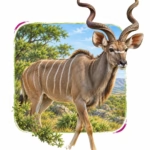
Common Eland Fact Highlight
From the full animal facts page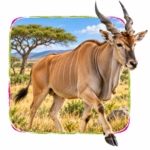
More Animal Comparisons
Pick another animal matchup and keep exploring. Compare appearances, habitats, diets, abilities, and surprising differences.

Make an Animal Story
Create an antelope story about a striped woodland jumper meeting the mighty heavyweight of the savanna!
Source notes: References used for this comparison. See more See less
Try Another Matchup
Explore this comparison →