
Common Green Lacewing vs Emperor Dragonfly: Winged Insect Comparison
Common Green Lacewings and Emperor Dragonflies both have four transparent wings and predatory young, but they fill different habitats and size classes. The pale green lacewing flutters around vegetation and lays eggs on silk stalks. Its alligator-like larva hunts aphids. The huge emperor begins as an aquatic ambush predator and becomes a fast aerial hunter over ponds.
About Common Green Lacewing
- Type Insect
- Diet Larva is carnivorous; adult mainly uses nectar, pollen, and honeydew
- Group Green lacewing family, Chrysopidae
- Known for Golden eyes, finely veined wings, stalked eggs, and aphid-eating larvae
- Special skill Places each egg on a silk stalk and produces a fierce aphid-hunting larva
About Emperor Dragonfly
- Type Insect
- Diet Carnivore
- Group Hawker dragonfly family, Aeshnidae
- Known for Large size, huge eyes, territorial patrols, and aerial hunting
- Special skill Controls four wings separately to hover, turn sharply, and catch prey in flight
Common Green Lacewing vs Emperor Dragonfly: Quick Answer
A Common Green Lacewing is a delicate 12 to 20 millimetre garden insect with long antennae, golden eyes, tent-like net-veined wings, stalked eggs, and aphid-hunting larvae. An Emperor Dragonfly is about 78 millimetres long, with enormous eyes, short antennae, outspread wings, an aquatic nymph, and powerful aerial flight.
Where Do They Fit?
Follow the branches to see how Common Green Lacewing and Emperor Dragonfly are classified and related.
Common Green Lacewing vs Emperor Dragonfly: Quick Comparison
| Feature | Common Green Lacewing | Emperor Dragonfly |
|---|---|---|
| Scientific name | Chrysoperla carnea | Anax imperator |
| Insect order | Neuroptera | Odonata |
| Adult length | About 12 to 20 mm | About 78 mm |
| Resting wings | Roof-like over the body | Open sideways |
| Antennae | Long and threadlike | Very short and bristle-like |
| Eyes | Bright metallic-gold compound eyes | Enormous blue-green compound eyes meeting broadly on the head |
| Young stage | Terrestrial alligator-like larva among plants | Aquatic predatory nymph in ponds and lakes |
| Main young-stage food | Aphids, thrips, mites, mealybugs, and other soft-bodied prey | Aquatic insects, small crustaceans, tadpoles, and other pond prey |
| Adult food | Mostly nectar, pollen, and honeydew in this species group | Flying insects caught in midair |
| Egg placement | Each pale egg stands on a long silk stalk | Eggs inserted into or placed with floating aquatic plants |
How Lacewings and Dragonflies Are Alike
- Both are insects with six legs, a head, thorax, abdomen, and two pairs of wings.
- Both have large compound eyes that detect movement.
- Both have predatory young that help control other small animals.
- Both adults can fly and use clear wings strengthened by many veins.
- Both help gardeners and ecosystems by eating other insects.
How Lacewings and Dragonflies Are Different
- An Emperor Dragonfly is roughly four to six times the body length of a Common Green Lacewing.
- A lacewing rests with wings like a roof, while a dragonfly holds its wings open sideways.
- Lacewings have long threadlike antennae, while dragonfly antennae are tiny.
- Lacewing larvae live among plants, while Emperor Dragonfly nymphs live underwater.
- A lacewing places eggs on silk stalks, while an emperor lays eggs with floating water plants.
Lacewing vs Dragonfly Adaptation Showdown
Adaptation showdown: Emperor Dragonfly wins size because its 78 mm body is roughly four to six times longer than a Common Green Lacewing. Emperor Dragonfly wins speed because its four powerful wings allow rapid pursuit, hovering, and sharp turns. Emperor Dragonfly wins strength because both its aquatic nymph and adult capture comparatively large animal prey. Common Green Lacewing wins stealth because its pale green body and clear wings blend among leaves, especially during evening activity. Social behavior is a Tie because both are mainly solitary. Emperor Dragonfly wins swimming because its young stage is an aquatic predator, while lacewing larvae live on plants. Common Green Lacewing wins weirdest for placing eggs on silk stalks and transforming from a delicate adult into an alligator-like aphid lion larva.
Fun Common Green Lacewing vs Emperor Dragonfly Facts
Eggs on Tiny Stalks
A female green lacewing lays pale oval eggs one at a time on the ends of thin silk stalks. The spacing can reduce danger from predators and newly hatched siblings.
The Aphid Lion
A lacewing larva looks a little like a miniature alligator and carries large curved mouthparts. It seizes aphids and other soft-bodied insects and draws out their fluids.
Four Wings, Separate Control
A dragonfly can adjust its four wings separately. That control allows an Emperor Dragonfly to hover, fly backward, turn sharply, and intercept prey in three-dimensional airspace.
Two Different Nurseries
Green lacewing larvae hatch onto leaves and stems near insect prey. Emperor Dragonfly nymphs hatch underwater and may live for years as pond ambush predators.
Golden Eyes and Giant Eyes
A Common Green Lacewing has bright metallic-gold eyes. An Emperor Dragonfly’s much larger compound eyes cover most of its head and provide an enormous view for aerial hunting.
Lacewing vs Dragonfly Quiz
- Which insect is much larger? Answer: The Emperor Dragonfly.
- Where does a green lacewing place each egg? Answer: On top of a thin silk stalk.
- What nickname is given to a lacewing larva? Answer: Aphid lion.
- Which insect has an aquatic nymph? Answer: The Emperor Dragonfly.
- How do their resting wings differ? Answer: Lacewing wings form a roof over the body, while dragonfly wings stay open sideways.
Common Green Lacewing vs Emperor Dragonfly FAQ
Is a lacewing a type of dragonfly?
No. Lacewings belong to Neuroptera, while dragonflies belong to Odonata.
Which insect is better for a garden?
Both can help. Lacewing larvae eat many plant pests, and dragonflies catch mosquitoes and other flying insects.
Can a lacewing swim?
No. Its larvae live on plants and other land surfaces, unlike an Emperor Dragonfly nymph living underwater.
Do lacewings bite people?
They are not dangerous. A larva may occasionally pinch skin if trapped, but it hunts tiny soft-bodied insects.
Why are lacewing wings called lacy?
A dense network of fine veins makes the transparent wings look like delicate lace.
Animal Words to Know
- Neuroptera: The insect order containing lacewings and their relatives.
- Odonata: The insect order containing dragonflies and damselflies.
- Biological control: Using a living predator, parasite, or disease to reduce a pest population.
- Honeydew: A sugary liquid produced by aphids and some other sap-feeding insects.
- Compound eye: An eye made from many visual units that provides a wide view and detects motion.
Build Two Wing and Nursery Models
Build Two Wing and Nursery Models
Draw exactly one adult Common Green Lacewing and exactly one adult Emperor Dragonfly at honest relative scale, making the emperor four to six times longer in body. Trace tent-like lacewing wings and outspread dragonfly wings on clear paper. Add a silk-stalk egg model above a paper leaf and an emperor nymph card below blue pond paper. Observe without people handling insects.
Meet Each Animal
Want the full fact file? Here are quick highlights from each animal’s own facts page.
Common Green Lacewing Fact Highlight
From the full animal facts page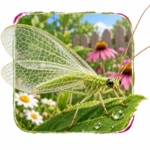
Emperor Dragonfly Fact Highlight
From the full animal facts page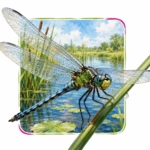
More Animal Comparisons
Pick another animal matchup and keep exploring. Compare appearances, habitats, diets, abilities, and surprising differences.






Make an Animal Story
Send a golden-eyed Lacewing and a sky-hunting Dragonfly through a garden-to-pond adventure with our free Animal Story Generator.
Source notes: References used for this comparison. See more See less
Try Another Matchup
Explore this comparison →