
Leopard Seal vs Weddell Seal: Antarctic Seal Species Comparison
Leopard and Weddell Seals are large Antarctic true seals, but their bodies tell two different ice stories. The Leopard Seal, Hydrurga leptonyx, is long and streamlined with an enormous head, long front flippers and teeth suited to both large prey and krill. The Weddell Seal, Leptonychotes weddellii, is usually heavier and rounder, with a small cat-like face. It lives close to stable fast ice, dives through breathing holes and uses its own teeth to stop those holes from freezing shut.
About Leopard Seal
- Type Living
- Diet Carnivore; eats krill, fish, squid, penguins and young seals, with different individuals specializing in different foods
- Group Large Antarctic earless seal in family Phocidae (Hydrurga leptonyx)
- Known for A long slender body, huge reptile-like head, wide jaws, powerful canine teeth, spotted coat and fast predatory swimming
- Special skill Combines long canine teeth for seizing large prey with interlocking back teeth that strain tiny krill from seawater
About Weddell Seal
- Type Living
- Diet Carnivore; eats mid-water and bottom fish, squid, octopus, krill, prawns and other marine animals
- Group Large Antarctic earless seal in family Phocidae (Leptonychotes weddellii)
- Known for A round cat-like face, thick mottled body, extreme deep dives, musical underwater calls and tooth-maintained breathing holes
- Special skill Navigates beneath solid sea ice, dives to about 720 m and rasps new ice from breathing holes with its front teeth
Leopard Seal vs Weddell Seal: Quick Answer
A male Leopard Seal averages about 2.8 m and 320 kg, while a female averages about 3 m and 370 kg; very large females exceed 3.5 m and 500 kg. It is a fast, mostly solitary predator of the pack ice. A Weddell Seal is about 3 m long and usually weighs 400–500 kg. It is a slower-looking but remarkable deep diver that lives around coastal fast ice and keeps breathing holes open with its teeth.
Leopard Seal vs Weddell Seal: Quick Comparison
| Feature | Leopard Seal | Weddell Seal |
|---|---|---|
| Scientific name | Hydrurga leptonyx | Leptonychotes weddellii |
| Usual adult size | Males average 2.8 m and 320 kg; females average 3 m and 370 kg | Both sexes about 3 m and commonly 400–500 kg |
| Body shape | Long, slender and streamlined with long front flippers | Thick, rounded and barrel-shaped with short front flippers |
| Head | Large reptile-like head, wide jaws and long canine teeth | Small round cat-like face with short snout and large dark eyes |
| Coat | Dark gray above, pale below, with many dark spots on throat and sides | Dappled gray and black above with a pale belly and variable silver patches |
| Ice home | Roams mainly through drifting Antarctic pack ice | Stays mainly around stable coastal fast ice and familiar access holes |
| Food | Krill, fish, squid, penguins and young seals | Fish, squid, octopus, krill, prawns and other marine prey |
| Special teeth | Canines seize prey; complex back teeth can strain krill | Incisors and canines rasp new ice from breathing holes |
| Diving style | Fast, agile hunter that often searches near pack ice and penguin colonies | Deep, long-duration diver; recorded to about 720 m and up to 45 minutes |
| Conservation | Least Concern, though Antarctic ecosystem change may affect food and ice | Least Concern, though climate change can alter fast-ice habitat and food webs |
How Are Leopard and Weddell Seals Alike?
- Both are large Antarctic earless seals with streamlined bodies, flippers and thick blubber.
- Both must surface to breathe and use sea ice for resting and raising a single pup.
- Both eat fish, squid and krill and hunt mainly underwater.
- Both use complex underwater calls during the breeding season.
- Both have a circumpolar range around Antarctica and are currently listed as Least Concern.
How Are Leopard and Weddell Seals Different?
- The Leopard Seal is long and narrow with a huge head; the Weddell Seal is thick-bodied with a small round face.
- Leopard Seals roam pack ice, while Weddell Seals stay closer to stable coastal fast ice.
- The Weddell Seal is usually heavier, although the longest large female Leopard Seals can exceed 3.5 m.
- Leopard Seals can hunt penguins and young seals; Weddell Seals mainly catch fish and squid beneath the ice.
- Weddell Seals rasp open breathing holes with their teeth, while Leopard Seals follow moving ice and open water.
Leopard vs Weddell Seal Showdown
- Size – Weddell Seal: Leopard Seals can be longer, but a typical Weddell’s 400–500 kg body is heavier than average Leopard Seal weights.
- Speed – Leopard Seal: Its slim body and long front flippers are built for rapid turns and chases in open water.
- Strength – Leopard Seal: Huge jaws, long canine teeth and experience seizing large prey give this predator the combat-power edge.
- Stealth – Leopard Seal: It can wait near ice edges and use a gray spotted body to approach prey through dark Antarctic water.
- Social – Weddell Seal: Mothers, pups and breeding adults gather around reliable fast-ice holes, while Leopard Seals are usually solitary.
- Swimming – Weddell Seal: Its navigation and oxygen stores support dives to about 720 m and as long as 45 minutes beneath solid ice.
- Weirdest – Weddell Seal: It sings beneath the ice, memorizes breathing-hole routes and files ice away with its own front teeth.
Fun Leopard Seal vs Weddell Seal Facts
Two Kinds of Hunting Teeth
A Leopard Seal has long canines for larger prey and special multi-pointed back teeth that lock together to filter krill.
Females Are the Giants
Female Leopard Seals are usually larger than males, and exceptional females can exceed 3.5 m and 500 kg.
An Ice-Hole Toothbrush
A Weddell Seal scrapes forming ice with its incisors and canines to keep a breathing entrance open.
Finding One Hole in the Dark
Weddell Seals navigate beneath winter ice and must return to a crack or breathing hole before their oxygen runs low.
Songs from Another World
Weddell and Leopard Seals produce trills, whistles and other calls underwater; Weddell calls can sound electronic to human ears.
Leopard vs Weddell Seal Quiz
Which seal has a long reptile-like head? A) Leopard Seal B) Weddell Seal C) Both Answer: A) Leopard Seal
Which seal is usually heavier? A) Leopard Seal B) Weddell Seal C) Neither Answer: B) Weddell Seal
Which seal keeps breathing holes open with its teeth? A) Leopard Seal B) Weddell Seal C) Neither Answer: B) Weddell Seal
Which seal may hunt penguins? A) Leopard Seal B) Weddell Seal C) Both never hunt Answer: A) Leopard Seal
What do both seals eat? A) Fish, squid and krill B) Grass only C) Tree bark only Answer: A) Fish, squid and krill
Leopard Seal vs Weddell Seal FAQ
Which Seal Is Bigger?
Weddell Seals are usually heavier at about 400–500 kg. Leopard Seals may be longer, and an exceptional female can also exceed 500 kg.
Would a Leopard Seal Eat a Weddell Seal?
Leopard Seals sometimes prey on young Weddell Seals, but adult Weddells are very large and are not a normal easy meal.
Why Does a Weddell Seal Chew Ice?
It must breathe air beneath fast ice, so it rasps new ice from cracks and holes to keep an opening available.
Can Leopard Seals Filter Krill?
Yes. Their complex back teeth fit together like a sieve, allowing water out while trapping small krill inside.
Are These Seals Dangerous to People?
They are powerful wild predators and should never be approached. Scientists and visitors follow strict distance rules, especially around Leopard Seals.
Animal Words to Know
- Blubber: A thick layer of fat beneath the skin that stores energy and reduces heat loss.
- Canine: A long pointed tooth used for gripping or tearing food.
- Fast ice: Sea ice attached to the coast or seabed rather than drifting freely.
- Pack ice: Broken pieces of sea ice that drift and press together on the ocean.
- Circumpolar: Found all the way around a polar region.
Build a Seal Shape and Dive Chart
Build a Seal Shape and Dive Chart
Draw one long, narrow Leopard Seal beside one thick, round Weddell Seal at the same 3 m scale. Add a water-depth ruler from 0 to 720 m. Mark the Weddell’s deepest reported dive, then sketch pack ice above the Leopard and stable fast ice with one breathing hole above the Weddell. Label head shape, body shape, teeth and ice type.
Meet Each Animal
Want the full fact file? Here are quick highlights from each animal’s own facts page.
Leopard Seal Fact Highlight
From the full animal facts page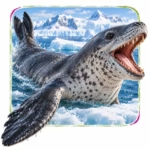
Weddell Seal Fact Highlight
From the full animal facts page
More Animal Comparisons
Pick another animal matchup and keep exploring. Compare appearances, habitats, diets, abilities, and surprising differences.



Make an Animal Story
Create an Antarctic mystery about a swift spotted hunter and a deep-diving ice-hole keeper!
Source notes: References used for this comparison. See more See less
Try Another Matchup
Explore this comparison →