
Leopard vs Dhole: Asian Predator Comparison
Leopards and Dholes overlap in parts of Asia, but one is a cat and the other is a wild canid. The Leopard is a muscular, solitary ambush hunter with rosette-shaped markings and superb climbing ability. The Dhole is a reddish pack hunter that communicates with whistles and shares many tasks. Both are adaptable predators, yet cooperation is central to the Dhole’s success while secrecy is central to the Leopard’s.
About Leopard
- Type Powerful spotted big cat
- Diet Carnivore
- Group Cat family, Felidae
- Known for Dark rosettes, stealth, enormous climbing skill, and carrying food into trees
- Special skill Climbs steep trunks with prey and often rests or stores food safely above the ground
About Dhole
- Type Social Asian wild canid
- Diet Carnivore
- Group Dog family, Canidae
- Known for Reddish fur, rounded ears, cooperative packs, and whistle-like calls
- Special skill Uses coordinated pursuit and a flexible pack to tackle prey much larger than one Dhole
Leopard vs Dhole: Quick Answer
A Leopard is usually larger and much heavier than one Dhole. It has retractable claws, spotted rosettes, a long balancing tail, and enough climbing power to haul prey into trees. A Dhole has dog-like feet, non-retractable claws, a reddish coat, rounded ears, and a social pack. Leopards stalk from cover and pounce at close range; Dholes cooperate during longer pursuits and communicate frequently with one another.
Where Do They Fit?
Follow the branches to see how Leopard and Dhole are classified and related.
Leopard vs Dhole: Quick Comparison
| Feature | Leopard | Dhole |
|---|---|---|
| Scientific name | Panthera pardus | Cuon alpinus |
| Animal family | Felidae, the cat family | Canidae, the dog family |
| Adult size | About 17 to 90 kg, depending on sex, region, and subspecies | Usually about 12 to 20 kg |
| Coat | Yellowish, golden, gray, or dark fur marked with spots and rosettes | Reddish to brown fur with a darker bushy tail and paler underside |
| Modern range | Many parts of sub-Saharan Africa plus scattered regions of Asia | Fragmented areas of South, Central, East, and Southeast Asia |
| Hunting style | Solitary stalk followed by a short rush or pounce | Cooperative pursuit in which pack members follow and surround prey |
| Climbing | Exceptional climber that often rests and caches food in trees | Capable on rough ground but mainly travels and hunts on the ground |
| Communication | Growls, roars, raspy calls, scent marks, scrapes, and visual signals | Whistles, squeaks, clucks, growls, scent marks, and pack signals |
| Claws | Sharp retractable claws suited to gripping prey and bark | Non-retractable claws suited to traction while running |
| Conservation | Vulnerable because of habitat loss, prey decline, persecution, and illegal trade | Endangered because of habitat loss, prey decline, persecution, and disease |
How Leopards and Dholes Are Alike
- Both are mammal predators that live in parts of Asia.
- Both may hunt deer, wild pigs, monkeys, and smaller animals where available.
- Both use scent, sounds, and body signals to communicate.
- Both care for dependent young in sheltered dens or hiding places.
- Both lose habitat and prey when forests are cleared, fragmented, or heavily hunted.
How Leopards and Dholes Are Different
- The Leopard is a spotted cat, while the Dhole is a reddish wild member of the dog family.
- A large Leopard can weigh several times as much as a Dhole.
- Leopards generally hunt alone, while Dholes travel and hunt in packs.
- A Leopard has retractable climbing claws, while a Dhole has non-retractable running claws.
- Leopards may carry food into trees, while Dholes feed and defend food together on the ground.
Leopard vs Dhole Adaptation Showdown
Adaptation showdown: Leopard wins size because large adults can outweigh a Dhole several times over. Leopard wins speed because its explosive cat sprint is faster over a short distance, while Dholes are built for coordinated pursuit. Leopard wins strength because its muscular shoulders, gripping claws, and jaws can lift heavy food into trees. Leopard wins stealth because rosettes, soft paws, and solitary stalking hide it in broken light. Dhole wins social behavior because the pack travels, hunts, rests, and helps raise pups together. Swimming is a Tie because both can cross water but neither is mainly aquatic. Dhole wins weirdest for its birdlike whistles and unusually cooperative wild-dog society.
Fun Leopard vs Dhole Facts
Rosettes Break Up the Body
A Leopard’s dark markings form spots and open rosettes. They interrupt the cat’s outline among leaves, branches, rock, and moving shade.
A Pantry in the Branches
A Leopard may drag a carcass into a tree, where it can feed with less interference from other predators and scavengers.
Whistles Through the Forest
Dholes use whistle-like calls to keep contact when vegetation blocks their view of other pack members.
Pups Eat Early
Adult Dholes cooperate around a den. Pack members can bring food back and allow pups to feed while the group guards the area.
Sharing the Same Landscape
Leopards and Dholes can live in the same Asian reserves, but they reduce risk by using cover, time, space, and prey in different ways.
Leopard vs Dhole Quiz
- Which animal has rosette-shaped coat markings? Answer: The Leopard.
- Which animal usually hunts in a pack? Answer: The Dhole.
- Why might a Leopard carry food into a tree? Answer: To feed with less interference from other animals.
- What special sound helps Dholes keep contact? Answer: A whistle-like call.
- Which animal has retractable claws? Answer: The Leopard.
Leopard vs Dhole FAQ
Is a Dhole a kind of domestic dog?
No. It is a wild Asian canid species with its own anatomy, behavior, and conservation needs.
Can Leopards and Dholes climb trees?
Leopards are expert tree climbers. Dholes may scramble over rough features, but their main movement and hunting happen on the ground.
Do Leopards and Dholes fight?
They can compete where they overlap, but predators usually avoid dangerous encounters. This comparison focuses on natural adaptations.
Are all Leopards yellow with black rosettes?
No. Coat color varies, and some Leopards are melanistic, appearing black while still carrying darker rosettes.
Why are Dholes Endangered?
Their habitat and prey have declined, people sometimes persecute them, and diseases can spread from domestic dogs.
Animal Words to Know
- Rosette: A ring or cluster of spots shaped a little like a flower.
- Cache: Food hidden or stored for later use.
- Melanistic: Having unusually large amounts of dark pigment in the skin or fur.
- Pack: A social group of canids that travels and performs many activities together.
- Habitat fragmentation: The breaking of a large habitat into smaller separated pieces.
Compare a Tree Climber and Pack Runner
Compare a Tree Climber and Pack Runner
Draw exactly one adult Leopard and exactly one adult Dhole at honest relative scale, making the Leopard clearly larger. Place the Leopard on a broad tree limb and the Dhole on a separate forest trail without a chase, prey animal, or confrontation. Label the Leopard’s rosettes, retractable claws, long tail, muscular shoulders, and soft paws. Label the Dhole’s reddish coat, rounded ears, bushy tail, running feet, and whistle symbols. Add habitat clues for Africa and Asia beside the Leopard and Asia beside the Dhole.
Meet Each Animal
Want the full fact file? Here are quick highlights from each animal’s own facts page.
Leopard Fact Highlight
From the full animal facts page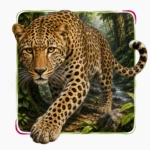
Dhole Fact Highlight
From the full animal facts page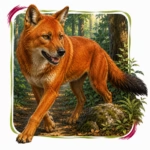
More Animal Comparisons
Pick another animal matchup and keep exploring. Compare appearances, habitats, diets, abilities, and surprising differences.


Make an Animal Story
Send a rosette-covered climber and a whistling forest runner on a mystery with our free Animal Story Generator.
Source notes: References used for this comparison. See more See less
Try Another Matchup
Explore this comparison →